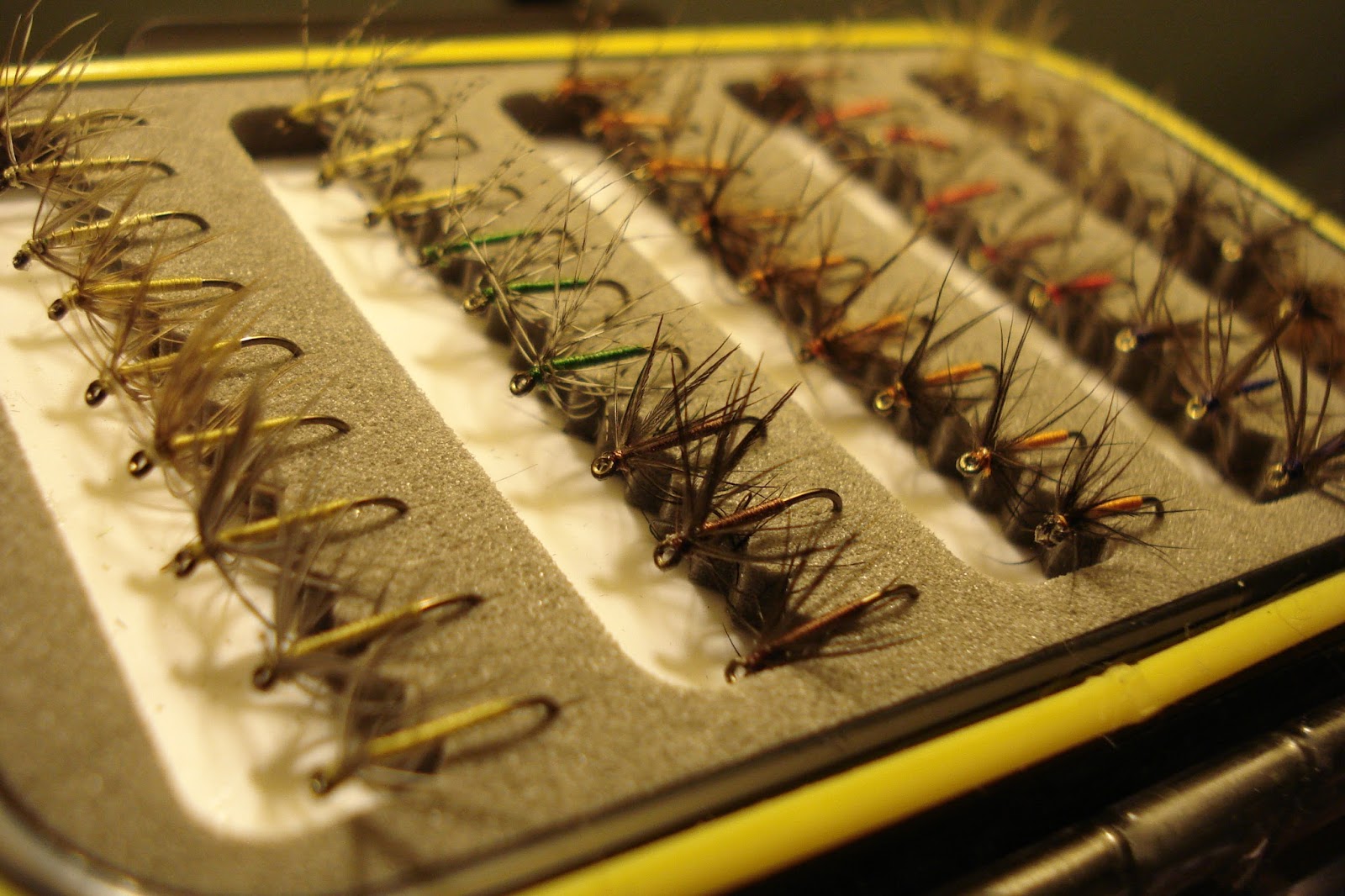
Showing posts with label Hidy. Show all posts

Wednesday, September 6, 2017

Breaking Off


It was a good run.

If I had had the wherewithal to continue posting through January 2018, Soft Hackles, Tight Lines would have been in operation for four-and-a-half years. My first posting was 3 June 2013. On the whole, the blog has included 110 posts with 106 devoted to a historical account of specific, related dressings, comprising almost 50,000 words and 166 photos of flies I have tied to represent those dressings and, quite often, their variations. While there are many more of flies that deserve to be researched, written up, and tied, the blog has come to occupy more time than I can devote to it now.

It has been a labor of love.

I very much appreciate the readers I have had throughout this project, from the outset to the eleventh hour. A few of my favorite posts are still available at the following links:

Black Spider                                                        Bracken Clock
Syl’s Nymph                                                        Hare’s Ear Flymph
Breadcrust                                                           Starling and Herl
Greenwell’s Glory Hackle                                 Black Louper
Pheasant Tail                                                      Exe Fly 
Small Ant                                                             Light Sedge
Orange Flie                                                          Carrot Fly
Yaller Hammer                                                   Red Fox Squirrel Nymph
            Gray Hackle Peacock                                         Dark Snipe and Green
            Blue Partridge                                                     Stone Fly 


I cannot resist listing some my favorite patterns for fishing on my homewaters in Western North Carolina and East Tennessee, in wide tailraces or the Great Smoky Mountains and the pasture streams of the New River Valley. I have not tried to name the originators of the pattern, only my sources. My additions or alternative materials are listed in parentheses.

A Baker's Dozen:


1. Dark Snipe and Purple - Lakeland, Brumfitt, Pritt
Hook:

16-18
Silk:

Purple silk
(Rib:

Extra small wine colored wire, optional)
Body:

Tying silk
Hackle:

Snipe covert (or smoky dun starling rump)


2. Waterhen Bloa - Pritt, Edmonds and Lee
Hook:

14-16
Silk:

Yellow silk
Body:

Muskrat or mole dubbed thinly on tying silk so that tying silk shows through distinctly
Hackle:

Waterhen undercovert (coot undercovert)


3. Iron Blue Dun - Hidy
Hook:

14-18
Silk:

Red silk
(Rib:

Extra small wine colored wire, optional)
Body:

Dark mole fur spun on red silk to form a taper toward the hackle, with two or three turns exposed at the tail
Hackle:

Starling (smoky dun starling rump or crow covert)


4. March Brown - Nemes
Hook:

10-14
Silk:

Orange silk (or yellow)
Tail:

Brown Partridge (optional)
Rib:

Extra small flat gold tinsel (or medium gold wire)
Body:

Hare’s mask mixed with hare’s ear (or brownish rabbit shoulder mixed with hare’s mask)
Hackle:

Brown partridge (two-and-half turns, so that slightly more hackle is situated on top of the hook shank, the vaguest suggestion of winging)


5. Pheasant Tail - Nemes
Hook:

16-22
Silk:

Dark brown thread (burnt orange,  olive dun, purple, etc. - matched to the thorax)
Tail:

Pheasant tail tips, optional
Rib:

Extra small copper wire (or gold, with olive thread)
Body:

Pheasant tail
(Thorax:

Sulfur, olive, purple, etc. superfine dubbing - matched to the thread)
Hackle:

Brown partridge


6. Light Snipe and Yellow - Leisenring
Hook:

14-16
Silk:

Primrose thread
Rib:

Small gold wire
Body:

Primrose silk buttonhole twist (Coats and Clark’s 72-A baby yellow, size D, for preference)
Hackle:

Snipe undercovert


7. Black Spider - Baillie, Stewart
Hook:

16-20
Thread:

Dark brown thread
Body/
Hackle:

Starling twisted on brown silk and palmered toward the eye of the hook (or waxed red or claret silk)


8. Grouse and Orange - Woolley, Nemes
Hook:

12-18
Silk:

Orange silk
Body:

Tying silk
Thorax:

Dark hare’s ear, optional (Nemes’ addition)
Hackle:

Speckled-brown red grouse covert
Tip:

Flat gold tinsel, optional (popular in earlier incarnations of the pattern)


9. Brown or Gray Hackle - Leisenring
Hook:

10-16
Silk:

Wine silk (or wine thread) or primrose silk (or primrose thread)
Rib:

Extra small flat gold tinsel, slightly tipping the herl body
Body:

Bronzy peacock herl
Hackle:

Red furnace or pale ginger furnace - matched to the corresponding silk/thread color


10. Orange Flie - Cotton
Hook:

14-18
Silk:

Orange silk (or gold)
Body:

Orange wool (burnt orange angora goat)
Hackle:

Black hackle (webby American crow neck or, for different parts of the season, starling back, nearer the rump)


11. Rough-Bodied Poult - Edmonds and Lee
Hook:

14-18
Silk:

Primrose silk
Body:

Buff opossum fur dubbed thinly on tying silk so that tying silk shows through distinctly
Hackle:

Young grouse undercovert (bobwhite quail undercovert or, for a lighter fly, mourning dove undercovert)


12. Red Fox Squirrel Nymph - Whitlock
Hook:

8-16
Silk:

Orange thread
Tail:

Red fox squirrel back fur, optional
Rib:

Gold twist (medium gold wire or small flat gold tinsel)
Abdomen:

Red fox squirrel belly fur
Thorax:

Red fox squirrel back fur
Hackle:

Brown speckled hen, mottled red grouse covert, or brown partridge back


13. Gray Hackle Red - Hughes
Hook:

10-16
Thread:

Black
Tip:

Small flat gold tinsel
Tail:

Bright, dyed-red hackle fibers
(Rib:

Extra small copper wire, reverse-ribbed)
Body:

Bronzy peacock herl
Hackle:

Stiffer, darker grizzly hen (two turns, no longer than the gold tip)


Wednesday, December 14, 2016

Blue Dun Hackle


Hook:

12-18
Thread:

Primrose
Rib:

Small gold tinsel
Body:

Mole fur with a little of the silk exposed at the tail
Hackle:

Gray hen hackle


While it might have been intended as a separate dressing for an olive mayfly like the Blue Dun, James Leisenring includes the Blue Dun Hackle separately from the Old Blue Dun in his Art of Tying the Wet Fly & Fishing the Flymph (1941). He dressed is with

“HOOK  12, 13, 14.
SILK  Primrose yellow.
HACKLE  Light-blue-dun hen hackle of good quality.
TAIL Two or three blue-dun fibers optional.
RIB  Very narrow flat gold tinsel.
BODY  Mole fur spun on primrose-yellow silk, a little of the silk exposed at the tail.”

Dave Hughes gives a dressing for similar fly, the Blue Dun Wingless, in his Wet Flies (1995 and 2015) and the updated second edition, which he configures like his Hare’s Ear Flymph, in the flymph style  he takes from Leisenring and James Hidy. He dresses the Blue Dun Wingless with:

“Hook: 1x fine or 2x stout, size 12-18.
Thread: Yellow Pearsall’s Gossamer silk or 6/0 or 8/0 nylon.
Hackle: Medium blue dun hen.
Tails: Medium blue dun hen hackle fibers.
Rib: Narrow Mylar tinsel, silver.
Body: Muskrat belly fur.”

This dressing used yellow thread and a found heron’s herl primary that the dressing prescribes as a body variation. It also leaves off the wings in favor of a hackled dressing comparable to Leisenring’s.


Leisenring’s dressing seems to be based on the Blue Dun that G. E. M. Skues includes in Minor Tactics of the Chalk Stream (1910). Skues’s Blue Dun is dressed with:

Wings: Snipe
Body: Water-rat on primrose or yellow tying silk. Vary body by dressing with undyed heron’s herl from the wing, and ribbing with find gold or medium silver wire.
Legs: Medium blue hen.”

Exclusive of the ever-popular peacock herl, herl-bodied dressings are rather rare in soft hackle literature, although they are common in Skues’ own nymphal dressings. Traditional soft hackles tend to opt for simple silk-bodied or dubbed fur dressings. Notable exceptions include Leisenring’s Black Gnat (dressed without the optional wings), the Old Master and Little Black that T. E. Pritt includes in North-Country Flies (1886), and especially Sylvester Nemes’ Pheasant Tail from his Soft-Hackled Fly (1975).

Wednesday, June 1, 2016

Blue Dun

This dressing substitutes pale yellow seal's fur for the pale "wool, mohair, or fine dyed pig's wool" that John Younger prescribes and uses starling undercovert.

Hook:

12-16
Thread:

Yellow
Body:

Blue rabbit underfur and pale yellow seal's fur
Hackle:

Starling undercovert


W. H. Lawrie’s Scottish Trout Flies (1966) reproduces lists of flies like John Younger’s list for fishing the Tweed. Of the six flies Younger dressed, the unnamed fly for April and May. His fly, undoubtedly a Blue Dun, is dressed with

“Wing: Transparent feather from the wing of the bunting or that of a full grown cock sparrow.
Body: Blue water-rat fur mixed with equal proportion pale yellow, inclining to white, wool, mohair or fine dyed pig’s wool.”

Younger includes one additional dressing for April and May with the same body, but hackled with a body feather from a grouse. G. E. M. Skues suggested that Younger’s dressing imitated a “small darkish Watery” that hatched from “May throughout the season,” No. VII on his list of flies for representing the Medium Olive. He adapted Younger’s pattern thus:

Hook.—No. 16 down-eyed Pennel sneck.
Tying Silk.—Bright yellow, waxed with clear colourless wax.
Hackle.—Dark-blue hen short—not more than two turns.
Whisks.—Two strands of darkish blue unspeckled feather from neck of cock guinea fowl- short.
Body.—Thinly laid dubbing of mole’s fur mixed with yellow seal’s fur.”


Skues also suggested that “the body may be varied by using English squirrel blue fur instead of mole.”

Roger Woolley notes in the last edition of his Modern Fly Dressing (1950) that the olive fly is the usually known as the Early Olive Dun. He introduces his dressings by noting that, “although entomologies tell us there is no such fly in nature as the Blue Dun, anglers always have had and will have their Blue Dun. It is an imitation of the large, early spring Olive Dun, a fly appearing in early spring, the first of the Ephemeridæ family to show on our streams.” A proliferation of olive dun colored bodies matched with dun hackles, however, makes pinpointing which are intended to match Woolley’s mythological Blue Dun a challenge. The Waterhen Blae, for instance, might equally serve the purpose. To limit the scope of these possibilities, soft hackled Blue Dun patterns here will to create an olive shade that the yellow silk underbody accents, either by mixing yellow and blue or by overwrapping the main body with a yellow or olive rib.

John Waller Hills traces the development of the Blue Dun in A History of Fly Fishing for Trout (1921) from Dame Juliana Berners and her A treatyse of fysshynge wyth an Angle (1496) to the twentieth century: “The progress of this fly is of extraordinary interest. It starts with a black wool body, dark mallard wings and possibly a jay's blue feather as hackle. This dressing is too dark altogether in body and wing. Cotton lightens both, and gives a fairly good fly, and Chetham a still better one. His Blue Dun has no hackle it is true, but its rough body of fox fur could easily be picked out, and except for this it is almost as it now exists. But there were one or two improvements, the snipe wing, which I think is better than the starling for the sunk fly, and mole's fur body. So we get the fly of to-day.” Hills suggests that flies like the Old Blue Dun are variations of the Blue Dun, utilizing a rib in place of blended blue and yellow body. The effect either way, he implies, simulates the olive hue that is characteristic of the Olive Dun. In their Art of Angling (1757, 1774), both Richard and Charles Bowlker include dressings for the Blue Dun that includes bodies “made of a blue fur of a fox, or the blue part of a squirrel’s furr, mixed with a little yellow mohair.”

Many dressings of the Blue Dun, like those of the Bowlkers, are winged. John Kirkbride includes, as he often does, dressings for winged flies and for hackles: “when dressed as a hackle-fly, a fine feather from the underside of the wing of the jack-snipe, or moor-pout, answers very well for the hackle.  The body must be the same as described above”—“from the light blue fur of the rabbit, or the grey squirrel, mixed with a very little yellow mohair.” The “moor-pout” is a Scottish term for a young grouse.


This dressing of Vernon S. Hidy’s Blue Dun uses primrose Pearsall’s gossamer silk for the tying silk and light olive Pearsall’s gossamer silk for the rib.


While many historical soft hackle patterns use a blue fur body mixed with yellow to create an olive effect, others are dubbed on dubbed on primrose or yellow thread and include a rib. James Leisenring’s angling companion, Vernon S. Hidy, included such a dressing for the Blue Dun in Chapter 10 “Soft-hackle Nymphs—the Flymphs” of The Master’s on the Nymph (1979): “Sizes 12, 14, 16; muskrat fur on primrose silk; olive-yellow thread ribbing; two turns of blue dun hen hackle.” The Old Blue Dun that Leisenring includes in The Art of Tying the Wet Fly & Dressing the Flymph (1941) seems dressed to achieve the same effect.