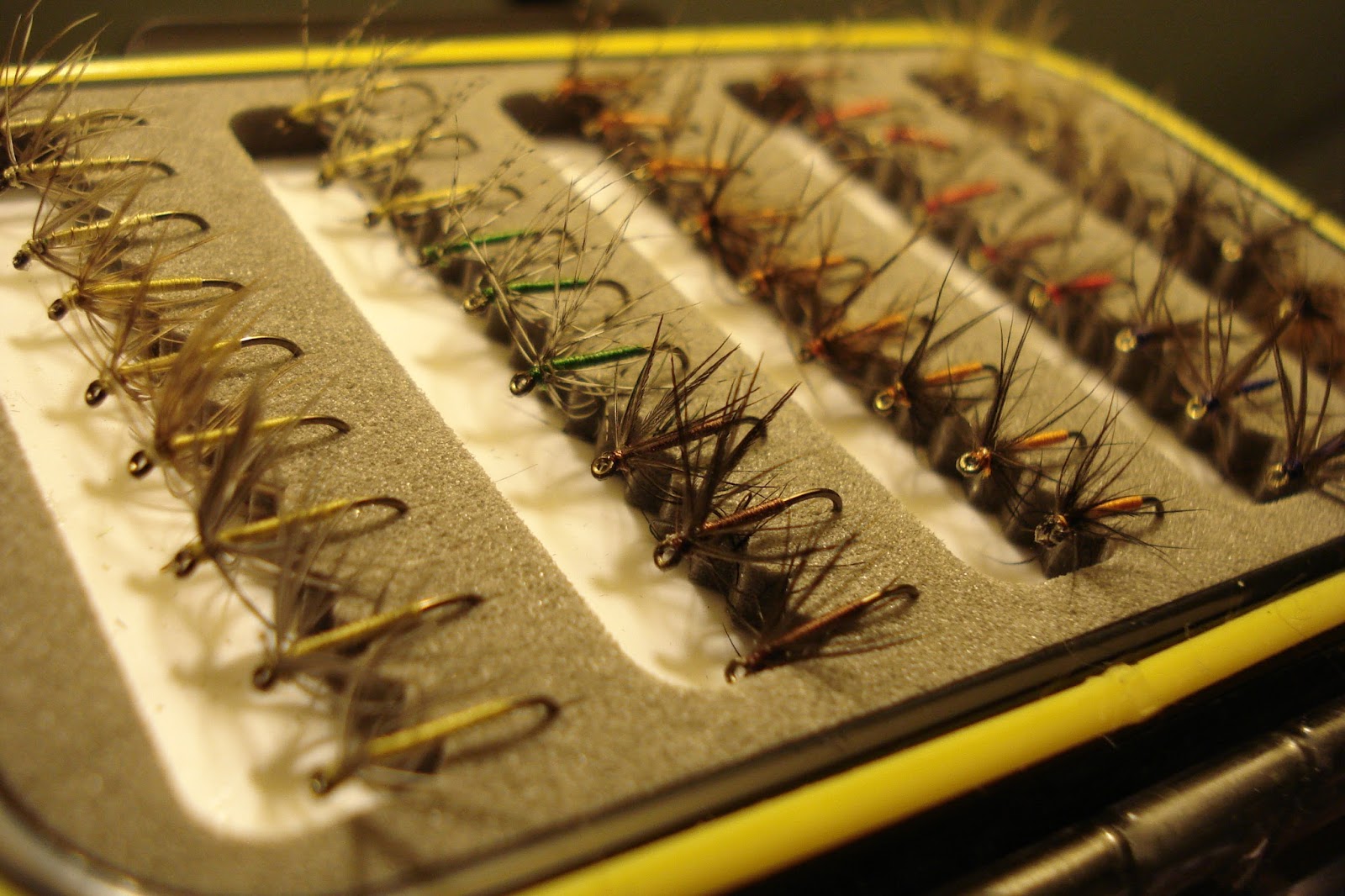
Showing posts with label Whitlock. Show all posts

Wednesday, September 6, 2017

Breaking Off


It was a good run.

If I had had the wherewithal to continue posting through January 2018, Soft Hackles, Tight Lines would have been in operation for four-and-a-half years. My first posting was 3 June 2013. On the whole, the blog has included 110 posts with 106 devoted to a historical account of specific, related dressings, comprising almost 50,000 words and 166 photos of flies I have tied to represent those dressings and, quite often, their variations. While there are many more of flies that deserve to be researched, written up, and tied, the blog has come to occupy more time than I can devote to it now.

It has been a labor of love.

I very much appreciate the readers I have had throughout this project, from the outset to the eleventh hour. A few of my favorite posts are still available at the following links:

Black Spider                                                        Bracken Clock
Syl’s Nymph                                                        Hare’s Ear Flymph
Breadcrust                                                           Starling and Herl
Greenwell’s Glory Hackle                                 Black Louper
Pheasant Tail                                                      Exe Fly 
Small Ant                                                             Light Sedge
Orange Flie                                                          Carrot Fly
Yaller Hammer                                                   Red Fox Squirrel Nymph
            Gray Hackle Peacock                                         Dark Snipe and Green
            Blue Partridge                                                     Stone Fly 


I cannot resist listing some my favorite patterns for fishing on my homewaters in Western North Carolina and East Tennessee, in wide tailraces or the Great Smoky Mountains and the pasture streams of the New River Valley. I have not tried to name the originators of the pattern, only my sources. My additions or alternative materials are listed in parentheses.

A Baker's Dozen:


1. Dark Snipe and Purple - Lakeland, Brumfitt, Pritt
Hook:

16-18
Silk:

Purple silk
(Rib:

Extra small wine colored wire, optional)
Body:

Tying silk
Hackle:

Snipe covert (or smoky dun starling rump)


2. Waterhen Bloa - Pritt, Edmonds and Lee
Hook:

14-16
Silk:

Yellow silk
Body:

Muskrat or mole dubbed thinly on tying silk so that tying silk shows through distinctly
Hackle:

Waterhen undercovert (coot undercovert)


3. Iron Blue Dun - Hidy
Hook:

14-18
Silk:

Red silk
(Rib:

Extra small wine colored wire, optional)
Body:

Dark mole fur spun on red silk to form a taper toward the hackle, with two or three turns exposed at the tail
Hackle:

Starling (smoky dun starling rump or crow covert)


4. March Brown - Nemes
Hook:

10-14
Silk:

Orange silk (or yellow)
Tail:

Brown Partridge (optional)
Rib:

Extra small flat gold tinsel (or medium gold wire)
Body:

Hare’s mask mixed with hare’s ear (or brownish rabbit shoulder mixed with hare’s mask)
Hackle:

Brown partridge (two-and-half turns, so that slightly more hackle is situated on top of the hook shank, the vaguest suggestion of winging)


5. Pheasant Tail - Nemes
Hook:

16-22
Silk:

Dark brown thread (burnt orange,  olive dun, purple, etc. - matched to the thorax)
Tail:

Pheasant tail tips, optional
Rib:

Extra small copper wire (or gold, with olive thread)
Body:

Pheasant tail
(Thorax:

Sulfur, olive, purple, etc. superfine dubbing - matched to the thread)
Hackle:

Brown partridge


6. Light Snipe and Yellow - Leisenring
Hook:

14-16
Silk:

Primrose thread
Rib:

Small gold wire
Body:

Primrose silk buttonhole twist (Coats and Clark’s 72-A baby yellow, size D, for preference)
Hackle:

Snipe undercovert


7. Black Spider - Baillie, Stewart
Hook:

16-20
Thread:

Dark brown thread
Body/
Hackle:

Starling twisted on brown silk and palmered toward the eye of the hook (or waxed red or claret silk)


8. Grouse and Orange - Woolley, Nemes
Hook:

12-18
Silk:

Orange silk
Body:

Tying silk
Thorax:

Dark hare’s ear, optional (Nemes’ addition)
Hackle:

Speckled-brown red grouse covert
Tip:

Flat gold tinsel, optional (popular in earlier incarnations of the pattern)


9. Brown or Gray Hackle - Leisenring
Hook:

10-16
Silk:

Wine silk (or wine thread) or primrose silk (or primrose thread)
Rib:

Extra small flat gold tinsel, slightly tipping the herl body
Body:

Bronzy peacock herl
Hackle:

Red furnace or pale ginger furnace - matched to the corresponding silk/thread color


10. Orange Flie - Cotton
Hook:

14-18
Silk:

Orange silk (or gold)
Body:

Orange wool (burnt orange angora goat)
Hackle:

Black hackle (webby American crow neck or, for different parts of the season, starling back, nearer the rump)


11. Rough-Bodied Poult - Edmonds and Lee
Hook:

14-18
Silk:

Primrose silk
Body:

Buff opossum fur dubbed thinly on tying silk so that tying silk shows through distinctly
Hackle:

Young grouse undercovert (bobwhite quail undercovert or, for a lighter fly, mourning dove undercovert)


12. Red Fox Squirrel Nymph - Whitlock
Hook:

8-16
Silk:

Orange thread
Tail:

Red fox squirrel back fur, optional
Rib:

Gold twist (medium gold wire or small flat gold tinsel)
Abdomen:

Red fox squirrel belly fur
Thorax:

Red fox squirrel back fur
Hackle:

Brown speckled hen, mottled red grouse covert, or brown partridge back


13. Gray Hackle Red - Hughes
Hook:

10-16
Thread:

Black
Tip:

Small flat gold tinsel
Tail:

Bright, dyed-red hackle fibers
(Rib:

Extra small copper wire, reverse-ribbed)
Body:

Bronzy peacock herl
Hackle:

Stiffer, darker grizzly hen (two turns, no longer than the gold tip)


Wednesday, December 28, 2016

Red Fox Squirrel Nymph

This dressing is an unweighted composite of primarily early directions for dressing the fly with a few of the later modifications, and in keeping with the standard for hook size and representation on the blog, it uses a size 14 dry fly hook rather than the nymph hook Whitlock prescribes. It largely follows Dave Whitlock’s “Standard Red Fox Squirrel-Hair Nymph” recipe from the June 1984 issue of Fly Fisherman magazine, using natural, prepackaged belly fibers for the abdomen and unblended back fur taken from a road-kill fox squirrel as the thorax. It adds the hackling and tailing that Whitlock suggests in the book chapter on nymphing. 

Hook:

6-16
Thread:

Burnt orange
Tail:

Red fox squirrel back fur (optional)
Rib:

Gold twist
Abdomen:

Red fox squirrel underbelly fur
Thorax:

Red fox squirrel back fur (dubbed slender)
Hackle:

Dark speckled brown hen hackle


Including the Red Fox Squirrel Nymph as soft hackle might be criticized as taking too much liberty with the blog definition of the style, as in the case of the northeastern Breadcrust, the ubiquitous Greenwell’s Glory, or the Tup’s Nymph (or most other patterns dressed by G. E. M. Skues). Nevertheless, it an impressionistic pattern and lends itself to dressing in many familiar styles. Pinpointing the inception of one of Dave Whitlock’s most iconic flies is a task likely best left to Whitlock himself. Since tracking down every reference to the fly would be even harder, a sample of Whitlock’s own words on the pattern must suffice.

An early publication that includes the Red Fox Squirrel Nymph was The Masters on the Nymph (1979), to which Whitlock contributed a chapter 7, “Nymphing Tackle.” The first of the four “favorite nymph patterns” he includes is the Red Fox Squirrel Nymph,” which he describes as his “favorite all-purpose nymph, as versatile and effective for a nymph as the Adams is for a dry fly. It works as well where mayflies, stone flies, caddis pupae, and scuds of similar colors exist, and where there are no nymphs.

Hook:   Mustad 9671, sizes 4-18
Body weight:   6 to 10 wraps of lead wire at thorax
Thread:   Black
Tail:   Sparse tuft of red-fox squirrel back hair, including both guard and underfur ½ length of hook shank
Rib:   Small oval tinsel
Abdomen: Red-fox squirrel belly fur
Thorax:  Red-fox squirrel back fur (with guard and underfur included)
Wing case:   Dark-brown swiss straw or turkey tail
Legs:   Either guard hairs of red-fox squirrel back or one turn of dark partridge hackle”

He also cited it as the nymph he used in his nymphing system in a pair of articles in Fly Fisherman magazine from 1983, but did not give it an explicit treatment of the fly itself until a June 1984 article entitled “Red Fox-Squirrel-Hair Nymph.”  In this article, he describes how to trim a red squirrel hide to preserve the scarce belly fur—split the skin down the back when dressing the body—and how to sort the fur into like colors. (He also notes that a shaved, tanned red fox squirrel skin can repurposed into buckskin nymphs. Very little of the animal goes to waste for the savvy, creative fly tier.)  More importantly, he discusses the reasons for the fly’s success. Rather than clinging to a narrow representational niche, the Red Fox Squirrel Nymph aims for impressionistic representation and is, as a result, characteristically versatile. By adjusting the length and thickness of the abdomen, and thorax, as well as the sparseness and length of the hackle, the Red Fox Squirrel Nymph could give the impression of a broad array of insects. In this article, he gives a dressing for “Dave Whitlock’s Standard Red Fox Squirrel-Hair Nymph” that looks much more like a soft hackle:

“HOOK:  Mustad 9671 or Tiemco Nymph Hook, #2 to #18.
THREAD: Black or dark brown nylon.
CEMENT: Dave’s Flexament.
WEIGHT: Lead or copper wire.
ABDOMEN: Belly fur from red fox squirrel skin, may be blended with synthetic sparkle dubbing. Abdomen should be ½ to 2/3 of the overall body length.
THORAX: Back fur from red fox squirrel skin, may be blended with synthetic sparkle dubbing. Thorax should be ½ to 1/3 of the overall body length.
RIB Gold wire or oval tinsel.”

In his Guide to Aquatic Trout Foods (1982), Whitlock’s fly boxes illustrate this versatility: it shows up, for instance, in his “Box No. 1: General Utility Box” at the head of the list in sizes 6-16, as well as “Box No. 4: Terrestrials and Summer Midges” in sizes 16 and 18.

Whitlock’s prolific writing has continued to describe the efficacy of the Red Fox Squirrel Nymph. He contributed a short article on the pattern in the September/October 2010 issue of Eastern Fly Fishing that reflects many of the modern, commercial interventions in fly dressing that have risen alongside media popularization of the sport, especially in print but also in film. This version updates the materials that Whitlock originally posted for the do-it-yourself fly tier of the late seventies and early eighties. In their blend of synthetic and natural fibers, these newer, branded materials regularize the color and consistency of the abdomen, thorax, and hackling, and they incorporate colors and sparkle that are more likely to attract a trout’s attention, particularly in off-color water. Both the original and contemporary versions have a place in the angler’s fly box. This Red Fox Squirrel Nymph uses:

Hook: TMC 5262, size 2-20
Thread: Orange Wapsi Ultra Thread 70
Weight: Lead Wire the diameter of the hook wire
Cements: Zap-a-Gap and Dave’s Flexament
Tail: Back hair of red fox squirrel
Rib: Small or medium gold oval tinsel
Abdomen: 50-50 blend of red fox squirrel belly hair and similar colors of Antron and SLF or No. 2 (red fox squirrel abdomen) Wapsi Dave Whitlock Plus SLF dubbing blend
Thorax: 50-50 blend of red fox squirrel back hair blended and hare’s ear Antron and SLF or No. 1 (red fox squirrel thorax) Wapsi Dave Whitlock Plus SLF dubbing blend
Legs: Dark ginger Metz hen back feather for hook sizes 2-12; for smaller hooks, pick out the dubbing guard hairs for legs
Head: Orange thread or gold bead.”