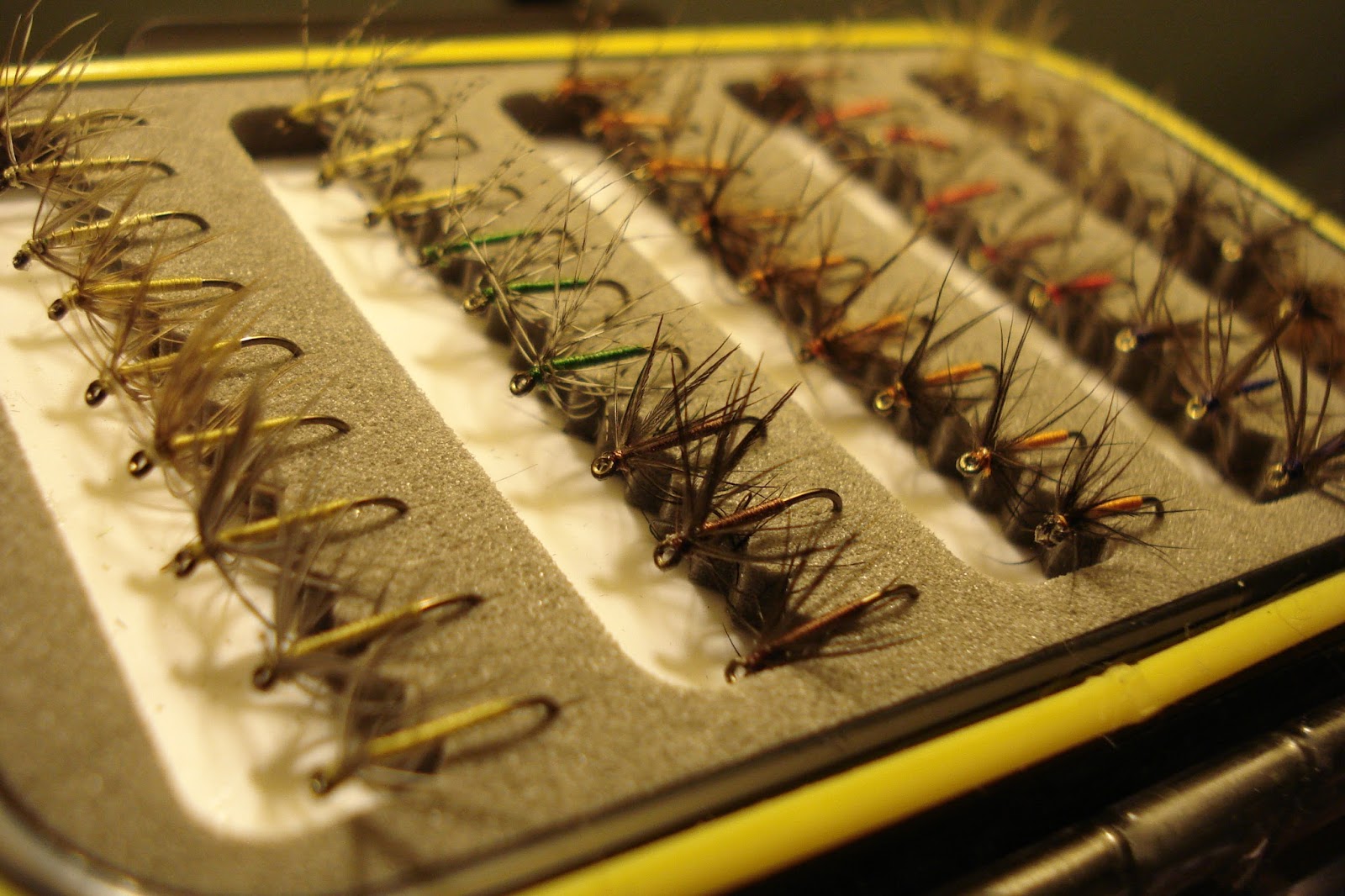
Showing posts with label Woolley. Show all posts

Wednesday, September 6, 2017

Breaking Off


It was a good run.

If I had had the wherewithal to continue posting through January 2018, Soft Hackles, Tight Lines would have been in operation for four-and-a-half years. My first posting was 3 June 2013. On the whole, the blog has included 110 posts with 106 devoted to a historical account of specific, related dressings, comprising almost 50,000 words and 166 photos of flies I have tied to represent those dressings and, quite often, their variations. While there are many more of flies that deserve to be researched, written up, and tied, the blog has come to occupy more time than I can devote to it now.

It has been a labor of love.

I very much appreciate the readers I have had throughout this project, from the outset to the eleventh hour. A few of my favorite posts are still available at the following links:

Black Spider                                                        Bracken Clock
Syl’s Nymph                                                        Hare’s Ear Flymph
Breadcrust                                                           Starling and Herl
Greenwell’s Glory Hackle                                 Black Louper
Pheasant Tail                                                      Exe Fly 
Small Ant                                                             Light Sedge
Orange Flie                                                          Carrot Fly
Yaller Hammer                                                   Red Fox Squirrel Nymph
            Gray Hackle Peacock                                         Dark Snipe and Green
            Blue Partridge                                                     Stone Fly 


I cannot resist listing some my favorite patterns for fishing on my homewaters in Western North Carolina and East Tennessee, in wide tailraces or the Great Smoky Mountains and the pasture streams of the New River Valley. I have not tried to name the originators of the pattern, only my sources. My additions or alternative materials are listed in parentheses.

A Baker's Dozen:


1. Dark Snipe and Purple - Lakeland, Brumfitt, Pritt
Hook:

16-18
Silk:

Purple silk
(Rib:

Extra small wine colored wire, optional)
Body:

Tying silk
Hackle:

Snipe covert (or smoky dun starling rump)


2. Waterhen Bloa - Pritt, Edmonds and Lee
Hook:

14-16
Silk:

Yellow silk
Body:

Muskrat or mole dubbed thinly on tying silk so that tying silk shows through distinctly
Hackle:

Waterhen undercovert (coot undercovert)


3. Iron Blue Dun - Hidy
Hook:

14-18
Silk:

Red silk
(Rib:

Extra small wine colored wire, optional)
Body:

Dark mole fur spun on red silk to form a taper toward the hackle, with two or three turns exposed at the tail
Hackle:

Starling (smoky dun starling rump or crow covert)


4. March Brown - Nemes
Hook:

10-14
Silk:

Orange silk (or yellow)
Tail:

Brown Partridge (optional)
Rib:

Extra small flat gold tinsel (or medium gold wire)
Body:

Hare’s mask mixed with hare’s ear (or brownish rabbit shoulder mixed with hare’s mask)
Hackle:

Brown partridge (two-and-half turns, so that slightly more hackle is situated on top of the hook shank, the vaguest suggestion of winging)


5. Pheasant Tail - Nemes
Hook:

16-22
Silk:

Dark brown thread (burnt orange,  olive dun, purple, etc. - matched to the thorax)
Tail:

Pheasant tail tips, optional
Rib:

Extra small copper wire (or gold, with olive thread)
Body:

Pheasant tail
(Thorax:

Sulfur, olive, purple, etc. superfine dubbing - matched to the thread)
Hackle:

Brown partridge


6. Light Snipe and Yellow - Leisenring
Hook:

14-16
Silk:

Primrose thread
Rib:

Small gold wire
Body:

Primrose silk buttonhole twist (Coats and Clark’s 72-A baby yellow, size D, for preference)
Hackle:

Snipe undercovert


7. Black Spider - Baillie, Stewart
Hook:

16-20
Thread:

Dark brown thread
Body/
Hackle:

Starling twisted on brown silk and palmered toward the eye of the hook (or waxed red or claret silk)


8. Grouse and Orange - Woolley, Nemes
Hook:

12-18
Silk:

Orange silk
Body:

Tying silk
Thorax:

Dark hare’s ear, optional (Nemes’ addition)
Hackle:

Speckled-brown red grouse covert
Tip:

Flat gold tinsel, optional (popular in earlier incarnations of the pattern)


9. Brown or Gray Hackle - Leisenring
Hook:

10-16
Silk:

Wine silk (or wine thread) or primrose silk (or primrose thread)
Rib:

Extra small flat gold tinsel, slightly tipping the herl body
Body:

Bronzy peacock herl
Hackle:

Red furnace or pale ginger furnace - matched to the corresponding silk/thread color


10. Orange Flie - Cotton
Hook:

14-18
Silk:

Orange silk (or gold)
Body:

Orange wool (burnt orange angora goat)
Hackle:

Black hackle (webby American crow neck or, for different parts of the season, starling back, nearer the rump)


11. Rough-Bodied Poult - Edmonds and Lee
Hook:

14-18
Silk:

Primrose silk
Body:

Buff opossum fur dubbed thinly on tying silk so that tying silk shows through distinctly
Hackle:

Young grouse undercovert (bobwhite quail undercovert or, for a lighter fly, mourning dove undercovert)


12. Red Fox Squirrel Nymph - Whitlock
Hook:

8-16
Silk:

Orange thread
Tail:

Red fox squirrel back fur, optional
Rib:

Gold twist (medium gold wire or small flat gold tinsel)
Abdomen:

Red fox squirrel belly fur
Thorax:

Red fox squirrel back fur
Hackle:

Brown speckled hen, mottled red grouse covert, or brown partridge back


13. Gray Hackle Red - Hughes
Hook:

10-16
Thread:

Black
Tip:

Small flat gold tinsel
Tail:

Bright, dyed-red hackle fibers
(Rib:

Extra small copper wire, reverse-ribbed)
Body:

Bronzy peacock herl
Hackle:

Stiffer, darker grizzly hen (two turns, no longer than the gold tip)


Wednesday, February 8, 2017

Smoky Mountain Blackbird; Crow Fly; or, Black Palmer

This dressing of the Smoky Mountain Blackbird is unweighted and uses the 2x dry fly hook in size 14 that other flies in this blog use. Also, following an almost identical dressing by Roger Lowe, the Crow Fly, it uses a starling primary for the palmer.

Hook:

4-10
Thread:

Black
Tail:

Starling primary barbules, tied the length of the hook shank
Body:

Peacock herl
Hackle:

Split starling primary


L. J. DeCuir includes the Smoky Mountain Blackbird in his Southeastern Flies (2001), noting the similarities between it and the better known Yallerhammer—it uses a peacock herl body and “utilizes the split wing feather of a bird.” DeCuir gives this dressing for the fly:

Hook: Mustad 9672, TMC 5263 or 3x or 4x Streamer Hook #4-10
Thread: Black
Weight: ‘Lead’ wire [or lead substitute]
Tail: Barbules from the wing feather of a blackbird
Palmered Rib: Split wing feather of a blackbird
Body: Peacock herl”

While the Smoky Mountain Blackbird most resembles DeCuir’s tailless dressing of the Yallerhammer, “it can also be fished like a Woolly Bugger,” even though, as DeCuir notes, it is “usually fished in the mountains of the Southeast like most heavily weighted nymphs.”

The “blackbird” of DeCuir’s Smoky Mountain Blackbird does not specify a species like the distinctive Yallerhammer, despite their similarities, and there are nearly thirty species of blackbird in the Americas. Roger Lowe gives an almost identical dressing in his Fly Pattern Guide to the Great Smoky Mountains (2001), which he calls Crow Fly. He notes that it is “tied similar to the Yellow Hammer but with a Crow feather; imitates the molting stonefly.”

“Hook: 9671 Mustad
Thread: Black
Body: Black yarn or peacock herl
Hackle: Biot quill from Crow or Starling”


Similar tailless dressings exist, most often listed as a Black Palmer. John Turton’s includes a Black Palmer Fly in his Angler’s Manual (1836) for fishing in the latter part of the season, from “July to September.” He dresses it “with dark orange silk; wing, black hen’s hackle feather; body, copper-coloured peacock’s feather; after rains, ribbed with silver twist.”

Roger Woolley includes a Black Palmer in a later edition of Modern Trout Flies (1950) that does not list a thread color, as is usually the case with the flies on Woolley’s list, but includes the materials for dressing Turton’s “after rains” Black Palmer Fly, with a rib of silver wire rather than silver twist. It could easily be dressed with the dark orange thread Turton gives.

The name Black Palmer covers a variety of dressings, the black referring either to the hackle, as in Turton’s dressing, or the body, like the Black Palmers of Alfred Ronalds’ and Charles Bowlker’s. Both Ronald’s and Bowlker’s dressings, in The Fly-Fisher’s Entomology (1836) and The Art of Angling (1774) respectively, utilize a black ostrich body, silver twist, and either a black or red cock’s hackle palmer.

John Jackson’s Practical Fly Fisher (1853) includes a dressing for the black palmer that is much more variable (and includes a variation that is very similar to the Yallerhammer):

Body.—Dark Peacock’s, or Ostrich’s herl, ribbed with gold tinsel and green silk.
Black, brown, or dark red Cock’s hackle over all.”

Wednesday, January 25, 2017

Dun Spider

This spider is dressed essentially as a thread-bodied, soft hackle palmer, a method that results in a fundamentally more vulnerable fly than the ones W. C. Stewart preferred to fish. It uses the starling substitute that Stewart suggests. It would best be dressed on a shorter shank that the dry fly hook used to regularize the blog's dressing. suggests..It would be best tied on a shorter shanked hook than the blog standard.

Hook:

14-18
Thread:

Blue Dun
Hackle:

Starling undercovert


W. C. Stewart Practical Angler (1857) made famous the spider style of dressing soft hackles with three specific dressings, the Black Spider, the Red Spider, and the Dun Spider. He states that “killing spiders may be made of all the feathers we have mentioned [“starling, landrail, dotterel, mavis, grey plover, golden plover, partridge, and grouse”], since “their superiority consists in their much greater resemblance to the legs of an insect, and their extreme softness. So soft are they, that when a spider is made of one of them and placed in the water, the least motion will agitate and impart a singularly life-like appearance to it.”

The Dun Spider “should be made of the small soft dun or ash-coloured feather, taken from the outside of the wing of the dotterel. This bird is unfortunately very scarce ; but a small feather may be taken from the inside of the wing of the starling, which will make an excellent substitute.”

Stewart notes that the “only objection to spiders is, that the feathers are so soft that the trout's teeth break them off, and after catching a dozen or two of trout, little is left of them but the bare dressing, rendering it necessary for the angler to change them; and if the trout are taking readily, this has to be repeated two or three times a day.” The life-like effect and overall effectiveness of the dressings, however, outweighs this objection. His method of dressing the fly strengthens the hackle stem and binds the hackle fibers in buggy positions. 

In his Wet Flies (1995), Dave Hughes suggests dressing Stewart’s spiders by winding tying thread from the eye of the hook halfway down the shank, tying the base of the hackle in from the middle of the shank to the eye, and then winding the tying thread back to the halfway point on the shank. To dress the fly, Hughes directs the fly tier to “take three to five evenly spaced turns of the hackle back to the midpoint of the hook. Catch the hackle tip with three turns of thread,” and he recommends breaking the tip off rather than clipping it with scissors. To finish the fly, Hughes gives another step: “Work your thread forward through the hackle to the hook eye. Wobble the thread back and forth as you go forward, to avoid matting down any hackle. This step is critical; without it, the fragile hackle stem will break and unwind on the first fish you catch.” The fly is finished at the eye of the hook. 

This dressing follows Roger Woolley’s suggestion that Stewart’s spiders might be dressed as hackle palmers: “just a soft hackle taken half-way down the hook, palmerwise, no body as in the usual type of fly, half the hook left bare," but uses the end of the tying thread as a rib, somewhat in the manner of Hughes.

Wednesday, October 19, 2016

Light Dun Hackle


Hook:

14-16
Thread:

Yellow
Rib:

Narrow flat gold tinsel
Body:

Yellow thread
Hackle:

Starling flank


Slyvester Nemes included the the Light Dun Hackle as an example of Roger Woolley’s dressings in Two Centuries of Soft-Hackled Flies (2003). Woolley included it under the heading of “Yorkshire and North Country Wet Flies” in the third edition (1950) of his Modern Trout Fly Dressing (1932). He dressed it with:

Body.—Waxed yellow tying silk, ribbed fine flat gold.
Hackle.—Small pale dun feather from under starling wing.”