Showing posts with label Stewart. Show all posts

Wednesday, September 6, 2017

Breaking Off


It was a good run.

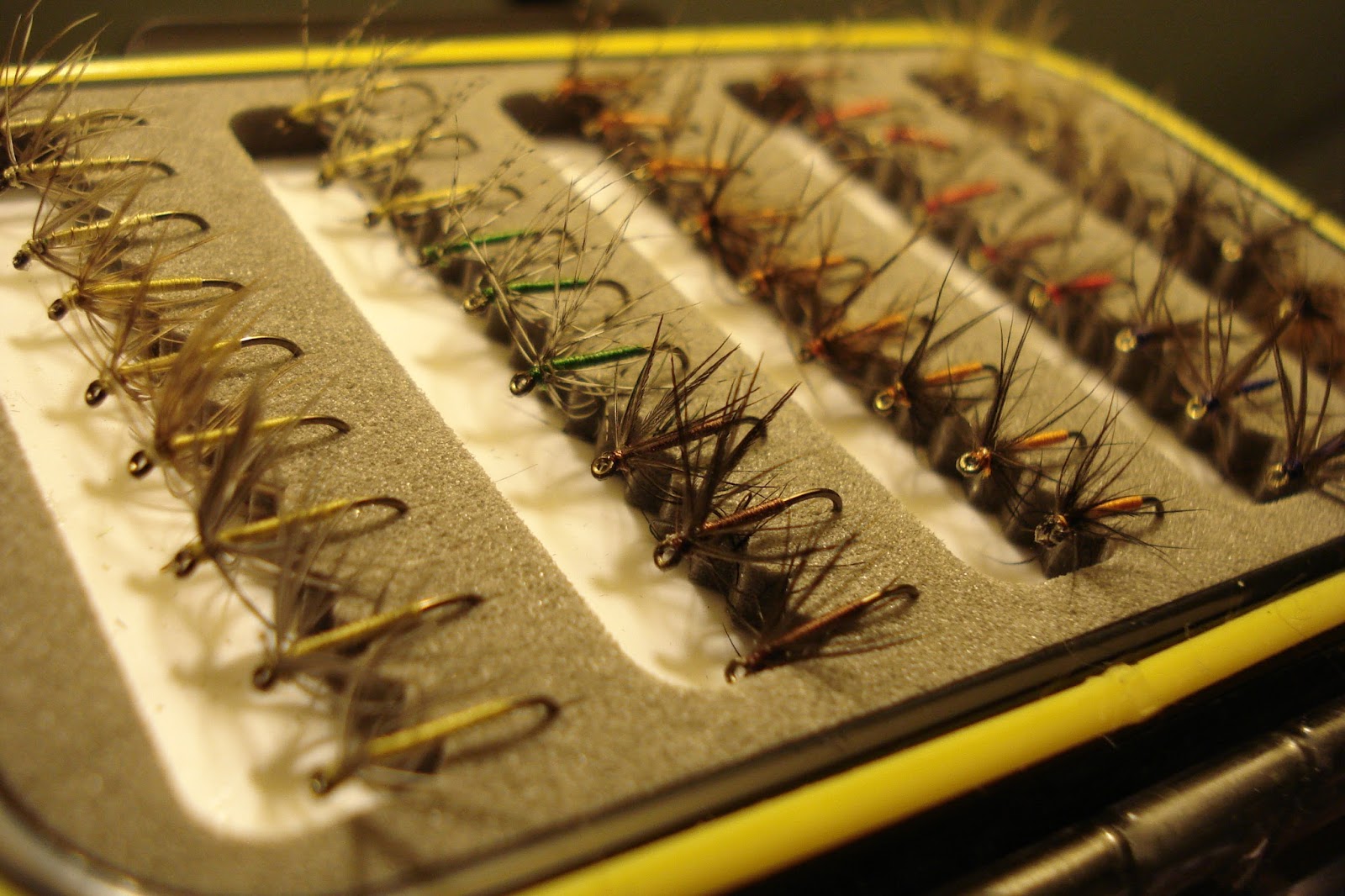
If I had had the wherewithal to continue posting through January 2018, Soft Hackles, Tight Lines would have been in operation for four-and-a-half years. My first posting was 3 June 2013. On the whole, the blog has included 110 posts with 106 devoted to a historical account of specific, related dressings, comprising almost 50,000 words and 166 photos of flies I have tied to represent those dressings and, quite often, their variations. While there are many more of flies that deserve to be researched, written up, and tied, the blog has come to occupy more time than I can devote to it now.

It has been a labor of love.

I very much appreciate the readers I have had throughout this project, from the outset to the eleventh hour. A few of my favorite posts are still available at the following links:

Black Spider                                                        Bracken Clock
Syl’s Nymph                                                        Hare’s Ear Flymph
Breadcrust                                                           Starling and Herl
Greenwell’s Glory Hackle                                 Black Louper
Pheasant Tail                                                      Exe Fly 
Small Ant                                                             Light Sedge
Orange Flie                                                          Carrot Fly
Yaller Hammer                                                   Red Fox Squirrel Nymph
            Gray Hackle Peacock                                         Dark Snipe and Green
            Blue Partridge                                                     Stone Fly 


I cannot resist listing some my favorite patterns for fishing on my homewaters in Western North Carolina and East Tennessee, in wide tailraces or the Great Smoky Mountains and the pasture streams of the New River Valley. I have not tried to name the originators of the pattern, only my sources. My additions or alternative materials are listed in parentheses.

A Baker's Dozen:


1. Dark Snipe and Purple - Lakeland, Brumfitt, Pritt
Hook:

16-18
Silk:

Purple silk
(Rib:

Extra small wine colored wire, optional)
Body:

Tying silk
Hackle:

Snipe covert (or smoky dun starling rump)


2. Waterhen Bloa - Pritt, Edmonds and Lee
Hook:

14-16
Silk:

Yellow silk
Body:

Muskrat or mole dubbed thinly on tying silk so that tying silk shows through distinctly
Hackle:

Waterhen undercovert (coot undercovert)


3. Iron Blue Dun - Hidy
Hook:

14-18
Silk:

Red silk
(Rib:

Extra small wine colored wire, optional)
Body:

Dark mole fur spun on red silk to form a taper toward the hackle, with two or three turns exposed at the tail
Hackle:

Starling (smoky dun starling rump or crow covert)


4. March Brown - Nemes
Hook:

10-14
Silk:

Orange silk (or yellow)
Tail:

Brown Partridge (optional)
Rib:

Extra small flat gold tinsel (or medium gold wire)
Body:

Hare’s mask mixed with hare’s ear (or brownish rabbit shoulder mixed with hare’s mask)
Hackle:

Brown partridge (two-and-half turns, so that slightly more hackle is situated on top of the hook shank, the vaguest suggestion of winging)


5. Pheasant Tail - Nemes
Hook:

16-22
Silk:

Dark brown thread (burnt orange,  olive dun, purple, etc. - matched to the thorax)
Tail:

Pheasant tail tips, optional
Rib:

Extra small copper wire (or gold, with olive thread)
Body:

Pheasant tail
(Thorax:

Sulfur, olive, purple, etc. superfine dubbing - matched to the thread)
Hackle:

Brown partridge


6. Light Snipe and Yellow - Leisenring
Hook:

14-16
Silk:

Primrose thread
Rib:

Small gold wire
Body:

Primrose silk buttonhole twist (Coats and Clark’s 72-A baby yellow, size D, for preference)
Hackle:

Snipe undercovert


7. Black Spider - Baillie, Stewart
Hook:

16-20
Thread:

Dark brown thread
Body/
Hackle:

Starling twisted on brown silk and palmered toward the eye of the hook (or waxed red or claret silk)


8. Grouse and Orange - Woolley, Nemes
Hook:

12-18
Silk:

Orange silk
Body:

Tying silk
Thorax:

Dark hare’s ear, optional (Nemes’ addition)
Hackle:

Speckled-brown red grouse covert
Tip:

Flat gold tinsel, optional (popular in earlier incarnations of the pattern)


9. Brown or Gray Hackle - Leisenring
Hook:

10-16
Silk:

Wine silk (or wine thread) or primrose silk (or primrose thread)
Rib:

Extra small flat gold tinsel, slightly tipping the herl body
Body:

Bronzy peacock herl
Hackle:

Red furnace or pale ginger furnace - matched to the corresponding silk/thread color


10. Orange Flie - Cotton
Hook:

14-18
Silk:

Orange silk (or gold)
Body:

Orange wool (burnt orange angora goat)
Hackle:

Black hackle (webby American crow neck or, for different parts of the season, starling back, nearer the rump)


11. Rough-Bodied Poult - Edmonds and Lee
Hook:

14-18
Silk:

Primrose silk
Body:

Buff opossum fur dubbed thinly on tying silk so that tying silk shows through distinctly
Hackle:

Young grouse undercovert (bobwhite quail undercovert or, for a lighter fly, mourning dove undercovert)


12. Red Fox Squirrel Nymph - Whitlock
Hook:

8-16
Silk:

Orange thread
Tail:

Red fox squirrel back fur, optional
Rib:

Gold twist (medium gold wire or small flat gold tinsel)
Abdomen:

Red fox squirrel belly fur
Thorax:

Red fox squirrel back fur
Hackle:

Brown speckled hen, mottled red grouse covert, or brown partridge back


13. Gray Hackle Red - Hughes
Hook:

10-16
Thread:

Black
Tip:

Small flat gold tinsel
Tail:

Bright, dyed-red hackle fibers
(Rib:

Extra small copper wire, reverse-ribbed)
Body:

Bronzy peacock herl
Hackle:

Stiffer, darker grizzly hen (two turns, no longer than the gold tip)


Wednesday, January 25, 2017

Dun Spider

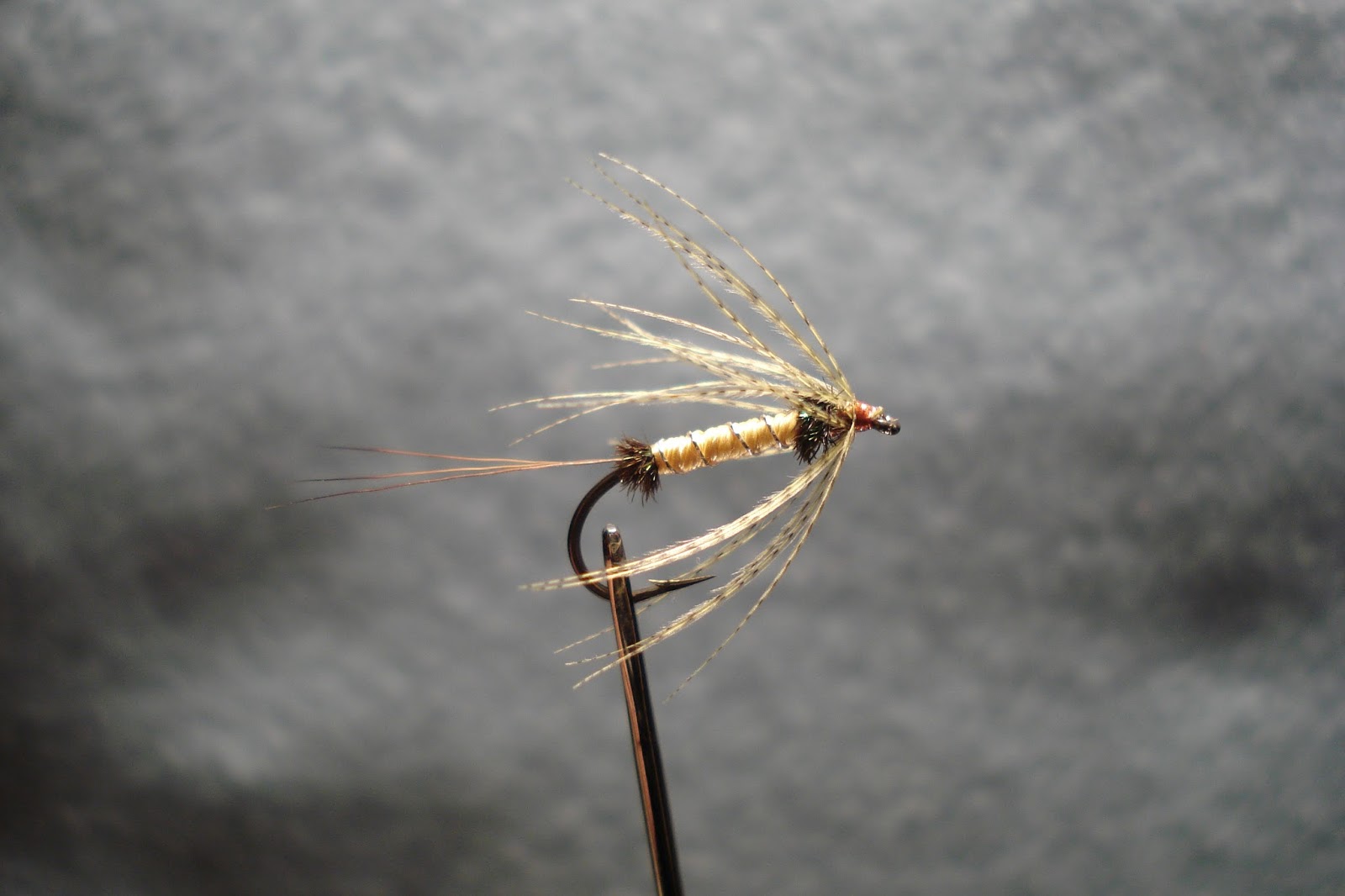
This spider is dressed essentially as a thread-bodied, soft hackle palmer, a method that results in a fundamentally more vulnerable fly than the ones W. C. Stewart preferred to fish. It uses the starling substitute that Stewart suggests. It would best be dressed on a shorter shank that the dry fly hook used to regularize the blog's dressing. suggests..It would be best tied on a shorter shanked hook than the blog standard.

Hook:

14-18
Thread:

Blue Dun
Hackle:

Starling undercovert


W. C. Stewart Practical Angler (1857) made famous the spider style of dressing soft hackles with three specific dressings, the Black Spider, the Red Spider, and the Dun Spider. He states that “killing spiders may be made of all the feathers we have mentioned [“starling, landrail, dotterel, mavis, grey plover, golden plover, partridge, and grouse”], since “their superiority consists in their much greater resemblance to the legs of an insect, and their extreme softness. So soft are they, that when a spider is made of one of them and placed in the water, the least motion will agitate and impart a singularly life-like appearance to it.”

The Dun Spider “should be made of the small soft dun or ash-coloured feather, taken from the outside of the wing of the dotterel. This bird is unfortunately very scarce ; but a small feather may be taken from the inside of the wing of the starling, which will make an excellent substitute.”

Stewart notes that the “only objection to spiders is, that the feathers are so soft that the trout's teeth break them off, and after catching a dozen or two of trout, little is left of them but the bare dressing, rendering it necessary for the angler to change them; and if the trout are taking readily, this has to be repeated two or three times a day.” The life-like effect and overall effectiveness of the dressings, however, outweighs this objection. His method of dressing the fly strengthens the hackle stem and binds the hackle fibers in buggy positions. 

In his Wet Flies (1995), Dave Hughes suggests dressing Stewart’s spiders by winding tying thread from the eye of the hook halfway down the shank, tying the base of the hackle in from the middle of the shank to the eye, and then winding the tying thread back to the halfway point on the shank. To dress the fly, Hughes directs the fly tier to “take three to five evenly spaced turns of the hackle back to the midpoint of the hook. Catch the hackle tip with three turns of thread,” and he recommends breaking the tip off rather than clipping it with scissors. To finish the fly, Hughes gives another step: “Work your thread forward through the hackle to the hook eye. Wobble the thread back and forth as you go forward, to avoid matting down any hackle. This step is critical; without it, the fragile hackle stem will break and unwind on the first fish you catch.” The fly is finished at the eye of the hook. 

This dressing follows Roger Woolley’s suggestion that Stewart’s spiders might be dressed as hackle palmers: “just a soft hackle taken half-way down the hook, palmerwise, no body as in the usual type of fly, half the hook left bare," but uses the end of the tying thread as a rib, somewhat in the manner of Hughes.

Wednesday, April 6, 2016

Green Drake

This dressing of Michael Theakston’s Green Drake departs from the general rule of the blog and uses a size 10 hook instead of a size 14. It also substitutes silk buttonhole twist for smooth wool, and a rib of the same twist dubbed with antron a shade darker, and it dresses his lightly-winged pattern as a hackle.
Hook:

6-12
Thread:

Yellow
Body:

Silk button hole twist – Belding-Corticelli 9040 lettuce, size D, tied in behind the eye of the hook and wound back toward the bend
Rib:

Body silk tightly twisted, dubbed with medium olive antron, and back wound forward toward the eye
Hackle:

Green Drake dyed mallard flank


The Green Drake is likely the most popular and most famous mayfly in historical angling texts. It is at the very least the mayfly that angling authors most anticipate. In their versions of The Art of Angling (1758, 1774), Richard Bowlker and his son Charles refer to the fly alternately as the May Fly, Yellow Cadow, or Green Drake, and both note the trout’s enthusiasm for the fly when it is on the water. 

Roger Woolley treats the Green Drake under its own heading in the third edition of his Modern Trout Flies (1950), noting that the "Mayfly (Green Drake) is the largest of the Ephemerdiæ family of flies, and much importance is attached to its appearance on the streams by anglers, for the reason that because of its size and the numbers in which it usually hatches out, it forms an annual feast for the trout, a time when all trout (and especially the very bigs ones that rarely rise to the smaller flies) are on the move, and at times rise madly. The sight of practically all the trout in the stream rising well at the same time has given the impression that the trout’s ‘silly season’ is the duffer’s opportunity to make larger captures. This will not be found to be always or even often the case."

In his List of Natural Flies (1853), Michael Theakston gives a simple dressing for the Green Drake, the sixty-second fly he lists for fishing in the course of the year and the eighteenth for the month of May alone. He recommends that it should be "hackled, for legs and wings with, a light coloured mottled feather from the wild mallard, that is stained the ground color of the wings," which he describes in the natural as a "light grass green with dim transparency." He calls for a body of a "pale yellow-green smooth woolen thread, warpt with eight or nine rounds of darker shade." He makes no mention of a tail.  Like many angling authors, Theakston cannot resist sharing stories of fishing the hatch, recalling a June morning in particular when a deft neighborhood angler Miles Shepherd swore off fishing the Green Drake hatch – "I reckon ‘nowt’ of your green drakes!" – because of fishing an unsuccessful dressing by John Stubbs, another fly tier whose dressings, in Theakston's estimation, "are bad to equal."

Charles Cotton recalls the success and frustration he had with his Green Drake on a seventeenth-century trip to the river, "in a Cloudy day, after a showr, and in a whistling wind": "five and thirty very great Trouts, and Graylings betwixt five, and eight of the Clock in the Evening and had no less than five, or six Flies with three good hairs apiece taken from me in despite of my heart, besides." He lists the Green Drake as his favorite of the four large flies that hatch in May in his additions to the Compleat Angler (1676), alongside the "little Yellow May-fly."

Like Theakston’s dressing, this fly uses a size 10 hook, and it substitutes primose silk button hole twist – Coats and Clark’s 72-A baby yellow, size D – for the floss silk that Alfred Ronalds prescribes, as well as using dark deer hair in place of rabbit whiskers for the tailing.


In his Fly-Fisher’s Entomology (1836), Alfred Ronald’s gives a description of the Green Drake and suitable dressings, and he indulges in no recollections of days astream fishing the Green Drake hatch. Many anglers do, incorporating it into their observations of the hatching. Ronalds, as always, takes a scientific bent more familiar to modern anglers. First, he notes that the Green Drake is also known as the “May Fly” or “Cadow” classes it “ Order, Neuroptera. Family, Ephemeridæ. Genus, Ephemera. Species, Vulgata.

“This fly, proceeding from a water nympha, lives three or four days as shown ; then the female changes to the Grey Drake (No. 29.), and the male to the Black Drake (see p. 89.). The Green Drake cannot be said to be in season quite three weeks on an average. Its season depends greatly upon the state of the weather; and it will be found earlier upon the slowly running parts of the stream (such as mill dams) than on the rapid places.

IMITATION.
BODY.  The middle part is of pale straw coloured floss silk, ribbed with silver twist. The extremities are of a brown peacock's herl, tied with light brown silk thread.
TAIL.  Three rabbit's whiskers.
WINGS AND LEGS.  Made buzz from a mottled feather of the mallard, stained olive. (See Dyes, Chap. II. p. 35. article 4.)

To make it with wings in their state of rest, part of a feather similarly stained must be used, and a pale brown Bittern's hackle, or in case of need, a partridge feather must be wrapped round the same body under the wings.”

Historical anglers have often felt it worth noting that the Green Drake is  large enough to fish as bait, suggesting how to best bait a hook alongside accounts of how an artificial fly might best be dressed. In his Angler’s Manual (1836) John Turton notes that the Green Drake "takes the best of fish: it is very often used in its natural state. In their season, these flies come off in such quantities, that a stranger would be astonished: boys can gather small drake baskets full of these baits in a very short time: these they sell to gentlemen to fish with." In the Practical Angler (1857), on the other hand, W. C. Stewart notes that the Green Drake is as hard to catch as the fish and "hardly deserves recognition." (For better bait fishing, he recommends clumsy stoneflies instead.)