Hook:
|
12-14
|
|
Thread:
|
Rust brown
|
|
Rib:
|
Peacock herl
|
|
Rib 2:
|
Vintage, fine gold twist wound along front edge
of peacock herl rib
|
|
Palmer:
|
Ginger cock hackle slightly smaller than front
hackle
|
|
Body:
|
Orange hare’s mask
|
|
Hackle:
|
Ginger cock hackle with a faint, medium dun list,
slightly larger than the palmer hackle
|
|
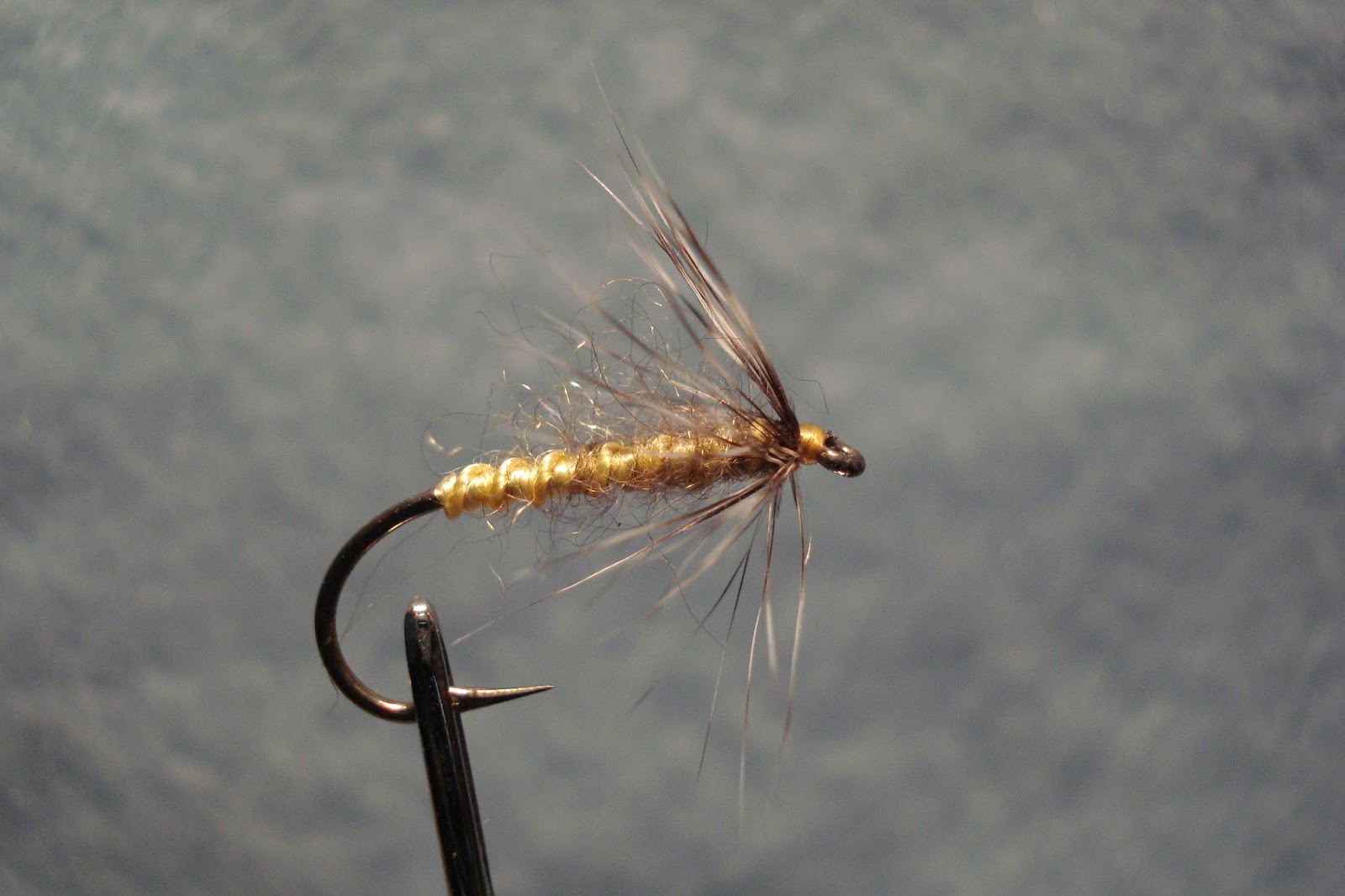
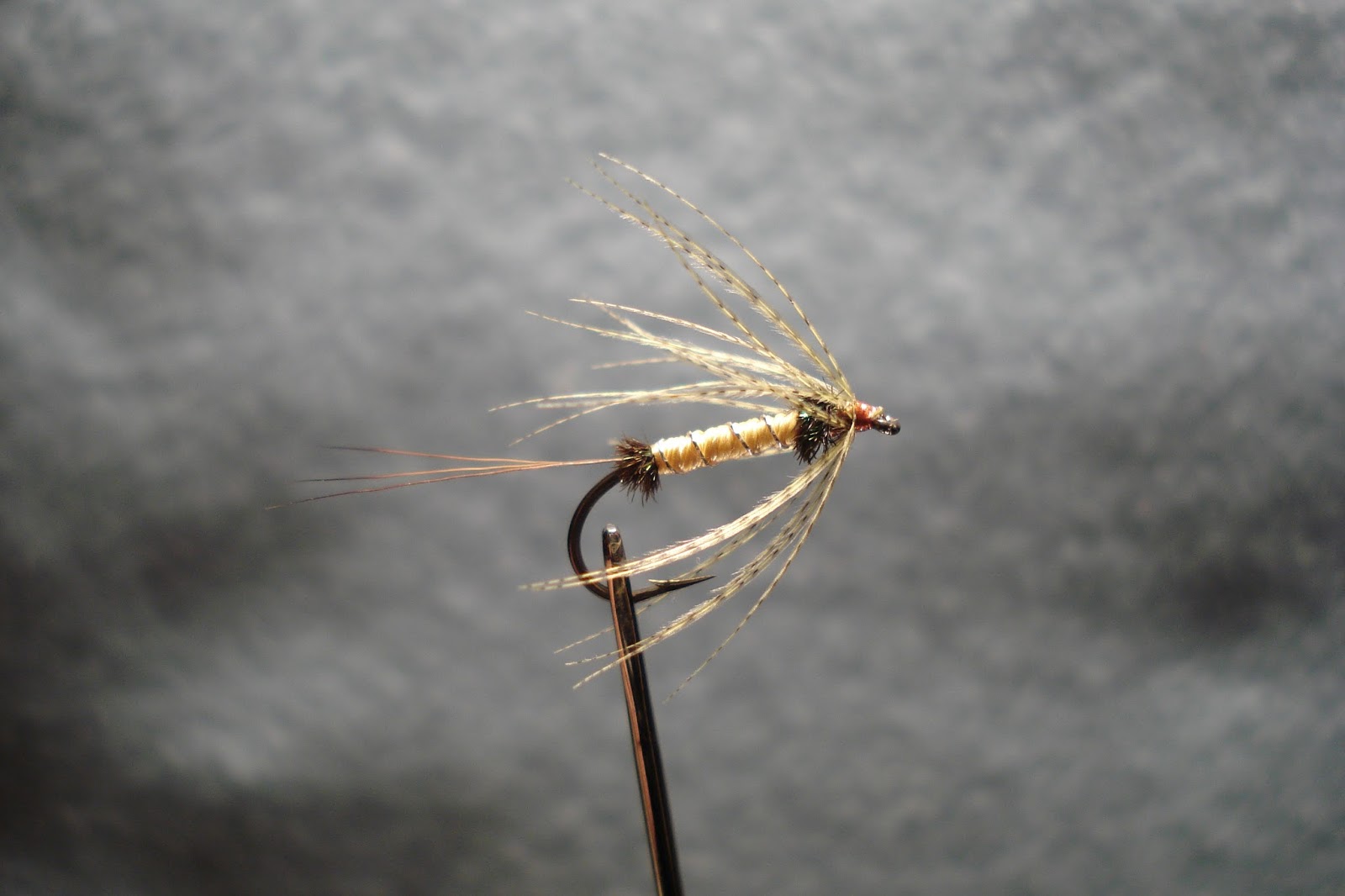
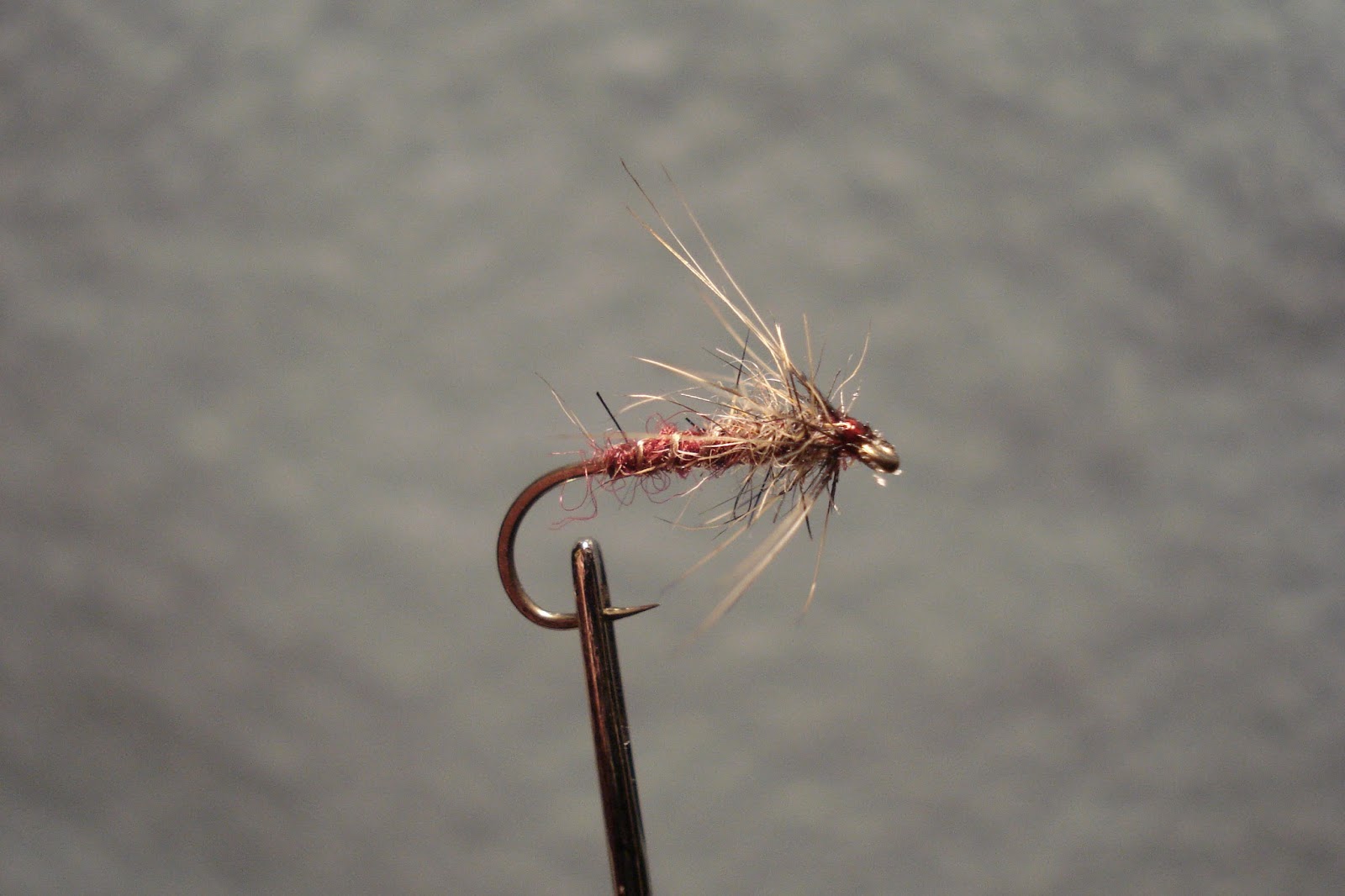
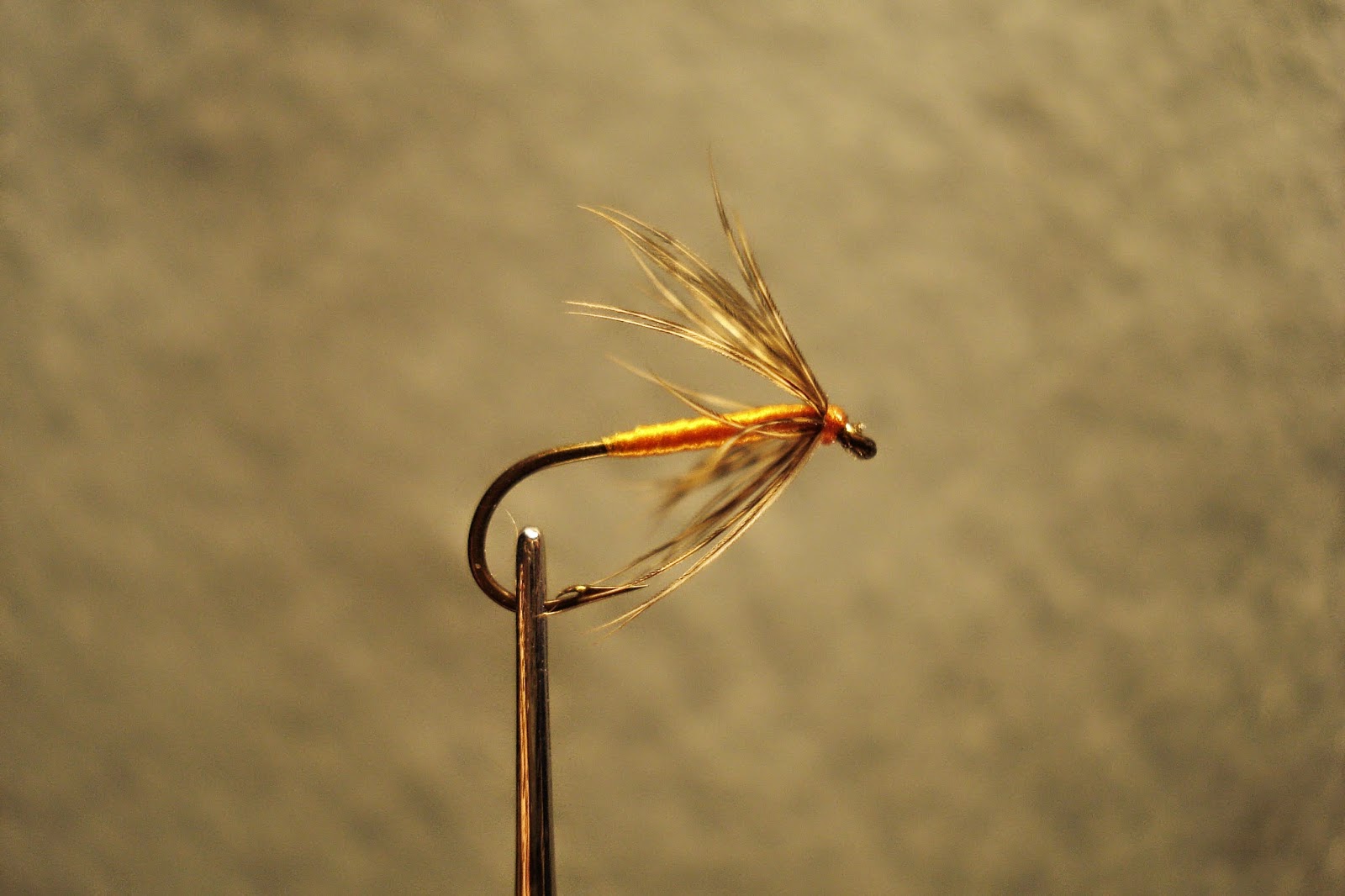
James Leisenring includes the Doctor Lyte Palmer
in The Art of Tying the Wet Fly & Fishing the Flymph (1941)
that he has “found at times very deadly.” It was originally dressed by one of
his “fishing companions, an expert flytier, Dr. H. W. Lyte of Allentown,
Pennsylvania.”
Leisenring's dressing of the Doctor Lyte Palmer calls for:
“HOOK 13,14
SILK Orange.
HACKLE Pure honey
dun of rich color and medium stiffness—two turns.
RIB Fine peacock
herl of the sword feather—one of the very long, thin fibers.
RIB #2 Very narrow
gold tinsel wound right alongside of the peacock herl rib and in front of it.
RIBBING HACKLE
Pure honey dun hackle slightly smaller than the front hackle.
BODY Dingy-orange
worsted wool.”
Sylvester Nemes leaves Doctor Lyte Palmer out of
the dressings he included in his coverage of Leisenring’s Art of Tying the Wet Fly from his Two
Centuries of Soft-Hackled Flies (2004), but it is likely the sort of fly Joe Humphrey had in mind in
his phenomenal textbook, Trout Tactics (1981), in his
observations on fishing the wet fly, particularly in his Pennsylvania
limestone home waters: “When caddies hatches are heavy in April or
early May, try this: fish only heavy, broken pocket water—forget the flats.
Use a short line and work downstream and fish only the pockets in behind
boulders and breaks. Use a well-dress palmered #10 or #8 wet fly, and bounce
the flies in the pockets. A long rod of nine feet or better can be an
advantage when trying to hold wet flies in one specific area. Heavy riffs or
currents push through the middle of a line and drag your flies out of
productive water at edges of the currents. The trout never get a good look at
your fly or refuse them as they drag; a longer rod can hold them there since
there is less line on the water.”
Leisenring’s Doctor Lyte Palmer recalls one of
the four palmer flies, the Golden Palmer, that Richard Bowlker included in his
1757 edition of The Art of Angling,
but which his son Charles excluded from his own 1774 edition: “His body is
made of orange-coloured silk, ribbed down with a peacock’s harle and gold
twist, with the red hackle of a cock wrapt over the body: The hook, No. 5, or
6, according to the water you fish in.”
|
Showing posts with label R Bowlker. Show all posts
Wednesday, August 2, 2017
Doctor Lyte Palmer
Wednesday, June 7, 2017
Stone Fly; Stone Flye or Flie; and, the Montana Stonefly
Hook:
|
6-10
|
|
Thread:
|
Wood Duck
|
|
Body:
|
Silk button hole twist – Belding-Corticelli 3715
bamboo, size D
|
|
Rib:
|
Silk button hole twist – Belding-Corticelli 3715 bamboo, size D dubbed with an equal blend of beaver fur and golden
stonefly antron
|
|
Hackle:
|
Grizzly cock
|
|
In a discussion of stoneflies in his Fly
Fishing: The North Country Tradition (1996), Leslie Magee suggests
that “of all the flies imitated by the flyfisher, the larger stoneflies are
the least familiar; few of the that I meet on the riverside have ever handled
a ‘creeper’ (the nymph or larvae) or an adult stonefly,” and that bait fishing with the stonefly was more common. While the
popularity of bait fishing with the stonefly has passed, Magee points out that it was still popular
in T. E. Pritt’s time, “when fishing the live creeper and the adult stonefly
cast upstream was all the rage on several North Country rivers.” Despite Magee's assertion that the popularity of bait fishing with stoneflies had waned by the early twentieth century, Harfield Edmonds and
Norman Lee devoted a chapter to it in their Brook and River Trouting (1916); “20 years after the publication
of Brook and River Trouting
upstream fishing with the creeper and live stonefly was virtually extinct”
due to developments in angling gear and fly fishing methods.
Nevertheless, historical angling authors give
testament to Magee’s assertion that fishing stone flies as bait was a
centuries old practice, much like fishing nymphal and mature Green Drakes. John Kirkbride, for
instance, expresses this preference in
his Northern Angler (1837): the
Stone Fly, “on a hot day, is a most destructive bait for trout,” and it “is
seldom used as an artificial fly; for it is best to dab with it after it
takes wing. It is here called the May-fly.” Michael Theakston likewise notes in
his List of Natural Flies (1843), that
the stone fly, the “Imperial Empress of all trout flies,” is “in general fished
natural.” “After sunset she comes out,” he notes, “for her enjoyments are
chiefly in the dusk and twilight of night and early morn; the whole family
are then in motion—flying about—running among the stones, and paddling upon
the waters.” Theakston explains that, to fish the stone fly successfully, the angler must “move,
unseen, with easy motion up the stream, and dab the fly with precision on the
eddies behind stones, or other places of succour where the trout takes his
station; or let it glide free and natural down the current over his likely
haunts; never drag it against the stream (unnatural for any fly) or suffer it
to drown; but succour and recover it by easy lifts and gentle jerks, to keep
it on the water alive and dry, for a dead fly hanging at the hook like a
piece of wet moss, will not be taken on the top.” Theakston regards fishing
the stone fly as an artificial as “a true trier of skill, and probably the
best test of the general merits of the flyfisher. Each rustic craftsman along
the banks of the winding streams, where the true art and science of
flyfishing is best known and practised, greet with glee the presence of the
stone fly.”
In the third edition of his Modern Trout Fishing (1950), some twenty-five years after bait
fishing the stonefly went extinct, in Magee’s account, Roger Woolley emphasized
how often the stone fly is fished as a natural, noting that “it is more used in
its natural state than as an artificial. It is called the Mayfly on the north
country rivers, where it hatches out in great numbers.” Woolley points out that “it is not always easy to
procure a sufficient number of the natural flies for a day’s fishing, and then
the artificial has to be resorted to, but the stone fly anglers prefer the
natural fly is procurable.” He goes on to list eighteen dressings for smaller
stoneflies, including five soft hackles like the Winter Brown that he attributes to the North Country tradition.
Although Woolley’s dressings are almost evenly
split between winged and corresponding hackled versions, historical stone flies
patterns were most often winged dressings. John Jackson’s Practical Fly-Fisher (1854) includes a
winged stone fly, no. 32, the May-Fly, but notes that the fly is “generally
fished natural, being large enough to swim a good sized hook, or two smaller
ones tied double.” Theakston’s dressing is also winged, as is the Stone Fly
that William Blacker includes in his Art
of Angling (1843). Kirkbride, Alfred Ronalds in The Fly-fisher’s Entomology (1837), and John Turton’s Angler’s Manual (1836) provide
dressings that seem to derive from sixteenth- and seventeenth-century antecedents that John Waller Hills
describes in A History of Fly Fishing for Trout (1921).
Hills lists the Stonefly as one of the twelve
most important flies to anglers, giving a brief account of early dressings
from Dame Julianna Berner’s A treatyse of fysshynge wyth an Angle (1496) to Charles Cotton’s 1676 additions
to Izaak Walton’s Compleat Angler (1657). Hills points out that the
Stonefly “has changed neither in name nor in dressing. It is quite
unmistakeable, a fat, stupid, clumsy clown, better at running than flying.
The Treatise is as follows: ‘The
stone fly, the body of black wool and yellow under the wing and under the
tail, and the wings of the drake.’ Markham as usual makes the dressing more
definite: the yellow under wings and tail is to be made with yellow silk and
the wings are of a drake's down, not the quill feather. Cotton knew the fly
well and gives an excellent account of its history: he made the body of dun
bear's hair and brown and yellow camlet well mixed, making your fly more
yellow on the belly and towards the tail, two or three hairs of a black cat's
beard for tail, and long, very large wings of grey mallard. Though we use different
furs from Cotton, his body survives unchanged in essence: but a hen
pheasant's quill feather makes a truer wing than light mallard, and we like
to add a hackle, either blue dun or greenish. But the changes are immaterial.”
Part of the “excellent account” that Hills
attributes to Cotton includes a description of the Stone-Flies’ unique manner
of hatching and eagerness of the trout to feed on them: “This same Stone-Flie
has not the patience to continue in his Crust, or Husk till his wings be full
grown, but so soon as ever they begin to put out, that he feels himself
strong (at which time we call him a Jack) squeezes himself out of Prison, and
crawls to the top of some stone, where he can find a chink that will receive
him, or can creep betwixt two stones, the one lying hollow upon the other
(which, by the way, we also lay so purposely to find them) he there lurks
tills his wings be full grown, and there is your only place to find him (and
from thence doubtless he derives his name) though, for want of convenience,
he will make shift with the hollow of a Bank, or any other place where the
wind cannot come to fetch him off.” Cotton notes that anglers often “dape or
dibble” the natural Stone-Flie, “as with the [Green] Drake” and that fishing
the fly is “much better toward 8, 9, 10 or eleven of the clock, at which time
also the best fish rise, and the latter the better, provided you can see your
Flie, and when you cannot, a made Flie will murder.”
In his Fly Fisher’s Guide (1816), George Bainbridge nods toward three traditions of fishing the stone fly. Not only is it “a deadly bait, used in the natural state,” but it is dressed after the fashion of Cotton's and Berners' precedent, winged and with a bear fur body. Brainbridge notes that it is also dressed as a hackled pattern, with “a long-fibred grizzled hackle from a cock’s back, without wings.” This latter dressing specifically recalls the Stone Flies of Richard Bowlker and his son Charles. Richard Bowlker provides a simple, soft hackle dressing for the Stone Fly in his Art of Flyfishing (1757). He describes the insect as “a large four-winged fly; bred from an insect in the water, called the water cricket; to be found in stony, gravelly brooks, or rivers; his belly is of a dirty yellow, his wings of a fine blue color, full of small veins, so that he is best made with a fine blue grizzle cock’s hackle; the body with dark brown mohair mixed with a dirty yellow.” Charles Bowlker offers a similar dressing in his 1776 edition, though its description reads more like a palmer: “This fly is made of the brown feather of a hen. His belly is of a dirty yellow and his back of the dark brown. His body is made of a yellow or brown spaniel’s hair, or Mohair, with the grizzled hackle of a cock around it.” |
| Breaking with the usual size 14 hook size for the blog, this dressing uses a 4x bait hook. It substitutes a cree hackle for the brown and grizzly hackles Charles Brooks requires. |
Stonefly dressings are the
stock-in-trade of modern American anglers, though they are often involved dressings.
A notable exception is Charles Brooks' Montana Stonefly nymph. Brooks famously
dressed heavily-weighted nymphal patterns “in the round” for fishing deep,
boulder-studded pocket water of the western trout streams he favored—much
like the water Theakston and the Bowlkers reference—and he described his
methods of fishing and dressing them in Nymph
Fishing for Larger Trout (1976).
Though it is a bit of a stretch, many, such as his Montana Stone Fly, are
essentially soft
hackles or flymphs, not far removed in form the Hare's Ear Flymph that Dave Hughes describes in Wet Flies (1995). This fly recalls the Bowlkers own dressing, though it
is unlikely Brooks had access to their books. Brooks dressed his Montana Stone on
long, heavy wire hooks in sizes 4 to 8 and weighted them heavily in order to
represent the “Pteronarcys genus
of stoneflies, especially P.
californica,” also known as the Giant Salmon Fly Nymph, a must different
stone fly than the one Alfred Ronalds describes: a fly hatching from “the beginning of April until the end of May,” of the “Order, Neuroptera.
Family, Perlidœ. Genus, Perla.
Species, Bicaudata.” Ronalds' stonefly is likely much more closely
related to the fly Ernest Schwiebert describes in Nymphs (1973) as Perla Capitata, the Great
Stonefly Nymph, Art Flick's Stonefly Creeper. Brooks’ Montana Stone is
somewhat more complicated to dress than the Bowlkers:
“Tail: Six fibers of raven or crow primary.
Rib: Copper wire.
Body: Black fuzzy yarn, four strand.
Hackle: One grizzly saddle and one grizzly dyed dark brown. Strip
hackles off lower hackles before tying in.
Gills: Light gray or white ostrich herls.
Thread: Black nymo 3/0.”
Brooks directs fly tiers to: “Tie in
thread at front, wind to bend. Lacquer shank. Tie in tail fibers and split to
form forked tail, three fibers per side. Tie in ribbing and yarn. Wind thread
forward, half hitch twice, and break off. Lacquer shank again. Wind yarn to
eye, back to bend, forward to eye and back to base of thorax. Tie off, tying
in thread at same time. Wind rib and tie off. Tie in one strand of ostrich
herl, and both hackles by the butts. Strip fibers off lower side of both
hackles. Wind two separated turns of hackle, one at the base of the thorax
and another halfway between there and the eye. Both colors of hackle should
lie one against the other. Tie off. Wind ostrich herl forward at the base of
the hackles, tie off. Spiral thread forward and finish head large and lacquer
well.”
|
Labels:
Bainbridge,
Berners,
Blacker,
Brooks,
C Bowlker,
Cotton,
Edmonds and Lee,
Hills,
Hughes,
Kirkbride,
Magee,
R Bowlker,
Ronalds,
Schwiebert,
Theakston,
Turton
Wednesday, June 1, 2016
Blue Dun
| This dressing substitutes pale yellow seal's fur for the pale "wool, mohair, or fine dyed pig's wool" that John Younger prescribes and uses starling undercovert. |
Hook:
|
12-16
|
|
Thread:
|
Yellow
|
|
Body:
|
Blue rabbit underfur and pale yellow seal's fur
|
|
Hackle:
|
Starling undercovert
|
|
W. H. Lawrie’s Scottish Trout Flies (1966) reproduces lists of flies like John Younger’s list for fishing the Tweed. Of the six flies Younger dressed, the unnamed fly for April and May. His fly, undoubtedly a Blue Dun, is dressed with
“Wing: Transparent feather from the wing of the bunting or that of a full grown cock sparrow.
Body: Blue water-rat fur mixed with equal proportion pale yellow, inclining to white, wool, mohair or fine dyed pig’s wool.”
Younger includes one additional dressing for April and May with the same body, but hackled with a body feather from a grouse. G. E. M. Skues suggested that Younger’s dressing imitated a “small darkish Watery” that hatched from “May throughout the season,” No. VII on his list of flies for representing the Medium Olive. He adapted Younger’s pattern thus:
“Hook.—No. 16 down-eyed Pennel sneck.
Tying Silk.—Bright yellow, waxed with clear colourless wax.
Hackle.—Dark-blue hen short—not more than two turns.
Whisks.—Two strands of darkish blue unspeckled feather from neck of cock guinea fowl- short.
Body.—Thinly laid dubbing of mole’s fur mixed with yellow seal’s fur.”
Skues also suggested that “the body may be varied by using English squirrel blue fur instead of mole.”
Roger Woolley notes in the last edition of his
Modern Fly Dressing (1950) that the
olive fly is the usually known as the Early Olive Dun. He introduces his
dressings by noting that, “although entomologies tell us there is no such fly
in nature as the Blue Dun, anglers always have had and will have their Blue
Dun. It is an imitation of the large, early spring Olive Dun, a fly appearing
in early spring, the first of the Ephemeridæ
family to show on our streams.” A proliferation of olive dun colored bodies
matched with dun hackles, however, makes pinpointing which are intended to
match Woolley’s mythological Blue Dun a challenge. The Waterhen Blae, for
instance, might equally serve the purpose. To limit the scope of these
possibilities, soft hackled Blue Dun patterns here will to create an olive
shade that the yellow silk underbody accents, either by mixing yellow and
blue or by overwrapping the main body with a yellow or olive rib.
John Waller Hills traces the development of
the Blue Dun in A History of Fly
Fishing for Trout (1921) from Dame Juliana Berners and her A treatyse
of fysshynge wyth an Angle
(1496) to the twentieth century: “The progress of this fly is of
extraordinary interest. It starts with a black wool body, dark mallard wings
and possibly a jay's blue feather as hackle. This dressing is too dark altogether
in body and wing. Cotton lightens both, and gives a fairly good fly, and
Chetham a still better one. His Blue Dun has no hackle it is true, but its
rough body of fox fur could easily be picked out, and except for this it is almost
as it now exists. But there were one or two improvements, the snipe wing,
which I think is better than the starling for the sunk fly, and mole's fur
body. So we get the fly of to-day.” Hills suggests that flies like the Old
Blue Dun are variations of the Blue Dun, utilizing a rib in place of blended
blue and yellow body. The effect either way, he implies, simulates the olive
hue that is characteristic of the Olive Dun. In their Art of Angling (1757, 1774), both Richard and Charles Bowlker
include dressings for the Blue Dun that includes bodies “made of a blue fur
of a fox, or the blue part of a squirrel’s furr, mixed with a little yellow
mohair.”
Many dressings of the Blue Dun, like those of
the Bowlkers, are winged. John Kirkbride includes, as he often does,
dressings for winged flies and for hackles: “when dressed as a hackle-fly, a
fine feather from the underside of the wing of the jack-snipe, or moor-pout, answers
very well for the hackle. The body
must be the same as described above”—“from the light blue fur of the rabbit,
or the grey squirrel, mixed with a very little yellow mohair.” The
“moor-pout” is a Scottish term for a young grouse.
|
| This dressing of Vernon S. Hidy’s Blue Dun uses primrose Pearsall’s gossamer silk for the tying silk and light olive Pearsall’s gossamer silk for the rib. |
While many historical soft hackle patterns use
a blue fur body mixed with yellow to create an olive effect, others are
dubbed on dubbed on primrose or yellow thread and include a rib. James
Leisenring’s angling companion, Vernon S. Hidy, included such a dressing for
the Blue Dun in Chapter 10 “Soft-hackle Nymphs—the Flymphs” of The Master’s on the Nymph (1979):
“Sizes 12, 14, 16; muskrat fur on primrose silk; olive-yellow thread ribbing;
two turns of blue dun hen hackle.” The Old Blue Dun that Leisenring includes
in The Art of Tying the Wet Fly &
Dressing the Flymph (1941) seems dressed to achieve the same effect.
|
Wednesday, April 6, 2016
Green Drake
Hook:
|
6-12
|
|
Thread:
|
Yellow
|
|
Body:
|
Silk button hole twist – Belding-Corticelli
9040 lettuce, size D, tied in behind the eye of the hook and wound back toward the bend
|
|
Rib:
|
Body silk tightly twisted, dubbed with medium olive antron, and back wound forward toward the eye
|
|
Hackle:
|
Green Drake dyed mallard flank
|
|
The Green Drake is likely the most popular and
most famous mayfly in historical angling texts. It is at the very least the mayfly that angling authors most anticipate. In their versions of The Art of Angling (1758, 1774), Richard Bowlker and his son Charles refer to the fly alternately as the May Fly, Yellow Cadow, or Green Drake, and both note the trout’s enthusiasm for the fly when it is on the water.
Roger Woolley treats the Green Drake under its own heading in the third edition of his Modern Trout Flies (1950), noting that the "Mayfly (Green Drake) is the largest of the Ephemerdiæ family of flies, and much importance is attached to its appearance on the streams by anglers, for the reason that because of its size and the numbers in which it usually hatches out, it forms an annual feast for the trout, a time when all trout (and especially the very bigs ones that rarely rise to the smaller flies) are on the move, and at times rise madly. The sight of practically all the trout in the stream rising well at the same time has given the impression that the trout’s ‘silly season’ is the duffer’s opportunity to make larger captures. This will not be found to be always or even often the case."
In his List of Natural Flies (1853),
Michael Theakston gives a simple dressing for the Green Drake, the
sixty-second fly he lists for fishing in the course of the year and the
eighteenth for the month of May alone. He recommends that it should be
"hackled, for legs and wings with, a light coloured mottled feather from
the wild mallard, that is stained the ground color of the wings," which
he describes in the natural as a "light grass green with dim
transparency." He calls for a body of a "pale yellow-green smooth
woolen thread, warpt with eight or nine rounds of darker shade." He
makes no mention of a tail. Like many angling authors, Theakston cannot
resist sharing stories of fishing the hatch, recalling a June morning in
particular when a deft neighborhood angler Miles Shepherd swore off fishing the Green
Drake hatch – "I reckon ‘nowt’ of your green drakes!" –
because of fishing an unsuccessful dressing by John Stubbs, another fly tier
whose dressings, in Theakston's estimation, "are bad to equal."
Charles Cotton recalls the success and frustration
he had with his Green Drake on a seventeenth-century trip to the river, "in a Cloudy day, after a showr, and in
a whistling wind": "five and thirty very great Trouts, and
Graylings betwixt five, and eight of the Clock in the Evening and had no less
than five, or six Flies with three good hairs apiece taken from me in despite
of my heart, besides." He lists the Green Drake as his favorite of the
four large flies that hatch in May in his additions to the Compleat
Angler (1676), alongside the "
|
In his Fly-Fisher’s
Entomology (1836), Alfred Ronald’s gives a description of the Green Drake
and suitable dressings, and he indulges in no recollections of days astream
fishing the Green Drake hatch. Many anglers do, incorporating it into their
observations of the hatching. Ronalds, as always, takes a scientific bent
more familiar to modern anglers. First, he notes that the Green Drake is also
known as the “May Fly” or “Cadow” classes it “ Order, Neuroptera. Family,
Ephemeridæ. Genus, Ephemera. Species, Vulgata.”
“This fly, proceeding
from a water nympha, lives three or four days as shown ; then the female changes
to the Grey Drake (No. 29.), and the male to the Black Drake (see p. 89.).
The Green Drake cannot be said to be in season quite three weeks on an
average. Its season depends greatly upon the state of the weather; and it
will be found earlier upon the slowly running parts of the stream (such as
mill dams) than on the rapid places.
IMITATION.
BODY. The middle part is of pale straw coloured
floss silk, ribbed with silver twist. The extremities are of a brown peacock's
herl, tied with light brown silk thread.
TAIL. Three rabbit's whiskers.
WINGS AND LEGS. Made buzz from a mottled feather of the
mallard, stained olive. (See Dyes, Chap. II. p. 35. article 4.)
To make it with wings
in their state of rest, part of a feather similarly stained must be used, and
a pale brown Bittern's hackle, or in case of need, a partridge feather must
be wrapped round the same body under the wings.”
Historical anglers have often felt it worth
noting that the Green Drake is large enough to fish as bait,
suggesting how to best bait a hook alongside accounts of how
an artificial fly might best be dressed. In his Angler’s Manual (1836)
John Turton notes that the Green Drake "takes the best of fish: it is
very often used in its natural state. In their season, these flies come off
in such quantities, that a stranger would be astonished: boys can gather
small drake baskets full of these baits in a very short time: these they sell
to gentlemen to fish with." In the Practical Angler (1857),
on the other hand, W. C. Stewart notes that the Green Drake is as
hard to catch as the fish and "hardly deserves recognition." (For
better bait fishing, he recommends clumsy stoneflies instead.)
|
Wednesday, February 24, 2016
Red Brown
Thread:
|
Yellow Pearsall’s gossamer silk
|
|
Abdomen:
|
Tying silk
|
|
Thorax:
|
Gray squirrel fur
|
|
Hackle:
|
Speckled hen hackle - here, Whiting Brahma
|
|
Early stoneflies like the February Red “are the earliest hatchings of the aquatic angling flies, and the first of the season to raise and cheer the lone trout,” Michael Theakston explains in his List of Flies (1843), “the harbingers of his better days; the warm sun draws out the firstlings of these hardy families; and they increase in numbers as the season advances, and the weather permits.” While Theakston does not cite a February Red, he does include a Red Brown as a dressing for February with “wings, from the landrail, or a slightly broken feather from a light freckled brown hen, or selected from the brown owl; orange or yellow silk for the body, with a few fibres of mohair or squirrel’s fur, at the breast, in imitation of the legs.” Theakston suggests two different colors for the body, but this comes as little surprise since every angling author seems to prefer a different color to imitate the same insect.
John Waller Hills
famously argued in his History of Fly Fishing (1921) that
the Orange
Patridge or Partridge and Orange, much after the fashion of Theakston, is
the classic dressing for the February Red, and he conjectures that Dame
Juliana Berners' gray wool-bodied Donne
Fly, a part of her twelve fly list in A treatyse of fysshynge
wyth an Angle (1496), was also originally dressed to match this
early stonefly hatch. Both James Chetham's Angler’s Vade Mecum (1681) and Charles Cotton’s additions to Izaak Walton’s Compleat Angler (1667) include a dressing for the Red-Brown (or Lesser Red-Brown) for February angling.
Cotton devotes more explanation to this fly than many: "Where the
Red-Brown of the last Month ends, another almost of the same colour begins
with this, saving that the dubbing of this must be of something a blacker
colour, and both of them warpt on with red silk; the dubbing that should make
this Flie, and that is the truest colour, is to be got of the black spot of a
Hogs ear: not that a black spot in any part of the Hog will not afford the
same colour; but that the hair in that place is by degrees softer, and more
fit for the purpose: his wing must be as the other, and this kills all this
Month, and is call’d the lesser Red-Brown." (The January dressing that
Cotton references and adjusts for February included very
specifically "the dubbing of the tail of a black long coated Cur,
such as they commonly makes muffs of; for the hair on the tail of such a Dog
dies, and turns to a red Brown.")
|
Likewise, Richard
and Charles Bowlker both include for the Red Fly in their editions of The
Art of Angling (1758, 1774), but theirs are winged wet flies. Alfred
Ronalds follows their cue in his Fly-Fisher’s Entomology (1836).
The Red Fly is the first on his list and is also dressed as a winged wet,
though he does, as usual, offer an alternative buzz or hackle dressing that uses a "copper
tinged dun hackle." The body he prescribes is much more complicated than
the simple silk recommended by other authors: "The dubbing is composed
of the dark red part of squirrel's fur, mixed with an equal
quantity of claret-coloured mohair, showing the most claret colour
at the tail of the fly. This is spun on, and warped with brown silk
thread."
|
Wednesday, December 16, 2015
Fern Fly or Woodcock and Orange; or, Soldier Fly
| This dressing of Richard Bowlker’s Fern Fly uses an American woodcock primary for the hackle. |
Hook:
|
14-18
|
|
Thread:
|
Burnt orange
|
|
Body:
|
Orange Pearsall’s marabou silk, lightly waxed
|
|
Hackle:
|
Woodcock covert
|
|
Leslie Magee traces the recurrence of popular dressings in North Country angling literature as well as the coterie publication of various North Country angling clubs from 1651—1885 in his Fly Fishing: the North Country Tradition (1994). He locates the Fern Fly or Woodcock and
Orange in at least eight angling texts: in Charles Cotton’s 1676 additions to Izaak Walton’s
Compleat Angler; James Chetham’s Angler’s Vade Mecum (1681), John
Williamson’s British Angler (1740);
in R. Brooks (1793); John Swarbrick’s List
of Wharefdale Flies (1807); George Bainbridge’s Fly-fisher’s Guide (1816); Michael Theakston’s List of Natural Flies (1853); and
William Brumfitt’s manuscript (1885).
In a book that Magee does not include, Alfred Ronalds' Fly-Fisher’s
Entomology (1836), the Fern Fly is listed as a
terrestrial, also known as the Soldier Fly. Ronalds also gives a winged dressing
and, as is his wont, a buzz or hackle dressing, a furnace palmer or heavily dressed
front hackle on an orange silk body. John Jackson, whose dressings Magee also excludes provides directions
for a winged Soldier Fly in his Practical
Fly-Fisher (1854), as does Theakston. Neither of these dressings uses
woodcock as winging or primary hackle - few of the Fern Fly dressings that Magee indicates use woodcock or orange at all.
Oddly enough, Magee does not locate the Fern Fly in
either of the Bowlkers’ editions of The
Art of Angling. In the 1753 edition, Richard Bowlker suggests dressing
the fly for mid-June through mid-July, and his dressing is the one that gives
it the name Woodcock and Orange: “He is a four-winged fly; his body very
slender and of an orange colour; he is to be fished with at any time of the
day, from sun-rise till sunset, being a very killing fly: His wings are made
with a woodcock’s feather, his body with orange-coloured silk.” His dressing seems to be a direct precedent for the Brown Fern Fly that John Kirkbride included The Northern Angler (1837), which only added a small dubbing ball thorax of hare's neck fur behind the hackle.
|
| This dressing of Charles Bowlker’s Fern Fly uses turkey tail for the body, American woodcock primaries for a hackle, and orange Pearsall’s gossamer silk twisted as a ribbing. |
Richard’s son Charles dresses the Fern Fly in
his 1774 edition of The Art of Angling.
He is not as convinced of its efficacy as his father: "The Fern Fly comes in
about the latter end of June, and does not continue above a week. He has four
wings that stand upright on his back. His wings and body are made of a
woodcock’s feather, ribbed with orange coloured silk. He is to be fished with
in a morning, the first of any fly, till abot eleven o’clock, and then you
may change your fly according to the brightness or dullness of the day, for
there are many flies on the water at that time."
|
Wednesday, September 9, 2015
Willow or Withy Fly
| This dressing uses yellow Pearsall's gossamer silk. |
Hook:
|
14-18
|
|
Thread:
|
Yellow
|
|
Body:
|
Mole’s fur spun on yellow silk
|
|
Hackle:
|
A dark dun cock’s hackle strongly tinged a
copper-colour
|
|
Alfred Ronalds lists the Willow (or Withy) Fly as no. 44, the last fly to be imitated during the regular season, in his Fly-Fisher’s Entomology (1836). He describes this diminutive stonefly—“Order, Neuroptera. Family, Perlidæ. Genus, Nemoura. Species, Nebulosa.”—as hatching in September and notes that "it is extremely abundant during this month and the next, and even later in the season. On very fine days it may be found on the water in February. It generally flutters across the stream, and is best imitated buzz fashion."
Publishing at the same time, John Turton lists
the hatch of the Willow Fly in September and October. He dresses a hackled
Willow Fly, no. 68, in the Angler’s
Manual (1836) “with a yellow silk: wing, a blue grizzled cock’s hackle
feather; body, blue squirrel’s fur and yellow down mixed, twisted on the
silk. Best on cold stormy days.”
|
John Jackson gives two dressings for the
Willow Fly, no. 57 the Small Willow Fly and no. 58 the Large Willow Fly, in
his Practical Fly-Fisher (1854). He
dresses the Small Willow Fly “by wrapping a feather from the inside of a
Snipe’s wing, or a small grizzled hackle, on a body of light brown silk, or
Mole’s fur and yellow silk,” and, Jackson notes, the fly is “best on warm days.”
He dresses the Large Willow Fly as a winged wet with
“Wings.—Inside of Woodcock’s wing feather.
Body.—Moles fur spun on yellow silk.
Legs.—Brown Hackle.
This fly is well made by hackling a grizzled hackled of a copperish hue on the above body.”
|
In Nymphs
(1974), Ernest Schwiebert credits the Bowlkers with first offering a historical imitation for the Willow Fly, and he lauds the endurance of their
identification and representation as a testament to their studies. Richard
Bowlker’s Art of Angling (1758)
describes the Willow Fly like Ronalds, noting that it “comes about the
beginning of September, and continues till the latter end of October: He is a
four-winged fly, and generally flutters upon the surface of the water: To be
fished with in cold stormy days, being then most plentiful upon the water.” Richard Bowlker suggests a dressing with “wings made of a blue grizzled cock’s hackle, the
body of the blue part of a squirrel’s fur, mixed with a little yellow
mohair.”
In his revisions (1774) to his father’s
original work, Charles Bowlker also points to the Willow Fly’s four wings as
a distinguishing feature for the stonefly in late summer and autumn: “He has
four wings which lie fly on his back: his belly of a dirty yellow, and his
back of a dark brown.” To represent the Willow Fly, Charles gives a dressing
with “wings made of a dun cock’s hackle a little freckled; his body of
squirrel’s furr, ribbed with yellow silk, and covered lightly with the same
coloured hackle as the wings.”
Under the heading “Stoneflies” in the third
edition of Modern Trout Dressing
(1950), Roger Woolley notes that the Willow Fly is synonymous with the Brown
Owl, which shows up as no. 5 in T. E. Pritt’s North Country Flies (1886) and no. 11 in Harfield Brooks and
Norman Lee’s Brook and River Trouting
(1916). They dress these flies for April, May, and June, rather than September through October (and even through February) like Ronalds, Turton, and the Bowlkers. This suggests two different insects. More likely,
Pritt, Edmonds, and Lee used the Waterhen Bloa, with its mole or muskrat
body on yellow silk, to imitate the Willow Fly instead of the Brown Owl.
Pritt, in particular, recommends the Waterhen Bloa as “indispensable during March and April,
and again towards the latter end of the season”; Edmonds and Lee specifically
prescribe its usefulness from “March to end of April, and again in
September.”
John Kirkbride includes a Willow Fly in the North-Country Angler (1837), noting
that its emergence coincides with the Yellow Dun in May and June. The stonefly he dubs the Willow
Fly seems much more like a Yellow Sally - an insect and imitation that Kirkbride does not include in
the text - than the later season stonefly that Richard Bowlker described almost
a century earlier as a Willow Fly. Kirkbride’s Willow Fly is “a very delicate-looking fly,
and the trout are very fond of it, particularly in the evenings. The body is
of a delicate transparent yellow colour, with a greenish or olive shade; it
must be ribbed with gold-coloured silk,” and “when it is made as a spider, a
feather from the breast of the yellow plover must be used.”
|
Labels:
C Bowlker,
Edmonds and Lee,
Jackson,
Kirkbride,
Pritt,
R Bowlker,
Ronalds,
Schwiebert,
Turton,
Woolley
Subscribe to:
Posts (Atom)