Showing posts with label Schwiebert. Show all posts

Wednesday, June 7, 2017

Stone Fly; Stone Flye or Flie; and, the Montana Stonefly


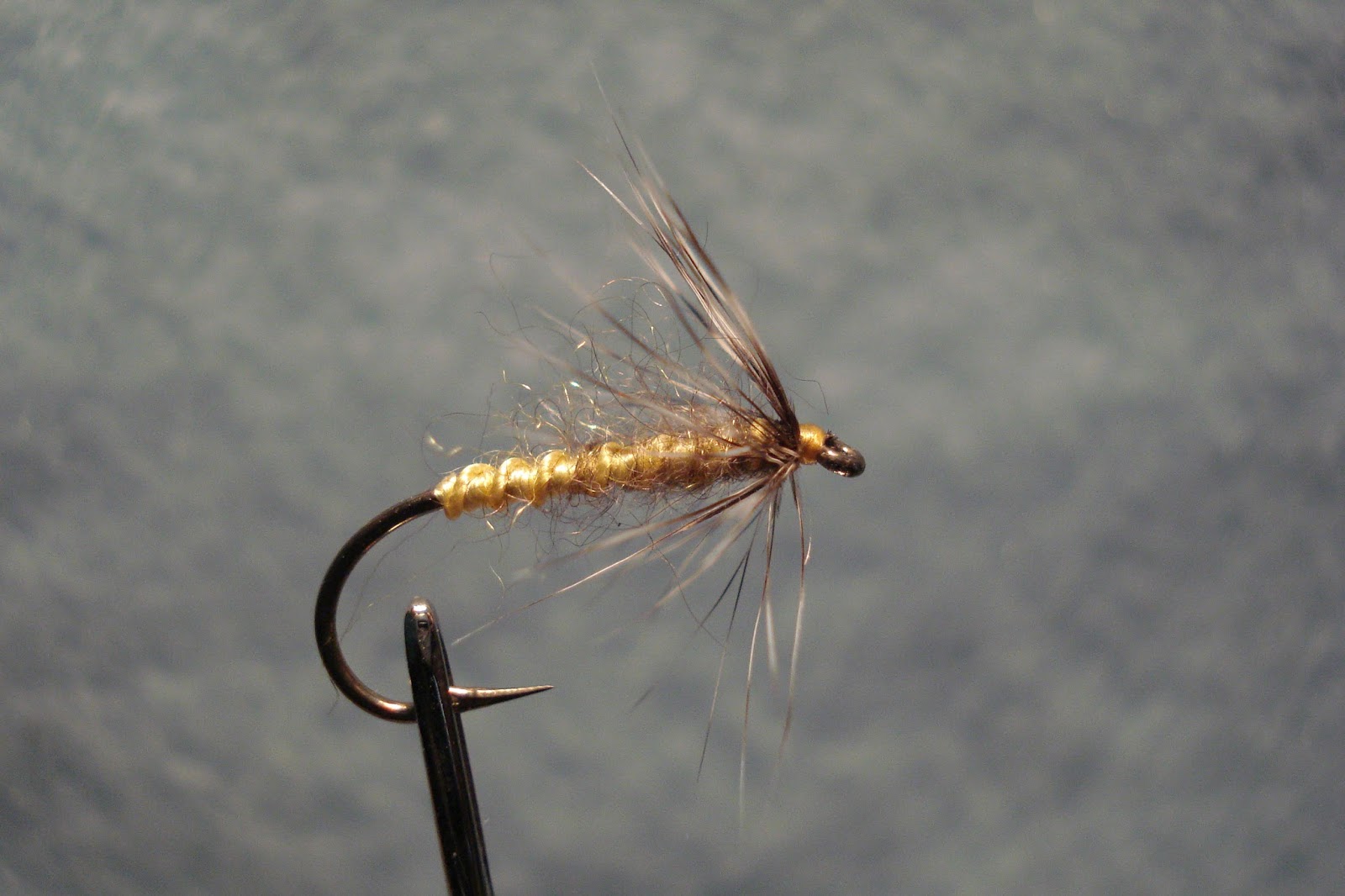
This dressing of the Stone Fly that Richard Bowlker describes in The Art of Angling (1757) departs from the general rule of the blog and uses a size 10 hook instead of a size 14. It also substitutes a blend of beaver fur and golden stonefly antron dubbed on rib of silk buttonhole twist, which, when wet, would be an apt substitute for Bowlker's “body with dark brown mohair, mixed with dirty yellow.”

Hook:

6-10
Thread:

Wood Duck
Body:

Silk button hole twist – Belding-Corticelli 3715 bamboo, size D
Rib:

Silk button hole twist – Belding-Corticelli 3715 bamboo, size D dubbed with an equal blend of beaver fur and golden stonefly antron
Hackle:

Grizzly cock


In a discussion of stoneflies in his Fly Fishing: The North Country Tradition (1996), Leslie Magee suggests that “of all the flies imitated by the flyfisher, the larger stoneflies are the least familiar; few of the that I meet on the riverside have ever handled a ‘creeper’ (the nymph or larvae) or an adult stonefly,” and that bait fishing with the stonefly was more common. While the popularity of bait fishing with the stonefly has passed, Magee points out that it was still popular in T. E. Pritt’s time, “when fishing the live creeper and the adult stonefly cast upstream was all the rage on several North Country rivers.” Despite Magee's assertion that the popularity of bait fishing with stoneflies had waned by the early twentieth century, Harfield Edmonds and Norman Lee devoted a chapter to it in their Brook and River Trouting (1916); “20 years after the publication of Brook and River Trouting upstream fishing with the creeper and live stonefly was virtually extinct” due to developments in angling gear and fly fishing methods.

Nevertheless, historical angling authors give testament to Magee’s assertion that fishing stone flies as bait was a centuries old practice, much like fishing nymphal and mature Green Drakes. John Kirkbride, for instance, expresses this preference in his Northern Angler (1837): the Stone Fly, “on a hot day, is a most destructive bait for trout,” and it “is seldom used as an artificial fly; for it is best to dab with it after it takes wing. It is here called the May-fly.” Michael Theakston likewise notes in his List of Natural Flies (1843), that the stone fly, the “Imperial Empress of all trout flies,” is “in general fished natural.” “After sunset she comes out,” he notes, “for her enjoyments are chiefly in the dusk and twilight of night and early morn; the whole family are then in motion—flying about—running among the stones, and paddling upon the waters.” Theakston explains that, to fish the stone fly successfully, the angler must “move, unseen, with easy motion up the stream, and dab the fly with precision on the eddies behind stones, or other places of succour where the trout takes his station; or let it glide free and natural down the current over his likely haunts; never drag it against the stream (unnatural for any fly) or suffer it to drown; but succour and recover it by easy lifts and gentle jerks, to keep it on the water alive and dry, for a dead fly hanging at the hook like a piece of wet moss, will not be taken on the top.” Theakston regards fishing the stone fly as an artificial as “a true trier of skill, and probably the best test of the general merits of the flyfisher. Each rustic craftsman along the banks of the winding streams, where the true art and science of flyfishing is best known and practised, greet with glee the presence of the stone fly.”

In the third edition of his Modern Trout Fishing (1950), some twenty-five years after bait fishing the stonefly went extinct, in Magee’s account, Roger Woolley emphasized how often the stone fly is fished as a natural, noting that “it is more used in its natural state than as an artificial. It is called the Mayfly on the north country rivers, where it hatches out in great numbers.” Woolley points out that “it is not always easy to procure a sufficient number of the natural flies for a day’s fishing, and then the artificial has to be resorted to, but the stone fly anglers prefer the natural fly is procurable.” He goes on to list eighteen dressings for smaller stoneflies, including five soft hackles like the Winter Brown that he attributes to the North Country tradition.

Although Woolley’s dressings are almost evenly split between winged and corresponding hackled versions, historical stone flies patterns were most often winged dressings. John Jackson’s Practical Fly-Fisher (1854) includes a winged stone fly, no. 32, the May-Fly, but notes that the fly is “generally fished natural, being large enough to swim a good sized hook, or two smaller ones tied double.” Theakston’s dressing is also winged, as is the Stone Fly that William Blacker includes in his Art of Angling (1843). Kirkbride, Alfred Ronalds in The Fly-fisher’s Entomology (1837), and John Turton’s Angler’s Manual (1836) provide dressings that seem to derive from sixteenth- and seventeenth-century antecedents that John Waller Hills describes in A History of Fly Fishing for Trout (1921).

Hills lists the Stonefly as one of the twelve most important flies to anglers, giving a brief account of early dressings from Dame Julianna Berner’s A treatyse of fysshynge wyth an Angle (1496) to Charles Cotton’s 1676 additions to Izaak Walton’s Compleat Angler (1657). Hills points out that the Stonefly “has changed neither in name nor in dressing. It is quite unmistakeable, a fat, stupid, clumsy clown, better at running than flying. The Treatise is as follows: ‘The stone fly, the body of black wool and yellow under the wing and under the tail, and the wings of the drake.’ Markham as usual makes the dressing more definite: the yellow under wings and tail is to be made with yellow silk and the wings are of a drake's down, not the quill feather. Cotton knew the fly well and gives an excellent account of its history: he made the body of dun bear's hair and brown and yellow camlet well mixed, making your fly more yellow on the belly and towards the tail, two or three hairs of a black cat's beard for tail, and long, very large wings of grey mallard. Though we use different furs from Cotton, his body survives unchanged in essence: but a hen pheasant's quill feather makes a truer wing than light mallard, and we like to add a hackle, either blue dun or greenish. But the changes are immaterial.”

Part of the “excellent account” that Hills attributes to Cotton includes a description of the Stone-Flies’ unique manner of hatching and eagerness of the trout to feed on them: “This same Stone-Flie has not the patience to continue in his Crust, or Husk till his wings be full grown, but so soon as ever they begin to put out, that he feels himself strong (at which time we call him a Jack) squeezes himself out of Prison, and crawls to the top of some stone, where he can find a chink that will receive him, or can creep betwixt two stones, the one lying hollow upon the other (which, by the way, we also lay so purposely to find them) he there lurks tills his wings be full grown, and there is your only place to find him (and from thence doubtless he derives his name) though, for want of convenience, he will make shift with the hollow of a Bank, or any other place where the wind cannot come to fetch him off.” Cotton notes that anglers often “dape or dibble” the natural Stone-Flie, “as with the [Green] Drake” and that fishing the fly is “much better toward 8, 9, 10 or eleven of the clock, at which time also the best fish rise, and the latter the better, provided you can see your Flie, and when you cannot, a made Flie will murder.”

In his Fly Fisher’s Guide (1816), George Bainbridge nods toward three traditions of fishing the stone fly. Not only is it “a deadly bait, used in the natural state,” but it is dressed after the fashion of Cotton's and Berners' precedent, winged and with a bear fur body. Brainbridge notes that it is also dressed as a hackled pattern, with “a long-fibred grizzled hackle from a cock’s back, without wings.” This latter dressing specifically recalls the Stone Flies of Richard Bowlker and his son Charles. Richard Bowlker provides a simple, soft hackle dressing for the Stone Fly in his Art of Flyfishing (1757). He describes the insect as “a large four-winged fly; bred from an insect in the water, called the water cricket; to be found in stony, gravelly brooks, or rivers; his belly is of a dirty yellow, his wings of a fine blue color, full of small veins, so that he is best made with a fine blue grizzle cock’s hackle; the body with dark brown mohair mixed with a dirty yellow.” Charles Bowlker offers a similar dressing in his 1776 edition, though its description reads more like a palmer: “This fly is made of the brown feather of a hen. His belly is of a dirty yellow and his back of the dark brown. His body is made of a yellow or brown spaniel’s hair, or Mohair, with the grizzled hackle of a cock around it.”


Breaking with the usual size 14 hook size for the blog, this dressing uses a 4x bait hook. It substitutes a cree hackle for the brown and grizzly hackles Charles Brooks requires.


Stonefly dressings are the stock-in-trade of modern American anglers, though they are often involved dressings. A notable exception is Charles Brooks' Montana Stonefly nymph. Brooks famously dressed heavily-weighted nymphal patterns “in the round” for fishing deep, boulder-studded pocket water of the western trout streams he favored—much like the water Theakston and the Bowlkers reference—and he described his methods of fishing and dressing them in Nymph Fishing for Larger Trout (1976). Though it is a bit of a stretch, many, such as his Montana Stone Fly, are essentially soft hackles or flymphs, not far removed in form the Hare's Ear Flymph that Dave Hughes describes in Wet Flies (1995). This fly recalls the Bowlkers own dressing, though it is unlikely Brooks had access to their books. Brooks dressed his Montana Stone on long, heavy wire hooks in sizes 4 to 8 and weighted them heavily in order to represent the “Pteronarcys genus of stoneflies, especially P. californica,” also known as the Giant Salmon Fly Nymph, a must different stone fly than the one Alfred Ronalds describes: a fly hatching from “the beginning of April until the end of May,” of the “Order, Neuroptera. Family, PerlidÅ“. Genus, Perla. Species, Bicaudata.” Ronalds' stonefly is likely much more closely related to the fly Ernest Schwiebert describes in Nymphs (1973) as Perla Capitata, the Great Stonefly Nymph, Art Flick's Stonefly Creeper. Brooks’ Montana Stone is somewhat more complicated to dress than the Bowlkers:

“Tail: Six fibers of raven or crow primary.
Rib: Copper wire.
Body: Black fuzzy yarn, four strand.
Hackle: One grizzly saddle and one grizzly dyed dark brown. Strip hackles off lower hackles before tying in.
Gills: Light gray or white ostrich herls.
Thread: Black nymo 3/0.”

Brooks directs fly tiers to: “Tie in thread at front, wind to bend. Lacquer shank. Tie in tail fibers and split to form forked tail, three fibers per side. Tie in ribbing and yarn. Wind thread forward, half hitch twice, and break off. Lacquer shank again. Wind yarn to eye, back to bend, forward to eye and back to base of thorax. Tie off, tying in thread at same time. Wind rib and tie off. Tie in one strand of ostrich herl, and both hackles by the butts. Strip fibers off lower side of both hackles. Wind two separated turns of hackle, one at the base of the thorax and another halfway between there and the eye. Both colors of hackle should lie one against the other. Tie off. Wind ostrich herl forward at the base of the hackles, tie off. Spiral thread forward and finish head large and lacquer well.”

Wednesday, August 24, 2016

Light Sedge; or, Light Dun

This dressing substitutes a mottled quail covert for "light-barred" landrail coverts and uses a red fox squirrel belly fur rather than the "reddish fur from the thigh of a squirrel."
Hook:

14-18
Thread:

Yellow
Body:

Red fox squirrel belly fur
Hackle:

Quail covert
Head:

Cock pheasant tail herl


In their Brook and River Trouting (1916), Harfield Edmonds and Norman Lee included the Light Sedge as a dressing for a June trichoptera that will fish well throughout the rest of the season. They dressed it with

“WINGS.—Hackled with a light-barred reddish feather, from the lesser coverts of a Landrail’s wing.
BODY.—Yellow silk, No. 4, dubbed with reddish fur from the thigh of a Squirrel.
HEAD.—A reddish herl from the tail of a cock Pheasant.”


Michael Theakston’s original dressing is variable enough to allow for a wide range of materials and substitutions. This dressing takes the following liberties: it uses burnt orange thread, Wapsi synthetic blend red fox squirrel belly fur for the body, and an American woodcock rump feather for the hackling.


Michael Theakston includes a dressing for the Light Dun in his List of Natural Flies (1843), which might correlate to the Light Sedge that Brooks and Lee list for June. Theakston’s Light Dun (a dun is a caddis or sedge in Theakston’s nomenclature) “commences hatching this month [April], and are plentiful in May in June, and again in autumn; but are out most in the dusk of evening.” Theakston’s insect is “the produce of the codbait,” a case-building caddis that constructs “artificial cases of some of the codbait tribe” with “small particles of vegetable substances mingled with those of stone, attached to them, which may impart a darker shade or freckle to the flies. The largest codbait creepers, when the case is covered with particles of stone only, produce the largest and lightest colored flies.”

Dressed in classic soft hackle style, rather than the winged pattern Theakstons preferred, the Light Dun is: “imitated with feathers from the landrail, brown owl, dotterel, brown hen, etcetera; with tawny, coppery colored silks, of lighter or darker shades.”

While it certainly was not dressed to match a British hatch, Ernest Schwiebert drew on the “little Scottish pattern called the Corncrake and Yellow” as the “basis for the accompanying pupal imitation for the accompanying pupal imitation of the Little Sand Sedge” he included in Nymphs (1973).The Little Sand Sedge American caddisfly that seems similar to those that historical British angling authors describe:

“Hook: Sizes 12-14 Mustad 3906 sproat
Nylon: Tan 6/0 nylon
Body: Pale dirty-yellowish dubbing
Thorax: Light brown dubbing
Wing cases: Light gray duck quill sections tied at sides
Antennae: Lemon woodduck fibers
Head: Tan nylon”

Wednesday, September 9, 2015

Willow or Withy Fly

This dressing uses yellow Pearsall's gossamer silk.
Hook:

14-18
Thread:

Yellow
Body:

Mole’s fur spun on yellow silk
Hackle:

A dark dun cock’s hackle strongly tinged a copper-colour


Alfred Ronalds lists the Willow (or Withy) Fly as no. 44, the last fly to be imitated during the regular season, in his Fly-Fisher’s Entomology (1836). He describes this diminutive stonefly—“Order, Neuroptera. Family, Perlidæ. Genus, Nemoura. Species, Nebulosa.”—as hatching in September and notes that "it is extremely abundant during this month and the next, and even later in the season. On very fine days it may be found on the water in February. It generally flutters across the stream, and is best imitated buzz fashion."

Publishing at the same time, John Turton lists the hatch of the Willow Fly in September and October. He dresses a hackled Willow Fly, no. 68, in the Angler’s Manual (1836) “with a yellow silk: wing, a blue grizzled cock’s hackle feather; body, blue squirrel’s fur and yellow down mixed, twisted on the silk. Best on cold stormy days.”


This dressing of John Jackson’s Small Willow Fly uses java Pearsall's gossamer silk and is dressed more heavily, in keeping with the illustrations of the natural and the pattern than Jackson includes on alternating plates.


John Jackson gives two dressings for the Willow Fly, no. 57 the Small Willow Fly and no. 58 the Large Willow Fly, in his Practical Fly-Fisher (1854). He dresses the Small Willow Fly “by wrapping a feather from the inside of a Snipe’s wing, or a small grizzled hackle, on a body of light brown silk, or Mole’s fur and yellow silk,” and, Jackson notes, the fly is “best on warm days.”

He dresses the Large Willow Fly as a winged wet with

“Wings.—Inside of Woodcock’s wing feather.
Body.—Moles fur spun on yellow silk.
Legs.—Brown Hackle.

This fly is well made by hackling a grizzled hackled of a copperish hue on the above body.”

This dressing substitutes blue rabbit underfur mixed with golden stone antron and dubbed on yellow Pearsall's gossamer silk as a substitute for the blue squirrel fur and yellow mohair body that Richard Bowlker recommends.


In Nymphs (1974), Ernest Schwiebert credits the Bowlkers with first offering a historical imitation for the Willow Fly, and he lauds the endurance of their identification and representation as a testament to their studies. Richard Bowlker’s Art of Angling (1758) describes the Willow Fly like Ronalds, noting that it “comes about the beginning of September, and continues till the latter end of October: He is a four-winged fly, and generally flutters upon the surface of the water: To be fished with in cold stormy days, being then most plentiful upon the water.” Richard Bowlker suggests a dressing with “wings made of a blue grizzled cock’s hackle, the body of the blue part of a squirrel’s fur, mixed with a little yellow mohair.”

In his revisions (1774) to his father’s original work, Charles Bowlker also points to the Willow Fly’s four wings as a distinguishing feature for the stonefly in late summer and autumn: “He has four wings which lie fly on his back: his belly of a dirty yellow, and his back of a dark brown.” To represent the Willow Fly, Charles gives a dressing with “wings made of a dun cock’s hackle a little freckled; his body of squirrel’s furr, ribbed with yellow silk, and covered lightly with the same coloured hackle as the wings.”

Under the heading “Stoneflies” in the third edition of Modern Trout Dressing (1950), Roger Woolley notes that the Willow Fly is synonymous with the Brown Owl, which shows up as no. 5 in T. E. Pritt’s North Country Flies (1886) and no. 11 in Harfield Brooks and Norman Lee’s Brook and River Trouting (1916). They dress these flies for April, May, and June, rather than September through October (and even through February) like Ronalds, Turton, and the Bowlkers. This suggests two different insects. More likely, Pritt, Edmonds, and Lee used the Waterhen Bloa, with its mole or muskrat body on yellow silk, to imitate the Willow Fly instead of the Brown Owl. Pritt, in particular, recommends the Waterhen Bloa as “indispensable during March and April, and again towards the latter end of the season”; Edmonds and Lee specifically prescribe its usefulness from “March to end of April, and again in September.”

John Kirkbride includes a Willow Fly in the North-Country Angler (1837), noting that its emergence coincides with the Yellow Dun in May and June. The stonefly he dubs the Willow Fly seems much more like a Yellow Sally - an insect and imitation that Kirkbride does not include in the text - than the later season stonefly that Richard Bowlker described almost a century earlier as a Willow Fly. Kirkbride’s Willow Fly is “a very delicate-looking fly, and the trout are very fond of it, particularly in the evenings. The body is of a delicate transparent yellow colour, with a greenish or olive shade; it must be ribbed with gold-coloured silk,” and “when it is made as a spider, a feather from the breast of the yellow plover must be used.”

Wednesday, November 19, 2014

Gray Caddis Larva


This pattern has been dressed after the fashion of a soft hackle rather than in a larval form, Sens-style, and it uses silver wire rather than oval tinsel.

Hook:

8-16
Thread:

Dark brown
Rib:

Fine oval tinsel or wire
Body:

Dark grayish muskrat fur dubbing
Thorax:

Dark brown fur dubbing
Hackle:

Dark partridge hackle fibers


In Nymphs (1973), Ernest Schwiebert prescribes many soft-hackled flies or flies based on traditional soft hackles to imitate caddis flies in general. He explains that the “Gray Caddis Larva is an extremely versatile pattern in all sizes, and both [the Gray and Yellow Caddis Larvae discussed alongside the Gray] are fine imitations of the Hydropsyche flies."

Wednesday, November 5, 2014

Grouse and Green

This dressing follows one of John Kirkbride's dressings for the Grouse Hackle, assigning a particular silk and thread. 

Hook:

14-18
Thread:

Olive dun
Body:

Olive Pearsall's Gossamer Silk
Hackle:

Grouse back


Because of Ernest Schwiebert’s reference to the Grouse and Green as a “traditional Yorkshire pattern” in Nymphs (1973), the pattern might presumably figure into multiple historical texts on North Country fly dressing. Schwiebert makes frequent reference to North Country and Scottish soft-hackled flies in the development of modern techniques for dressing nymphal patterns. He attributes the success of those patterns to the brawling waters of Scotland and the North Country where anglers dressed and fished them. Such waters are home to many species of caddis flies, which, Schwiebert argues, provides an imitative corollary that accounts for the success of the flies. Of the three times he references the Grouse and Green, he attributes it to W. C. Stewart, but Stewart makes no reference to a soft-hackled or spider Grouse and Green in his Practical Angler (1857). Later posthumous editions of Stewart’s book include color plates that depict a Grouse and Green which is a much more heavily-dressed wet fly than the characteristically “dour patterns” which Schwiebert suggests must have “filled his [Stewart's] fly books.”

Schwiebert gives a dressing for the Medium Dark-Olive Sedge based on the Grouse and Green which he has “modified” in order “to imitate . . . olive-bodied Macronema flies," which he discusses in his chapter on Trichoptera: “W. C. Stewart used an [this] ancient border pattern to imitate similar caddis flies on his beloved Whiteadder, Teviot, and Tweed.”

Schwiebert’s misattribution is easy—the Grouse and Green does not seem to be mentioned anywhere - Roger Woolley only pairs grouse with claret, yellow, and orange silk in his Modern Trout Flies (1950) -though the hackle and body combination does in a few very specific instances appear under dressings for the Grouse Hackle. Typically, soft-hackled patterns using grouse hackles also use an orange body, as in the Grouse Hackle that William Blacker includes in his Art of Angling (1843). Blacker also includes dressings for a Partridge or Grouse Hackle utilizing different furs for bodies. One variation calls for a “Body—hare’s ear fur mixed with olive mohair” to create a green effect. It also includes a starling wing.

In the Northern Angler (1837), John Kirkbride also includes various dressings for the Grouse Hackle, one of which is illustrated above as the Grouse and Green: “It is made as a hackle, with a small bright mottled feather from the back of a cock grouse, with a dusky yellow or olive body.”

Wednesday, July 2, 2014

Small Ant; and, Black Ant; etc.


This dressing for T. E. Pritt's Small Ant Fly, No. 58, substitutes a reddish-brown hen for the tomtit's tail Pritt recommends.

Hook:

12-18
Thread:

Orange
Body:

Peacock herl, tied large fore and aft
Hackle:

Reddish-brown (furnace) hen with a black list


Ant patterns have historically been popular with anglers, presumably because they are effective dressings and relatively easy to dress. The Mid-Season 1978 issue of Fly Fisherman magazine included an article entitled “Ants,” a deceptively simple title for a comprehensive treatment of the insect. Author Ernest Schwiebert examines the ant’s “structural morphology” and asserts, tongue-in-cheek perhaps, that the “angler fully prepared to match ant forms on most American rivers must have 40-odd patterns in his bag of tricks" that range widely in size, from the size 28 Minute Black Ant (Monomorium ergatogyna) to  the size 10 Giant Carpenter Ant (Camponotus occidentalis), and in color, from black to brown to red to red-brown to hot orange to yellow to pinkish-red fox to whatever best matches the nuance of different species’ gasters, pedicels, and legs. 

Most anglers before Schwiebert and since (and likely into perpetuity) have preferred simpler criteria for delineating the wide variety of ant species: black or red and winged or wingless. 

British angling-authors often focused on winged ants, and used a range of materials to form the body, although they were most commonly peacock or ostrich herl. The wingless pattern shown above is the Small Ant, No. 52 that T. E. Pritt includes in  North-Country Flies (1886):

“WINGS.—Hackled with a feather from a Tomtit’s tail.
BODY AND HEAD.—A bright brownish peacock’s herl; body dressed full, as shown in the plate.”

Plate 10 for June and July shows a dressing that mimics the typical dressing for an ant—a larger body and smaller head separated by hackle. Pritt notes that the pattern “is best on hot days in July and August. The natural fly is abundant on almost every English river, and the artificial fly is alluded to by most writers. It will now and then do great execution, particularly after a flight of ants.” Harfield Edmonds and Norman Lee include an almost identical dressing in their Brook and River Trouting (1916), but they place the hackle  just behind the eye, a position more typical of historical soft-hackled flies than the mid-shank dressing.

Pritt also includes a Large Ant, No 58, which is a winged dressing, much more in the traditional style of ant patterns. It retains the fore-and-after body style, but hackles the fly at the front of the hook, under a wing that extends beyond the aft section of the body. The vast majority of ant patterns are dressed for winged ants, often utilizing a peacock or fur body. John Jackson gives a dressing for the Black and Red Ant, Nos. 44 and 45, in The Practical Angler (1854). His dressing for the Red Ant is unique in that it calls for the “Herl of Cock Pheasant’s tail” to be used for the body, and in the Art of Angling (1843), William Blacker includes a dressing for a body with “Black mohair.”  In his List of Natural Flies (1843), Michael Theakston also includes dressings for the Red Ant Fly, No. 77—which he recommends to anglers with “the scriptural mandate: ‘Go to the Ant, etc.’”—and the Black Ant Fly, No. 80. Theakston dresses the latter uniquely: “Wings, a silvery grizzle cock’s hackle; dark, blood red or black silk, well waxed, for body, etc.; with a few fibres of dark red mohair at the breast, for legs.”  John Kirkbride, on the other hand, offers fairly traditional dressings for the Red Ant Fly and the Black Ant Flies with bodies of peacock or black ostrich, respectively, in The Northern Angler (1837). John Turton, too, dresses a traditional, winged Red Ant Fly, No. 10 in The Angler’s Manual (1836).

Alfred Ronalds includes a dressing for the Red and Black Ant, No. 36, in The Fly Fisher’s Entymology (1836) that combines the body materials to dress the Black Ant:

This dressing omits the starling wing, but maintains the placement of the hackle that Ronalds depicts on color plate XVI his book. Since he does not prescribe a thread color, this dressing maintains the  color given for the red ant, even though wine or black would seem more appropriate.


Ronalds gives this dressing for the Black Ant: “THE BLACK ANT is made of peacock’s herl, and black ostrich mixed, for the body. Wings from the darkest part of the starling’s wing, and legs a black cock’s hackle.

An ant pattern is also listed as the Aunt Flie, No. 22, in John Swarbrick’s List of Wharfedale Flies (1807), which Leslie Magee reprints in Fly Fishing: The North Country Tradition (1994). Swarbrick’s pattern calls for the same body and winging materials as Pritt’s ant patterns, but peacock is first listed as a body material for red ants in Charles Bowlker’s Art of Angling (1774). Both Charles’ edition and his father Richard’s (1758), utilize black ostrich for the body of the black ant. Richard, however, preferred a body dubbed with “hog’s down, died of an amber colour” for the red ant, which seems an heir to the “dubbing of brown and red Camlet mixt” for dressing the  “flying Ant, or Ant-flie” that Charles Cotton July in his 1676 additions to the Compleat Angler.


Wednesday, December 18, 2013

Canon Fly; or, Down-hill Fly; later, the Oak Fly; and, the Down Looker

This dressing assigns a specific thread to the pattern, substitutes ruffed grouse tail for bittern (a protected species in the United States and Great Britain) and an American woodcock covert for hackle instead of wings.

Thread:

Burnt Orange
Abdomen:

Light orange and brown barred grouse tail 
Hackle:

Woodcock covert 


Both versions of the Art of Angling include dressings for the Canon Fly Richard Bowlker’s dressing (1758) for the Canon Fly lists two ingredients: “His wings are made of the feather out of a woodcock’s wings; and his body of a bittern’s feather.” The natural, he explains, “is to be found on the butts of oaks, and other trees near the water-side, with his head commonly downwards; for which reason he has generally obtained the name of the Down-hill fly.” He believed that the fly was “bred in the balls that grow on the boughs of large oaks, commonly called oak apples.” 


This dressing also substitutes ruffed grouse tail for bittern.


Charles Bowlker’s Art of Angling (1774) adds a head to the two ingredients his father originally included for the Canon Fly, and he changes the hackling: “His wings are made with a feather out of the wing with the partridge; his body with a bittern’s feather, the head with a little of the brown part of hare’s fur: The hook, No. 7.” He noted that the natural “comes about the sixteenth of May, and continues about a week in June, to be found in the buts of trees, with his head always downwards.”

 A cursory survey of modern angling literature suggests that the Canon Fly is less popular with anglers—Ernest Schwiebert, for instance, does not list the Canon Fly in Nymphs (1973) as one of the Bowlkers’ more enduring dressings—so the historical dressings of the Canon Fly here chronologically follow the Bowlkers’ in ascending order. The elder Bowlker lists many flies common to contemporary angling manuals that he held in low regard: “There are many other Flies taken notice of in some other treatises of angling, which may probably be of use in some rivers; the principal of which I shall just mention to satisfy the curiosity of my brother anglers; but I never think it worth while to make any of them artificially.” His son, Charles, repeats this list, and both make mention of the Oak Fly.

In The Angler’s Manual; or Fly-Fisher’s Oracle (1836), John Turton of Yorkshire lists a hackle he calls the Oak Fly, No. 34, which seems to be a dressing of the Canon Fly that the Bowlkers describe. Like their insect, the one he seeks to imitate hatches in May and his imitation, like the one advocated by Charles, uses partridge hackle in front of a dingy, orangish-yellow body similar to the bittern body that both Bowlkers use. Turton dresses it “with yellow silk: wing, partridge’s rump feather, without moon; body, yellow silk, ribbed with a strong black horse-hair, light brown down under wing.”

This dressing of Theakston’s Oak Fly (or downlooker) uses primrose Pearsall’s Gossamer Silk thread ribbed with silk buttonhole twist – Coats & Clark’s 184 rust, size D – for a the body and a speckled hen hackle, as Theakston suggests, in place of hackles and wings.


Michael Theakston lists the “Oak Fly (or downlooker)” as the 56th fly in his List of Natural Flies (1853) that is similar to the Bowlkers’ and Turton’s patterns. Theakston’s fly also hatches in the middle of May and is “a land fly, found often on the buts of oak, ash, or other trees; generally with their heads downwards.” He explains that the artificial is “dressed with various materials: wings from the woodcock or partridge; and winged and legged with a bittern hackle, or a yellow brown freckled hen; body, yellow or pale amber silk, with open rounds of deep red brown; shoulders, tinged with water-rat or squirrel’s ashy fur.”


This dressing of Jackson’s Down Looker substitutes a dark hare’s ear thorax for the woodcock wings Jackson prescribes, and it uses orange Pearsall’s Gossamer Silk for the body, ribbed with silk buttonhole twist – Talon 120, a lead color, size D.


John Jackson’s Practical Fly-Fisher (1853) lists the Down Looker, No. 21, as an imitation for an insect that hatches near the end of April on through June. In name and coloration, it is reminiscent of the Bowlkers’ Canon Flies. He dresses the Down Looker thus:

“Wings.—Feather from the inside of a Woodcock’s wing.
Body.—Orange and lead-coloured silk neatly ribbed.
Legs.—Hackle of Woodcock, or Grouse hen’s neck.
                    An excellent killer.”

Alfred Ronalds also lists the Canon Fly under its various names as No. 21 in his Fly-Fishers Entomology (1836). In Ronalds’ account, the insect is known as the “Downhill Fly, Oak Fly, Ash Fly, Cannon Fly, Downlooker, Woodcock Fly, Downhead Fly.” His description of the insects behaviors and hatch times is identical to the earlier descriptions in the Bowlkers. His dressing and Jackson’s are similar, apart from the palmered hackle:

BODY. Orange floss silk tied with ash-colour silk thread, which may be shewn at the tail and shoulders.
WINGS. From a feather of the woodcock.
LEGS. A furnace hackle, (i. e. a red cock’s hackle, with a black list up the middle, and tinged with black also at the extremities of the fibres). This should be warped all down the body, and the fibres snipped off again nearly up to where the wings are set on, leaving a sufficient quantity for the legs uncut off.”

Wednesday, August 14, 2013

The Welshman's Button; or, The Hazle Fly

This dressing of Richard Bowlker's Welshman's Button uses a blend of raw wool and synthetic in place of camel fur and ties the wing as a hackle.
Hook:

14-18
Thread:

Olive
Abdomen:

Natural brown wool – in this instance, the raw fleece of the Polworth breed
Hackle:

Dark, iridescent green pheasant from the neck


In his version of The Art of Angling (1758), Richard Bowlker describes the Welshman’s (Welchman's) Button; or Hazle Fly as one of the flies best for late July and situates the Large Black Ant Fly and the Little Red and Black Ant Flies. His dressing calls simply for a “wing [that] is made of dark hackle feather of a pheasant; and the body of the dark part of camel’s hair.”

This dressing uses wine thread, even though Charles Bowlker does not prescribe a particular color, and it also leaves off the partridge wing.


Charles Bowlker modified the Welshman’s Button for his additions to the 1786 version of The Universal Angler.

Hook:

16-18 (This fly, however, is dressed on a size 14 like all other flies on the Soft Hackle Pattern Book.)
Thread:

Wine
Abdomen:

2 peacock herls twisted with one strand of black ostrich herl, the fibers of which should be slightly longer than those of the peacock herls, , so that the ostrich creates a halo effect around the peacock
Hackle:

Black hackle


In his updates to his father’s treatise, Charles Bowlker gives this dressing for the Welshman’s Button, or Hazle Fly: “his wings are made with the red feather that grows upon the rump or tail of the partridge; the body is made with a peacock’s harle and an ostrich’s feather mixed, with a fine black cock’s hackle for the legs: The hook, No. 7” 

Charles Bowlker largely follows his father's etymological description of the terrestrial that the Welshman's Button is meant to imitate. Charles explains that the fly "comes about the latter end of July, and continues about nine or ten days; is in form like a round button, from which he derives his name; he has four wings, the uppermost husky and hard, the under most of a fine blue colour, soft and transparent; to be found upon hazle trees, or fern bushes: He is an excellent fly for bobbing at the bush, or long line, being rather difficult to make, upon account of his shape and form."

Later anglers where influenced by the Bowlkers’ dressings. Ernest Schweibert described these flies in his Nymphs (1973) as “surprisingly modern versions of standard patterns,” which “apparently began with the Bowlkers,” pointing out that “authorship of so many patterns that have survived for two centuries is an impressive feat.” In his Fly-Fisher’s Entomology (1836), Alfred Ronalds includes the Marlow Buzz as No. 30, giving Hazel Fly as an alternate name, as well as the “Coch-A-Bonddu, and Shorn Fly.” His color plate XIV depicts the insect as a beetle (though Schweibert reads it as a sedge), and he describes a dressing of the fly with an identical body to Charles Bowlker’s, except that he uses a palmered furnace hackle.