Showing posts with label Turton. Show all posts

Wednesday, June 7, 2017

Stone Fly; Stone Flye or Flie; and, the Montana Stonefly


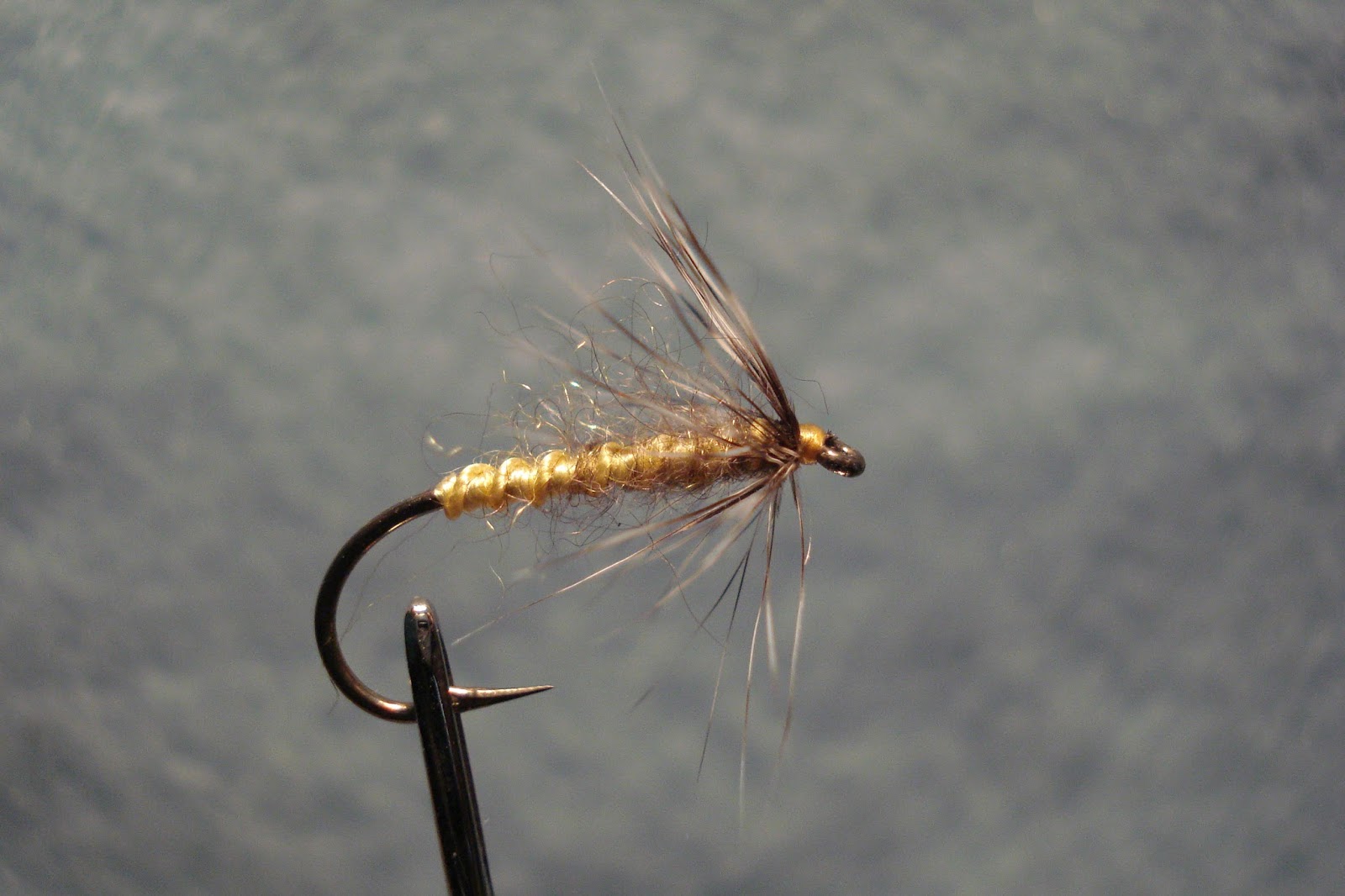
This dressing of the Stone Fly that Richard Bowlker describes in The Art of Angling (1757) departs from the general rule of the blog and uses a size 10 hook instead of a size 14. It also substitutes a blend of beaver fur and golden stonefly antron dubbed on rib of silk buttonhole twist, which, when wet, would be an apt substitute for Bowlker's “body with dark brown mohair, mixed with dirty yellow.”

Hook:

6-10
Thread:

Wood Duck
Body:

Silk button hole twist – Belding-Corticelli 3715 bamboo, size D
Rib:

Silk button hole twist – Belding-Corticelli 3715 bamboo, size D dubbed with an equal blend of beaver fur and golden stonefly antron
Hackle:

Grizzly cock


In a discussion of stoneflies in his Fly Fishing: The North Country Tradition (1996), Leslie Magee suggests that “of all the flies imitated by the flyfisher, the larger stoneflies are the least familiar; few of the that I meet on the riverside have ever handled a ‘creeper’ (the nymph or larvae) or an adult stonefly,” and that bait fishing with the stonefly was more common. While the popularity of bait fishing with the stonefly has passed, Magee points out that it was still popular in T. E. Pritt’s time, “when fishing the live creeper and the adult stonefly cast upstream was all the rage on several North Country rivers.” Despite Magee's assertion that the popularity of bait fishing with stoneflies had waned by the early twentieth century, Harfield Edmonds and Norman Lee devoted a chapter to it in their Brook and River Trouting (1916); “20 years after the publication of Brook and River Trouting upstream fishing with the creeper and live stonefly was virtually extinct” due to developments in angling gear and fly fishing methods.

Nevertheless, historical angling authors give testament to Magee’s assertion that fishing stone flies as bait was a centuries old practice, much like fishing nymphal and mature Green Drakes. John Kirkbride, for instance, expresses this preference in his Northern Angler (1837): the Stone Fly, “on a hot day, is a most destructive bait for trout,” and it “is seldom used as an artificial fly; for it is best to dab with it after it takes wing. It is here called the May-fly.” Michael Theakston likewise notes in his List of Natural Flies (1843), that the stone fly, the “Imperial Empress of all trout flies,” is “in general fished natural.” “After sunset she comes out,” he notes, “for her enjoyments are chiefly in the dusk and twilight of night and early morn; the whole family are then in motion—flying about—running among the stones, and paddling upon the waters.” Theakston explains that, to fish the stone fly successfully, the angler must “move, unseen, with easy motion up the stream, and dab the fly with precision on the eddies behind stones, or other places of succour where the trout takes his station; or let it glide free and natural down the current over his likely haunts; never drag it against the stream (unnatural for any fly) or suffer it to drown; but succour and recover it by easy lifts and gentle jerks, to keep it on the water alive and dry, for a dead fly hanging at the hook like a piece of wet moss, will not be taken on the top.” Theakston regards fishing the stone fly as an artificial as “a true trier of skill, and probably the best test of the general merits of the flyfisher. Each rustic craftsman along the banks of the winding streams, where the true art and science of flyfishing is best known and practised, greet with glee the presence of the stone fly.”

In the third edition of his Modern Trout Fishing (1950), some twenty-five years after bait fishing the stonefly went extinct, in Magee’s account, Roger Woolley emphasized how often the stone fly is fished as a natural, noting that “it is more used in its natural state than as an artificial. It is called the Mayfly on the north country rivers, where it hatches out in great numbers.” Woolley points out that “it is not always easy to procure a sufficient number of the natural flies for a day’s fishing, and then the artificial has to be resorted to, but the stone fly anglers prefer the natural fly is procurable.” He goes on to list eighteen dressings for smaller stoneflies, including five soft hackles like the Winter Brown that he attributes to the North Country tradition.

Although Woolley’s dressings are almost evenly split between winged and corresponding hackled versions, historical stone flies patterns were most often winged dressings. John Jackson’s Practical Fly-Fisher (1854) includes a winged stone fly, no. 32, the May-Fly, but notes that the fly is “generally fished natural, being large enough to swim a good sized hook, or two smaller ones tied double.” Theakston’s dressing is also winged, as is the Stone Fly that William Blacker includes in his Art of Angling (1843). Kirkbride, Alfred Ronalds in The Fly-fisher’s Entomology (1837), and John Turton’s Angler’s Manual (1836) provide dressings that seem to derive from sixteenth- and seventeenth-century antecedents that John Waller Hills describes in A History of Fly Fishing for Trout (1921).

Hills lists the Stonefly as one of the twelve most important flies to anglers, giving a brief account of early dressings from Dame Julianna Berner’s A treatyse of fysshynge wyth an Angle (1496) to Charles Cotton’s 1676 additions to Izaak Walton’s Compleat Angler (1657). Hills points out that the Stonefly “has changed neither in name nor in dressing. It is quite unmistakeable, a fat, stupid, clumsy clown, better at running than flying. The Treatise is as follows: ‘The stone fly, the body of black wool and yellow under the wing and under the tail, and the wings of the drake.’ Markham as usual makes the dressing more definite: the yellow under wings and tail is to be made with yellow silk and the wings are of a drake's down, not the quill feather. Cotton knew the fly well and gives an excellent account of its history: he made the body of dun bear's hair and brown and yellow camlet well mixed, making your fly more yellow on the belly and towards the tail, two or three hairs of a black cat's beard for tail, and long, very large wings of grey mallard. Though we use different furs from Cotton, his body survives unchanged in essence: but a hen pheasant's quill feather makes a truer wing than light mallard, and we like to add a hackle, either blue dun or greenish. But the changes are immaterial.”

Part of the “excellent account” that Hills attributes to Cotton includes a description of the Stone-Flies’ unique manner of hatching and eagerness of the trout to feed on them: “This same Stone-Flie has not the patience to continue in his Crust, or Husk till his wings be full grown, but so soon as ever they begin to put out, that he feels himself strong (at which time we call him a Jack) squeezes himself out of Prison, and crawls to the top of some stone, where he can find a chink that will receive him, or can creep betwixt two stones, the one lying hollow upon the other (which, by the way, we also lay so purposely to find them) he there lurks tills his wings be full grown, and there is your only place to find him (and from thence doubtless he derives his name) though, for want of convenience, he will make shift with the hollow of a Bank, or any other place where the wind cannot come to fetch him off.” Cotton notes that anglers often “dape or dibble” the natural Stone-Flie, “as with the [Green] Drake” and that fishing the fly is “much better toward 8, 9, 10 or eleven of the clock, at which time also the best fish rise, and the latter the better, provided you can see your Flie, and when you cannot, a made Flie will murder.”

In his Fly Fisher’s Guide (1816), George Bainbridge nods toward three traditions of fishing the stone fly. Not only is it “a deadly bait, used in the natural state,” but it is dressed after the fashion of Cotton's and Berners' precedent, winged and with a bear fur body. Brainbridge notes that it is also dressed as a hackled pattern, with “a long-fibred grizzled hackle from a cock’s back, without wings.” This latter dressing specifically recalls the Stone Flies of Richard Bowlker and his son Charles. Richard Bowlker provides a simple, soft hackle dressing for the Stone Fly in his Art of Flyfishing (1757). He describes the insect as “a large four-winged fly; bred from an insect in the water, called the water cricket; to be found in stony, gravelly brooks, or rivers; his belly is of a dirty yellow, his wings of a fine blue color, full of small veins, so that he is best made with a fine blue grizzle cock’s hackle; the body with dark brown mohair mixed with a dirty yellow.” Charles Bowlker offers a similar dressing in his 1776 edition, though its description reads more like a palmer: “This fly is made of the brown feather of a hen. His belly is of a dirty yellow and his back of the dark brown. His body is made of a yellow or brown spaniel’s hair, or Mohair, with the grizzled hackle of a cock around it.”


Breaking with the usual size 14 hook size for the blog, this dressing uses a 4x bait hook. It substitutes a cree hackle for the brown and grizzly hackles Charles Brooks requires.


Stonefly dressings are the stock-in-trade of modern American anglers, though they are often involved dressings. A notable exception is Charles Brooks' Montana Stonefly nymph. Brooks famously dressed heavily-weighted nymphal patterns “in the round” for fishing deep, boulder-studded pocket water of the western trout streams he favored—much like the water Theakston and the Bowlkers reference—and he described his methods of fishing and dressing them in Nymph Fishing for Larger Trout (1976). Though it is a bit of a stretch, many, such as his Montana Stone Fly, are essentially soft hackles or flymphs, not far removed in form the Hare's Ear Flymph that Dave Hughes describes in Wet Flies (1995). This fly recalls the Bowlkers own dressing, though it is unlikely Brooks had access to their books. Brooks dressed his Montana Stone on long, heavy wire hooks in sizes 4 to 8 and weighted them heavily in order to represent the “Pteronarcys genus of stoneflies, especially P. californica,” also known as the Giant Salmon Fly Nymph, a must different stone fly than the one Alfred Ronalds describes: a fly hatching from “the beginning of April until the end of May,” of the “Order, Neuroptera. Family, PerlidÅ“. Genus, Perla. Species, Bicaudata.” Ronalds' stonefly is likely much more closely related to the fly Ernest Schwiebert describes in Nymphs (1973) as Perla Capitata, the Great Stonefly Nymph, Art Flick's Stonefly Creeper. Brooks’ Montana Stone is somewhat more complicated to dress than the Bowlkers:

“Tail: Six fibers of raven or crow primary.
Rib: Copper wire.
Body: Black fuzzy yarn, four strand.
Hackle: One grizzly saddle and one grizzly dyed dark brown. Strip hackles off lower hackles before tying in.
Gills: Light gray or white ostrich herls.
Thread: Black nymo 3/0.”

Brooks directs fly tiers to: “Tie in thread at front, wind to bend. Lacquer shank. Tie in tail fibers and split to form forked tail, three fibers per side. Tie in ribbing and yarn. Wind thread forward, half hitch twice, and break off. Lacquer shank again. Wind yarn to eye, back to bend, forward to eye and back to base of thorax. Tie off, tying in thread at same time. Wind rib and tie off. Tie in one strand of ostrich herl, and both hackles by the butts. Strip fibers off lower side of both hackles. Wind two separated turns of hackle, one at the base of the thorax and another halfway between there and the eye. Both colors of hackle should lie one against the other. Tie off. Wind ostrich herl forward at the base of the hackles, tie off. Spiral thread forward and finish head large and lacquer well.”

Wednesday, April 5, 2017

Black with Red

This dressing uses black antron for the thorax rather than the “black down,” presumably felted rabbit fur from a hat, in the original dressing. It also substitutes crow shoulder for black hen neck.

Hook:

12-16
Thread:

Red Pearsall’s gossamer silk
Abdomen:

Embroidery thread – DMC 310 black
Thorax:

Black antron
Hackle:

Crow shoulder


John Turton lists the Black with Red as a hackle for “all the season,” no. 28 the second list he includes in The Angler’s Manual (1836). He dresses it “with red silk: wing, black hen’s feather from neck; body, black silk at tail, and black down close under wing.”

Black down is a material Turton recommended that every fly tier keep in a “dubbing  or down book,” which “must be made of a few leaves of parchment sewed separately to the outside leaves, to give room to shut when the downs are put in, which must be done by cutting them across with small pointed scissors, about a quarter of an inch from each other; then the pieces through it;  this will hold them fast and the leaves maybe turned over as to find any color wanted. Small pockets must be made at each end” for the furs with “no skin attached to them.” When Turton assigns “black down” to a dressing, he is apparently referring to the black down he would include in a down book, “from the best stuff hats,” rather than a down feather or after shaft.

The combination of red thread, a black body, and black hackle recalls the James Leisenring’s dressing of the Black Gnat in The Art of Tying the Wet Fly and Fishing the Flymph (1941).

Wednesday, November 2, 2016

Red Shiner Fly

This dressing substitutes American woodcock covert for British woodcock and the same peacock herl for the rib as the head. 

Hook:

10-14
Thread:

Orange
Rib:

Peacock herl
Body:

Burnt orange Madeira Classic Color rayon embroidery thread, 1021
Hackle:

American woodock covert
Head:

Peacock herl


John Turton describes the Red Shiner Fly as no. 31 in his Angler’s Manual (1836). He notes that it is "For April: made with orange silk: wing, red woodcock’s feather from butt end of wing; body, light bright orange silk, ribbed with green peacock’s feather; and peacock's head."  He also notes that the fly is a " good killer after rains." 

Turton also describes variant dressings: "It  changes these colours: -  if there be bright days, the red owl'sfeather, from butt end up wing, is used for wings; if a dark day, the brown owl's feather must be used from outside of wing; if clear low water, the partridge's rump feather is best."

Wednesday, July 13, 2016

Waspe Flye; Wasp-flie; Wasp Fly; the Bee

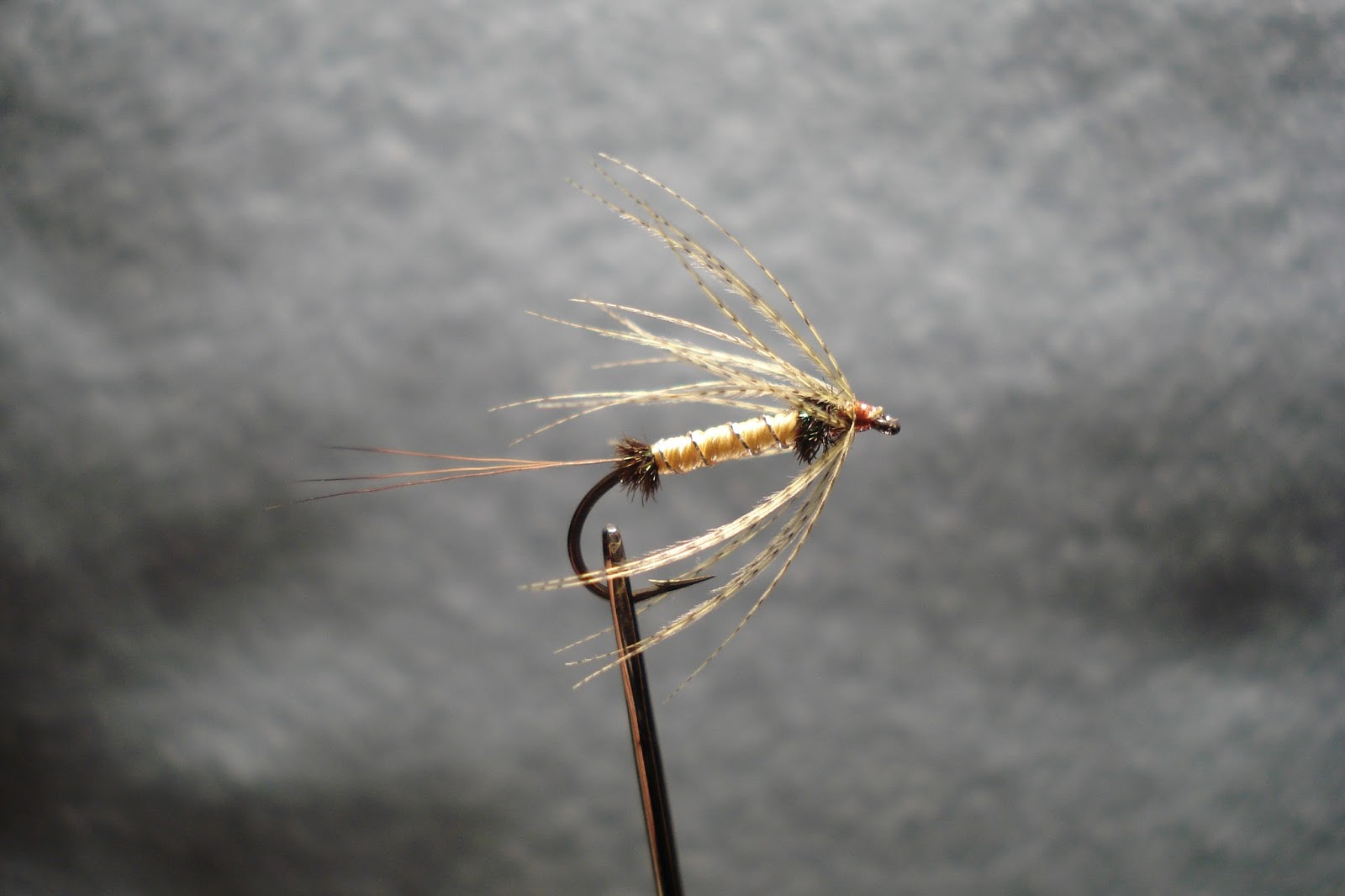
This dressing substitutes a grizzly hackle for raptor hackle and assigns silk button hole twist for the ribbing, as well as the yellow tying thread for dressing the fly overall.
Hook:
10-14
Thread:
Yellow
Rib:
Silk buttonhole twist, Coat's & Clarks 223 yellow, size D
Body:
Raw Black Welsh Mountain wool
Hackle:
Dingy dun grizzle hackle

Flies tied to mimic bees are immediately recognizable date as far back as historical dressings like the Brown Hackle. Dressings of wasps and bees, like many terrestrial flies, tend more toward generalization than flies tied to represent water-born insects. However flawed the assumption might be, fly tiers seem to think trout will respond better to a strict representation of insects they see underwater all the time, but only need a suggestive pattern to represent terrestrials. Whereas dressings of the Small Ant or Black Ant focus on a pronounced thorax and abdomen, and beetle dressings like the Bracken Clock assign iridescent peacock herl to suggest wing cases and abdomens, wasp and bee dressings typically focus on two key traits, the insect's abdominal barring and its wing coloration. This focus has not changed much since the late middle ages. Dame Julianna Berner’s A treatyse of fysshynge wyth an Angle (1496), for instance, provides an early instance of such considerations: “The body of blacke wull & lappid abowte wt yellow thread: the winges of the bosarde.”

In Part II of The Compleat Angler (1676), Charles Cotton includes a very similar Wasp-flie as the third dressing for July: “We have likewise this month a Wasp-flie, made either of a black Cats tail, ribb’d about with yellow silk, and the wing of the grey feather of a Mallard.” Likewise, John Turton includes a hackled dressing of the Wasp Fly in his Angler’s Manual (1836), which he also dresses for July: “made with light brown silk: wing, starling’s underwing feather; body, brown bear’s   hair, ribbed with yellow silk.”

William Blacker includes a slightly different dressing for a Bee —the standard dressing, he claims, for all bee or wasp patterns—in The Art of Angling (1843):

“Body, Yellow tail, then brown, then black.
Legs, Black-red hackled, at the head.
Wings, Hen pheasant, or partridge wings.”

Despite including dressings for a variety of terrestrial categories in his List of Natural Flies (1843), Michael Theakston emphasizes other terrestrials - house flies, beetles, and ants. Alfred Ronalds, likewise, does not include a yellow and black barred bee in his Fly Fisher’s Entomology (1836), though both Theakston and Ronalds include an Orange Fly, dressed to imitate a small orange wasp.

In Favorite Flies and their Dressings (1892), Mary Orvis Marbury lists the Bee as no. 98. Its dressing includes the wings and familiar chenille body associated with the less imitative dressings of bee flies as attractor patterns. She notes that “imitations have been made of bees since early times with no special restriction as to material, so each maker has chosen his own.” Regarding the Bee dressing she includes, Marbury explains that it “was first made by C. F. Orvis in 1878, for use in streams west of the Mississippi River. The peculiar burnished effect of the upper feather of the wild turkey used for the wings, and the alternate rings of chenille which permitted a bulky, bee-like body without too much weight.” Granting the imperfections that always attend reproductions of color plates in historical texts, the Bee Marbury depicts on Plate M - Trout Flies has a chenille body of alternating olive and gold rather than brown or black and yellow. Paired with the brown "wild turkey" wings and the brown furnace hackle, the lightweight, "bulky" chenille body was probably less representative of a bee than a grasshopper in the large "streams west of the Mississippi."

In Wet Flies (1995 and 2015), Dave Hughes provides a dressing of a classic winged wet fly, the McGinty, which seems related to Marbury’s dressing of the Bee:

“Hook: 2x stout, size 10-14.
Thread: Black 6/0 or 8/0 nylon.
Hackle: Brown hen.
Tail: Scarlet red hackle fibers under teal flank fibers.
Body: Yellow and black chenille, wound together.
Wings: White-tipped mallard secondary wing quills.”

Wednesday, May 18, 2016

Turkey Brown; Little Brown Dun; Little Dark Brown

This dressing follows Alfred Ronalds’ suggestion for dressing the Turkey Brown “buzz,” as a hackled rather than a winged fly.
Hook:

12-16
Thread:

Purple
Tail:

Red hackle, matching as closely as possible the grouse hackle
Rib:

Purple Pearsall’s gossamer silk
Body:

Embroidery thread - DMC 938 dark coffee brown
Hackle:

Grouse covert


Alfred Ronalds includes the Turkey Fly or Little Brown Dun as No. 22 in his Fly-Fisher’s Entomology (1836) to imitate a May mayfly: “Order, Neuroptera. Family, Ephemeridæ. Genus, Ephemera.”

“It is to be used on cold days ; is a very good fly upon some waters ; and is in season from about the time that the March Brown becomes scarce until the end of June.*

IMITATION.
BODY.  Dark brown floss silk ribbed with purple silk thread.
TAIL.  A whisk or two of a red cock's hackle, stained as for the legs.
WINGS. Tip of the brownest feather from a partridge's tail, or, if well selected, a feather may be found on the back of the partridge.
LEGS.  Red cock's hackle stained a good brown with copperas.

To make it buzz, a feather from the Grouse may be tied on, in the manner shown in the imitation of the Green Drake, No. 28.

* A fly is found upon some waters, similar in every respect to the above, except that the wings partake of the colour of the Iron-blue. The Little-dark-Spinner, No. 23., answers for its metamorphosis”

Although it seems like a stretch, T. E. Pritt correlates his No. 32, the Orange Partridge or Little Brown Dun in North-Country Flies (1886), Turkey Fly, which suggests other precedents to and heirs of Ronalds’ dressing, like the Brown Watchet. 

This dressing substitutes split silk buttonhole twist – Belding-Corticelli 8545 purple, size D, for violet camlet and uses beaver as a “dark brown dubbing.” It uses a mourning dove covert for the hackle and purple silk for the body and head.


Even more speculative is the possible connection between the Turkey Brown and a Restoration-era dressing, the Little Dark Brown. In his Anglers Vade Mecum (1681), James Chetham reprints the list of flies that Charles Cotton added as the second part (1676) of Izaak Walton’s Compleat Angler (1653). Both authors list the Little Dark Brown as the second fly for April and dress the “little dark brown, the dubbing of that colour, and some violet Camlet mixt, and the wing of the grey feather of the Mallard.” It's name, dirty purplish body, and emergence suggest a possible connection between this dress and Ronalds' Turkey Brown. They also suggest a distant connection to the Small Dark Dun Spider. 


Wednesday, April 20, 2016

Brown Watchet; Orange Brown

This dressing substitutes hen hackle for partridge back.

Hook:

12-18
Thread:

Orange
Body:

Orange Pearsall’s gossamer silk
Hackle:

Speckled hen; here, Whiting Brahma hen hackle
Head:

Peacock herl


This In his North-Country Flies (1886), T. E. Pritt lists his No. 31 Brown Watchet or Little Brown Dun alongside the more famous, quintessential Orange Partridge, No. 32, noting that they are almost identical and that he prefers the simpler dressing, No. 32, without the peacock head. He dressed the Brown Watchett or Little Brown Dun with

“WINGS.-Hackled with a well dappled feather from a Partridge’s back.
BODY.-Orange silk.
HEAD.-Peacock herl.”

Pritt notes that “the angler may look upon one of them as indispensable on his cast from April to September, on warm days.” While he recommends them to match a mayfly, Norman Edwards and Harfield Lee note in their Brook and River Trouting (1916) that their No. 6, essentially the same as Pritt's No. 31 and 32, can be fished to imitate both a mayfly and a stonefly, the Red Brown. 

This Brown Watchet substitutes quail covert for wren tail hackling and uses orange Pearsall's marabou silk for the body.


John Turton's Brown Watchet “by some anglers called the Orange Brown,” No. 3 in his Angler's Manual (1836), is almost identical to Pritt's No. 31, with the exception of the hackle. Turton claims the Brown Watchet “kills all year” and dressed it with “light orange silk; wing, a wren's tail feather; body, bright light orange silk; head, green peacock's feather. In dark water, with a little green peacock feather under the wing.” Rather than substitute a red grouse neck hackle for wren’s tail, this dressing follows the hackling equivalent that James Blades listed for his Wren Tail in a list Robert L. Smith appended to his North Country Fly: Yorkshire’s Soft Hackle Tradition (2015), available from Coch-y-Bonddu Books: Blades' dressing equates the hackle “from the outside of a quail wing” with hackling from a “wren tail.”

Turton points out that “this is so noted a fly to kill with, that anglers, asked what the fish are taking, frequently say – ‘Wren Tail and Orange for ever!’” Interestingly, Turton also noted that “a little brown bear's down is used at the spring of the year, twisted round the silk.” This dressing, orange silk with reddish brown fur, recalls the Winter Brown that Roger Woolley dressed to include early stoneflies and included in the third edition of his Modern Fly Dressing (1950).

Wednesday, April 6, 2016

Green Drake

This dressing of Michael Theakston’s Green Drake departs from the general rule of the blog and uses a size 10 hook instead of a size 14. It also substitutes silk buttonhole twist for smooth wool, and a rib of the same twist dubbed with antron a shade darker, and it dresses his lightly-winged pattern as a hackle.
Hook:

6-12
Thread:

Yellow
Body:

Silk button hole twist – Belding-Corticelli 9040 lettuce, size D, tied in behind the eye of the hook and wound back toward the bend
Rib:

Body silk tightly twisted, dubbed with medium olive antron, and back wound forward toward the eye
Hackle:

Green Drake dyed mallard flank


The Green Drake is likely the most popular and most famous mayfly in historical angling texts. It is at the very least the mayfly that angling authors most anticipate. In their versions of The Art of Angling (1758, 1774), Richard Bowlker and his son Charles refer to the fly alternately as the May Fly, Yellow Cadow, or Green Drake, and both note the trout’s enthusiasm for the fly when it is on the water. 

Roger Woolley treats the Green Drake under its own heading in the third edition of his Modern Trout Flies (1950), noting that the "Mayfly (Green Drake) is the largest of the Ephemerdiæ family of flies, and much importance is attached to its appearance on the streams by anglers, for the reason that because of its size and the numbers in which it usually hatches out, it forms an annual feast for the trout, a time when all trout (and especially the very bigs ones that rarely rise to the smaller flies) are on the move, and at times rise madly. The sight of practically all the trout in the stream rising well at the same time has given the impression that the trout’s ‘silly season’ is the duffer’s opportunity to make larger captures. This will not be found to be always or even often the case."

In his List of Natural Flies (1853), Michael Theakston gives a simple dressing for the Green Drake, the sixty-second fly he lists for fishing in the course of the year and the eighteenth for the month of May alone. He recommends that it should be "hackled, for legs and wings with, a light coloured mottled feather from the wild mallard, that is stained the ground color of the wings," which he describes in the natural as a "light grass green with dim transparency." He calls for a body of a "pale yellow-green smooth woolen thread, warpt with eight or nine rounds of darker shade." He makes no mention of a tail.  Like many angling authors, Theakston cannot resist sharing stories of fishing the hatch, recalling a June morning in particular when a deft neighborhood angler Miles Shepherd swore off fishing the Green Drake hatch – "I reckon ‘nowt’ of your green drakes!" – because of fishing an unsuccessful dressing by John Stubbs, another fly tier whose dressings, in Theakston's estimation, "are bad to equal."

Charles Cotton recalls the success and frustration he had with his Green Drake on a seventeenth-century trip to the river, "in a Cloudy day, after a showr, and in a whistling wind": "five and thirty very great Trouts, and Graylings betwixt five, and eight of the Clock in the Evening and had no less than five, or six Flies with three good hairs apiece taken from me in despite of my heart, besides." He lists the Green Drake as his favorite of the four large flies that hatch in May in his additions to the Compleat Angler (1676), alongside the "little Yellow May-fly."

Like Theakston’s dressing, this fly uses a size 10 hook, and it substitutes primose silk button hole twist – Coats and Clark’s 72-A baby yellow, size D – for the floss silk that Alfred Ronalds prescribes, as well as using dark deer hair in place of rabbit whiskers for the tailing.


In his Fly-Fisher’s Entomology (1836), Alfred Ronald’s gives a description of the Green Drake and suitable dressings, and he indulges in no recollections of days astream fishing the Green Drake hatch. Many anglers do, incorporating it into their observations of the hatching. Ronalds, as always, takes a scientific bent more familiar to modern anglers. First, he notes that the Green Drake is also known as the “May Fly” or “Cadow” classes it “ Order, Neuroptera. Family, Ephemeridæ. Genus, Ephemera. Species, Vulgata.”

“This fly, proceeding from a water nympha, lives three or four days as shown ; then the female changes to the Grey Drake (No. 29.), and the male to the Black Drake (see p. 89.). The Green Drake cannot be said to be in season quite three weeks on an average. Its season depends greatly upon the state of the weather; and it will be found earlier upon the slowly running parts of the stream (such as mill dams) than on the rapid places.

IMITATION.
BODY.  The middle part is of pale straw coloured floss silk, ribbed with silver twist. The extremities are of a brown peacock's herl, tied with light brown silk thread.
TAIL.  Three rabbit's whiskers.
WINGS AND LEGS.  Made buzz from a mottled feather of the mallard, stained olive. (See Dyes, Chap. II. p. 35. article 4.)

To make it with wings in their state of rest, part of a feather similarly stained must be used, and a pale brown Bittern's hackle, or in case of need, a partridge feather must be wrapped round the same body under the wings.”

Historical anglers have often felt it worth noting that the Green Drake is  large enough to fish as bait, suggesting how to best bait a hook alongside accounts of how an artificial fly might best be dressed. In his Angler’s Manual (1836) John Turton notes that the Green Drake "takes the best of fish: it is very often used in its natural state. In their season, these flies come off in such quantities, that a stranger would be astonished: boys can gather small drake baskets full of these baits in a very short time: these they sell to gentlemen to fish with." In the Practical Angler (1857), on the other hand, W. C. Stewart notes that the Green Drake is as hard to catch as the fish and "hardly deserves recognition." (For better bait fishing, he recommends clumsy stoneflies instead.)

Wednesday, January 27, 2016

Red Spider

This dressing substitutes American woodcock undercovert for landrail covert. W. C. Stewart's spiders are better dressed on a short shank, light-midwire hook, but in keeping with the established pattern of the the blog, this is dressed on a regular size 14 dry fly hook.

Hook:

14-18
Thread:

Yellow Pearsall’s gossamer silk
Hackle:

American woodcock undercovert


W. C. Stewart—famous for the straightforward simplicity of his Practical Angler (1857)—states that “killing spiders may be made of all the feathers we have mentioned [“starling, landrail, dotterel, mavis, grey plover, golden plover, partridge, and grouse”], but the three following are all we consider necessary”: the first is the Black Spider; second, the Red Spider; third, Dun Spider.

Stewart dressed his Red Spider “of the small feather taken from outside of the wing of the landrail, dressed with yellow silk.” He notes that it “is deserving of a very high rank, particularly in coloured water.” Much like the namesake hackle of the traditional Dotterel, landrail is, as Robert L. Smith points out, "almost impossible to obtain." In his North Country Fly: Yorkshire's Soft Hackle Tradition (2015), available from Coch-y-Bonddu Books, Smith notes that landrail hackles "are of a ruddy brownish coloration" and suggests that "a suitably dyed starling feather is reasonable replacement, or the marginal covert feather of a jay." On the other hand, Sylvester Nemes in Two Centuries of Soft-Hackled Flies (2004) suggests using "a reddish-tinged hen feather," but the illustration he includes shows a fly dressed with red silk and a red grouse hackle. 

Stewart dressed spiders differently than soft-hackled flies are traditionally dressed. Roger Woolley elaborates on how to dress Stewart’s spiders: “Commence tying half-way down the hook shank and wind typing silk to the shoulder, tie in hackle by its stem, then laying the waxed tying silk along the centre stem of the inside of the hackle, twirl them round together until the feather is rolled round the tying silk, and in this state wrap it round the hook, taking care that a sufficient number of fibres stick out to represent legs. This is a difficult operation to do neatly and well, though it is a method of dressing that makes a strong, hard-wearing fly.”

Woolley also suggests that Stewart’s dressing was, as the Red Spider above, “just a soft hackle taken half-way down the hook, palmerwise, no body as in the usual type of fly, half the hook left bare.”


John Turton also gives a dressing for a Red Spider in the Angler’s Manual (1836) that shares elements with Stewart’s own. He describes it as a hackle rather than winged fly, “for March and April,” describing it as a dressing “made with yellow silk; wing, a red mottled partridge rump feather; body, hare’s ear, dark coloured at bottom, and grey at top, twisted around the yellow silk.” Turton recommends a color combination of yellow and red “in summer, for dark waters,” when “yellow dubbing is used.”