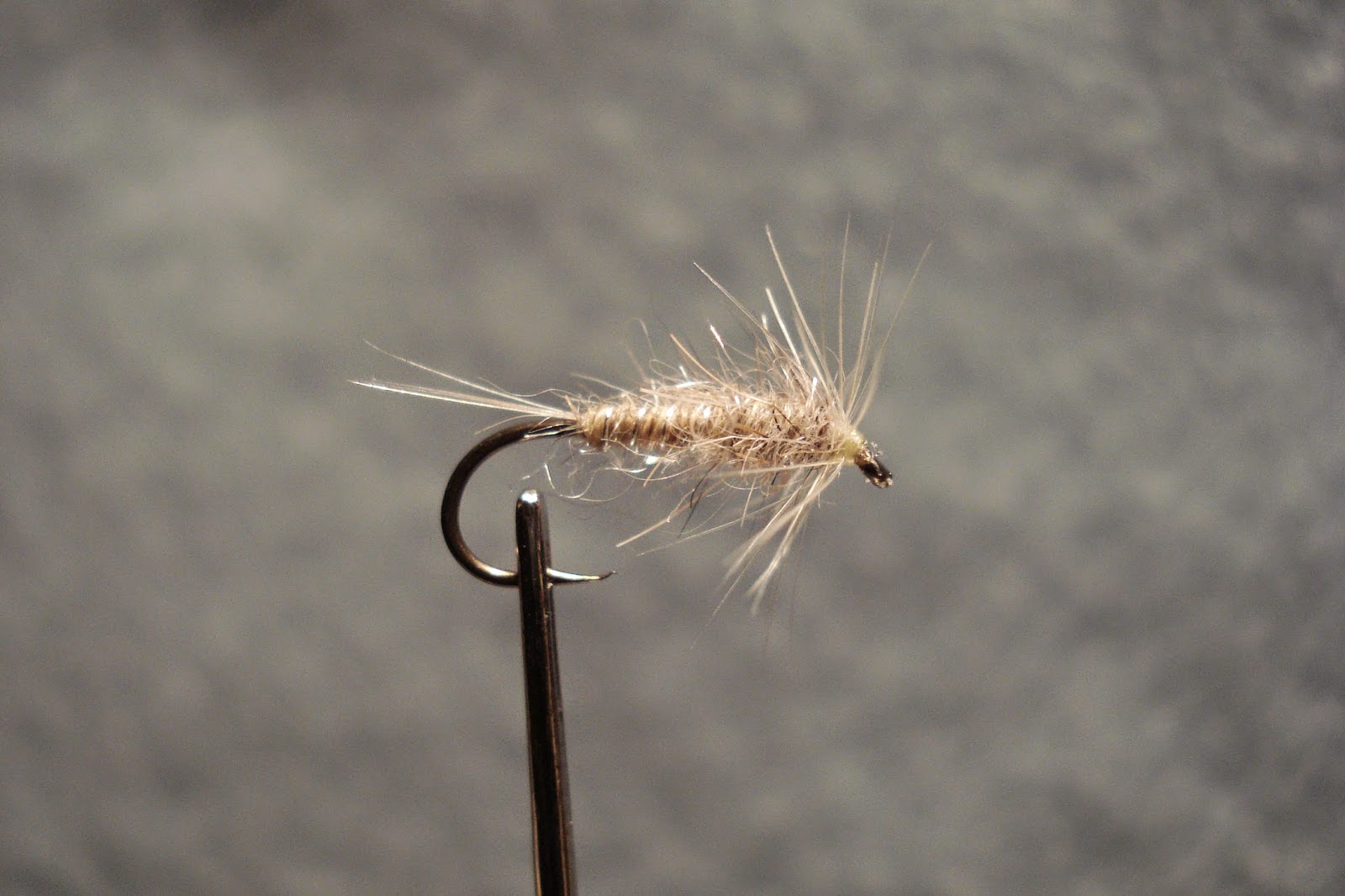
Hook:
|
6-16
|
|
Thread:
|
Burnt orange
|
|
Tail:
|
Red fox squirrel back fur (optional)
|
|
Rib:
|
Gold twist
|
|
Abdomen:
|
Red fox squirrel underbelly fur
|
|
Thorax:
|
Red fox squirrel back fur (dubbed slender)
|
|
Hackle:
|
Dark speckled brown hen hackle
|
|
Including the Red Fox Squirrel Nymph as soft
hackle might be criticized as taking too much liberty with the blog
definition of the style, as in the case of the northeastern Breadcrust, the
ubiquitous Greenwell’s Glory, or the Tup’s Nymph (or most other patterns dressed by G. E. M. Skues). Nevertheless, it an
impressionistic pattern and lends itself to dressing in many familiar styles.
Pinpointing the inception of one of Dave Whitlock’s most iconic flies is a
task likely best left to Whitlock himself. Since tracking down every
reference to the fly would be even harder, a sample of Whitlock’s own words
on the pattern must suffice.
An early publication that includes the Red Fox
Squirrel Nymph was The Masters on the
Nymph (1979), to which Whitlock contributed a chapter 7, “Nymphing
Tackle.” The first of the four “favorite nymph patterns” he includes is the
Red Fox Squirrel Nymph,” which he describes as his “favorite all-purpose
nymph, as versatile and effective for a nymph as the Adams is for a dry fly.
It works as well where mayflies, stone flies, caddis pupae, and scuds of similar
colors exist, and where there are no nymphs.
Hook: Mustad 9671, sizes 4-18
Body weight: 6 to 10 wraps of lead wire at thorax
Thread: Black
Tail: Sparse tuft of red-fox squirrel back hair,
including both guard and underfur ½ length of hook shank
Rib: Small oval tinsel
Abdomen: Red-fox squirrel
belly fur
Thorax: Red-fox squirrel back fur (with guard and
underfur included)
Wing case: Dark-brown swiss straw or turkey tail
Legs: Either guard hairs of red-fox squirrel
back or one turn of dark partridge hackle”
He also cited it as the nymph he used in his
nymphing system in a pair of articles in Fly
Fisherman magazine from 1983, but did not give it an explicit treatment
of the fly itself until a June 1984 article entitled “Red Fox-Squirrel-Hair
Nymph.” In this article, he describes how to trim a red squirrel hide to preserve the scarce belly fur—split the
skin down the back when dressing the body—and how to sort the fur into like
colors. (He also notes that a shaved, tanned red fox squirrel skin can
repurposed into buckskin nymphs. Very little of the animal goes to waste for
the savvy, creative fly tier.) More
importantly, he discusses the reasons for the fly’s success. Rather than
clinging to a narrow representational niche, the Red Fox Squirrel Nymph aims
for impressionistic representation and is, as a result, characteristically
versatile. By adjusting the length and thickness of the abdomen, and thorax,
as well as the sparseness and length of the hackle, the Red Fox Squirrel
Nymph could give the impression of a broad array of insects. In this article,
he gives a dressing for “Dave Whitlock’s Standard
Red Fox Squirrel-Hair Nymph” that looks much more like a soft hackle:
“HOOK: Mustad 9671 or Tiemco Nymph Hook, #2 to
#18.
THREAD: Black or dark
brown nylon.
CEMENT: Dave’s
Flexament.
WEIGHT: Lead or copper
wire.
ABDOMEN: Belly fur from
red fox squirrel skin, may be blended with synthetic sparkle dubbing. Abdomen
should be ½ to 2/3 of the overall body length.
THORAX: Back fur from
red fox squirrel skin, may be blended with synthetic sparkle dubbing. Thorax
should be ½ to 1/3 of the overall body length.
RIB Gold wire or oval
tinsel.”
In his Guide
to Aquatic Trout Foods (1982), Whitlock’s fly boxes illustrate this
versatility: it shows up, for instance, in his “Box No. 1: General Utility
Box” at the head of the list in sizes 6-16, as well as “Box No. 4:
Terrestrials and Summer Midges” in sizes 16 and 18.
Whitlock’s prolific writing has continued to describe the
efficacy of the Red Fox Squirrel Nymph. He contributed a short article on the
pattern in the September/October 2010 issue of Eastern
Fly Fishing that reflects many of the modern, commercial interventions in
fly dressing that have risen alongside media popularization of the sport,
especially in print but also in film. This version updates the materials that
Whitlock originally posted for the do-it-yourself fly tier of the late seventies
and early eighties. In their blend of synthetic and natural fibers, these
newer, branded materials regularize the color and consistency of the abdomen,
thorax, and hackling, and they incorporate colors and sparkle that are more
likely to attract a trout’s attention, particularly in off-color water. Both
the original and contemporary versions have a place in the angler’s fly box. This
Red Fox Squirrel Nymph uses:
“Hook: TMC 5262, size 2-20
Thread: Orange Wapsi Ultra Thread 70
Weight: Lead Wire the diameter of the hook wire
Cements: Zap-a-Gap and Dave’s Flexament
Tail: Back hair of red fox squirrel
Rib: Small or medium gold oval tinsel
Abdomen: 50-50 blend of red fox squirrel belly hair and similar
colors of Antron and SLF or No. 2 (red fox squirrel abdomen) Wapsi Dave
Whitlock Plus SLF dubbing blend
Thorax: 50-50 blend of red fox squirrel back hair blended and
hare’s ear Antron and SLF or No. 1 (red fox squirrel thorax) Wapsi Dave
Whitlock Plus SLF dubbing blend
Legs: Dark ginger Metz hen back feather for hook sizes 2-12; for
smaller hooks, pick out the dubbing guard hairs for legs
Head: Orange thread or gold bead.”
|
Showing posts with label Skues. Show all posts
Wednesday, December 28, 2016
Red Fox Squirrel Nymph
Wednesday, December 14, 2016
Blue Dun Hackle
Hook:
|
12-18
|
|
Thread:
|
Primrose
|
|
Rib:
|
Small gold tinsel
|
|
Body:
|
Mole fur with a little of the silk exposed at
the tail
|
|
Hackle:
|
Gray hen hackle
|
|
While it might have been intended as a
separate dressing for an olive mayfly like the Blue Dun, James Leisenring
includes the Blue Dun Hackle separately from the Old Blue Dun in his Art of Tying the Wet Fly & Fishing the
Flymph (1941). He dressed is with
“HOOK 12, 13, 14.
SILK Primrose yellow.
HACKLE Light-blue-dun hen hackle of good quality.
TAIL Two or three
blue-dun fibers optional.
RIB Very narrow flat gold tinsel.
BODY Mole fur spun on primrose-yellow silk, a
little of the silk exposed at the tail.”
Dave Hughes gives a dressing for similar fly,
the Blue Dun Wingless, in his Wet Flies
(1995 and 2015) and the updated second edition, which he configures like his Hare’s Ear Flymph, in the flymph style he
takes from Leisenring and James Hidy. He dresses the Blue Dun Wingless with:
“Hook: 1x fine or 2x
stout, size 12-18.
Thread: Yellow
Pearsall’s Gossamer silk or 6/0 or 8/0 nylon.
Hackle: Medium blue
dun hen.
Tails: Medium blue dun
hen hackle fibers.
Rib: Narrow Mylar
tinsel, silver.
Body: Muskrat belly
fur.”
|
Leisenring’s dressing seems to be based on the Blue Dun that G. E. M. Skues includes in Minor Tactics of the Chalk Stream (1910).
Skues’s Blue Dun is dressed with:
“Wings: Snipe
Body: Water-rat on primrose or yellow tying silk. Vary body by
dressing with undyed heron’s herl from the wing, and ribbing with find gold
or medium silver wire.
Legs: Medium blue hen.”
Exclusive of the ever-popular peacock herl, herl-bodied dressings are rather
rare in soft hackle literature, although they are common in Skues’ own nymphal
dressings. Traditional soft hackles tend to opt for simple silk-bodied or
dubbed fur dressings. Notable exceptions include Leisenring’s Black Gnat
(dressed without the optional wings), the Old Master and Little Black that T.
E. Pritt includes in North-Country
Flies (1886), and especially Sylvester Nemes’ Pheasant Tail from his Soft-Hackled Fly (1975).
|
Wednesday, October 5, 2016
Carrot Fly; Carrot and Black Nymph; or, Carrot Nymph
| This dressing substitutes yellow-green dyed quail undercovert for the green parrot Skues prescribed for the tail and yellow-green dyed covert in place of the poultry hackle. |
Hook:
|
12-14
|
|
Thread:
|
Primrose
|
|
Tail:
|
Olive dyed quail covert fibers
|
|
Body:
|
Rear 1/3—pale yellow wool; Middle 1/3—hot orange
wool; Front 1/3—green seal fur
|
|
Hackle:
|
Olive dyed quail covert
| |
G. E. M. Skues introduced anglers to the Carrot Fly in the journal of the London Flyfisher’s Club in 1912 as proof of “what asses trout are.” In 1975 winter issue of Fly Fisherman magazine, T. Donald Overfield notes that the response to the fly was mixed. Some anglers questioned whether Skues was having a laugh; others, “perhaps shamefacedly, cast it to the trout, with surprising results.”
Overfield notes that the “tying is not
difficult,” but advises fly tiers to “aim for a steeply tapered body, as
shown in the ‘natural,’” a carrot: “The silk is waxed primrose (1). Tie in
two strands of green parrot feather-fiber, or its equivalent, (2) and return
the silk up the hook three turns. Tie in a length of pale yellow wool (3), bringing
the silk forward to one-third the length of the body. Wind the wool forward
and secure (4). Tie in a length of hot-orange wool (5) and take the silk up
the hook for another third. Wind the wool up to the silk and secure, (7). Now
tie in a length of greenish seal’s fur dubbing (8), and a short, fibred
hackle dyed olive-green (9). Wind the dubbing and secure. Take a few turns of
the hackle round the hook shank and secure with a whip-finish (10).”
Jay Zimmerman traces the history of the Carrot Fly in The Best Carp Flies: How to Tie and Fish Them (2015). He credits Skues with developing the first, but notes that Skues only casually mentions his Carrot Fly in the The Way of a Trout with a Fly (1921), where he called it "the famous Carrot fly." (Presumably, Skues deferred to this short-hand reference because of the fly's popularity following its introduction in the journal of the London Flyfisher's Club nine years earlier.) For whatever reason, American fly tiers have exhibited a strong inclination to imitate garden produce in the pursuit freshwater species. Zimmerman notes that "Reuben Cross from Neversink, New York, introduced a nymph in his book Tying American Trout Lures (Dodd, Mead & Company, 1936) he called the Carrot and Black" fifteen years after Skues' Way of the Trout with a Fly (and twenty-four years after Skues' club journal article). Zimmerman cites Cross's directions: "'The Carrot and Black is tied with brown hackle tail, carrot-colored body with black Chenille shoulder and dun hackle wound on the same as with a wet fly. After you have finished off with the tying silk take your scissors and clip out the top and bottom whisks, leaving the side legs." Later a similar dressing, the Carrot Nymph as Elsie Darbee tied and named it, showed up in A. J. McClane's classic McClane's Standard Fishing Encyclopedia (Holt, Rinehart And Winston, 1965). Zimmerman also suggests that Randall Kaufmann further confused the dressing in American Nymph Fly Tying Manual (1975) by calling it the Carrot Fly and giving it a dubious lineage. Kaufmann noted that the an "old standby for years in the east" and, incorrectly, only recently in the west, and his dressing emphasized "halloween colors" untrue to Cross's American original that "account for many fat rainbows and brookies from pond and stream alike" More confusing was that Kaufmann's explanation of the dressing "is a slight variation from the original," presumably Cross's. His fly uses black hackle for the tail and unclipped front hackle, and orange tying thread with a black chenille thorax for the body. |
Wednesday, June 1, 2016
Blue Dun
| This dressing substitutes pale yellow seal's fur for the pale "wool, mohair, or fine dyed pig's wool" that John Younger prescribes and uses starling undercovert. |
Hook:
|
12-16
|
|
Thread:
|
Yellow
|
|
Body:
|
Blue rabbit underfur and pale yellow seal's fur
|
|
Hackle:
|
Starling undercovert
|
|
W. H. Lawrie’s Scottish Trout Flies (1966) reproduces lists of flies like John Younger’s list for fishing the Tweed. Of the six flies Younger dressed, the unnamed fly for April and May. His fly, undoubtedly a Blue Dun, is dressed with
“Wing: Transparent feather from the wing of the bunting or that of a full grown cock sparrow.
Body: Blue water-rat fur mixed with equal proportion pale yellow, inclining to white, wool, mohair or fine dyed pig’s wool.”
Younger includes one additional dressing for April and May with the same body, but hackled with a body feather from a grouse. G. E. M. Skues suggested that Younger’s dressing imitated a “small darkish Watery” that hatched from “May throughout the season,” No. VII on his list of flies for representing the Medium Olive. He adapted Younger’s pattern thus:
“Hook.—No. 16 down-eyed Pennel sneck.
Tying Silk.—Bright yellow, waxed with clear colourless wax.
Hackle.—Dark-blue hen short—not more than two turns.
Whisks.—Two strands of darkish blue unspeckled feather from neck of cock guinea fowl- short.
Body.—Thinly laid dubbing of mole’s fur mixed with yellow seal’s fur.”
Skues also suggested that “the body may be varied by using English squirrel blue fur instead of mole.”
Roger Woolley notes in the last edition of his
Modern Fly Dressing (1950) that the
olive fly is the usually known as the Early Olive Dun. He introduces his
dressings by noting that, “although entomologies tell us there is no such fly
in nature as the Blue Dun, anglers always have had and will have their Blue
Dun. It is an imitation of the large, early spring Olive Dun, a fly appearing
in early spring, the first of the Ephemeridæ
family to show on our streams.” A proliferation of olive dun colored bodies
matched with dun hackles, however, makes pinpointing which are intended to
match Woolley’s mythological Blue Dun a challenge. The Waterhen Blae, for
instance, might equally serve the purpose. To limit the scope of these
possibilities, soft hackled Blue Dun patterns here will to create an olive
shade that the yellow silk underbody accents, either by mixing yellow and
blue or by overwrapping the main body with a yellow or olive rib.
John Waller Hills traces the development of
the Blue Dun in A History of Fly
Fishing for Trout (1921) from Dame Juliana Berners and her A treatyse
of fysshynge wyth an Angle
(1496) to the twentieth century: “The progress of this fly is of
extraordinary interest. It starts with a black wool body, dark mallard wings
and possibly a jay's blue feather as hackle. This dressing is too dark altogether
in body and wing. Cotton lightens both, and gives a fairly good fly, and
Chetham a still better one. His Blue Dun has no hackle it is true, but its
rough body of fox fur could easily be picked out, and except for this it is almost
as it now exists. But there were one or two improvements, the snipe wing,
which I think is better than the starling for the sunk fly, and mole's fur
body. So we get the fly of to-day.” Hills suggests that flies like the Old
Blue Dun are variations of the Blue Dun, utilizing a rib in place of blended
blue and yellow body. The effect either way, he implies, simulates the olive
hue that is characteristic of the Olive Dun. In their Art of Angling (1757, 1774), both Richard and Charles Bowlker
include dressings for the Blue Dun that includes bodies “made of a blue fur
of a fox, or the blue part of a squirrel’s furr, mixed with a little yellow
mohair.”
Many dressings of the Blue Dun, like those of
the Bowlkers, are winged. John Kirkbride includes, as he often does,
dressings for winged flies and for hackles: “when dressed as a hackle-fly, a
fine feather from the underside of the wing of the jack-snipe, or moor-pout, answers
very well for the hackle. The body
must be the same as described above”—“from the light blue fur of the rabbit,
or the grey squirrel, mixed with a very little yellow mohair.” The
“moor-pout” is a Scottish term for a young grouse.
|
| This dressing of Vernon S. Hidy’s Blue Dun uses primrose Pearsall’s gossamer silk for the tying silk and light olive Pearsall’s gossamer silk for the rib. |
While many historical soft hackle patterns use
a blue fur body mixed with yellow to create an olive effect, others are
dubbed on dubbed on primrose or yellow thread and include a rib. James
Leisenring’s angling companion, Vernon S. Hidy, included such a dressing for
the Blue Dun in Chapter 10 “Soft-hackle Nymphs—the Flymphs” of The Master’s on the Nymph (1979):
“Sizes 12, 14, 16; muskrat fur on primrose silk; olive-yellow thread ribbing;
two turns of blue dun hen hackle.” The Old Blue Dun that Leisenring includes
in The Art of Tying the Wet Fly &
Dressing the Flymph (1941) seems dressed to achieve the same effect.
|
Wednesday, November 4, 2015
Hare's Ear Flymph; Hare's Ear
Hook:
|
12-16
|
|
Thread:
|
Red Pearsall’s gossamer silk
|
|
Tail:
Rib: |
Red badger
Narrow gold tinsel |
|
Body:
|
Medium dark hare’s ear
|
|
Hackle:
|
Red badger
|
|
Even before the advent of the barrel-bodied, highly effective versions of the Hare's Ear that gained popularity in the 70s and 80s and the gold-bead-headed variety that showed up in the 90s, the Hare’s Ear nymph was long a staple of the modern fly box, just as the the winged wet Hare's Ear had earlier been a stock pattern for southern chalkstream anglers and their North Country counterparts in England.
In his Wet Flies (1995) - a new, updated edition is available - Dave Hughes nodded to American wet fly traditions established by James Leisenring and Vernon “Pete” Hidy in the first half of the twentieth century, which drew on the nymphal dressings developed by G. E. M. Skues. Leisenring and Hidy tied wet flies that Hidy would term "flymphs." While Leisenring readily lumped flymphs among traditional North Country Patterns (like his Light Snipe and Yellow), classic winged wets and Stewart's spiders, Hughes explicitly distinguishes the flymph from the soft-hackled fly by virtue of the spiky body and hackle.
Drawing on Leisenring and Hidy, Hughes explains that the hackle of a flymph “should not dominate the body of the fly. In a well-tied
flymph, the body and hackle entrap bubbles of air and take them beneath the
surface. A properly tied body shows the primary color of any insect that is
around when fish are feeding, plus some slight undercolor that shows through
when the fly is wet in the water. The primary color comes from the dubbing
fur selected. The undercolor comes from the silk on which the fur is spun.
The two colors should harmonize with each other. They should also be in
harmony with whatever insect is available to fish the time you’re using the
fly.” Hughes' description certainly distinguishes the Hare's Ear Flymph from traditional soft-hackle dressings like the Grouse and Green or Orange Partridge, but the uniqueness of its thoracic hackling and the important role the plays in creating the overall effect of life qualifies it for inclusion here, much like the thoracic hackling of nymphs and hatching duns qualified W. H. Lawrie's Book of the Rough Stream Nymph (1947) for inclusion in Sylvester Nemes's Two Centuries of Soft-Hackled Flies (2003).
However contentious this point of definition may be, Hughes' Hare's Ear Flymph (and his flymph in general) is a pattern somewhere between a soft hackle and a winged wet or between a soft hackle and nymph tied in the round, like the nymphal patterns that Charles Brooks advanced in his Nymph Fishing for Larger Trout (1976). Hughes dresses his flymph with a tail and a full body dubbed on silk from the bend to eye of the hook and a rib wrapped over that to the thorax. He ties a hackle in behind the eye, dubs the thorax, and winds the hackle from the eye of the
hook back toward the bend, tying it off in the front third or fourth of the body. He finishes by winding the silk back through the hackle toward the eye of the hook (a technique he recommends for dressing and strengthening Stewart's spiders) and then whip finishing the silk behind the eye of the hook.
“Hook: 12-16.
Thread: Pearsall’s
Gossamer silk, crimson red.
Hackle: Brown or
furnace hen.
Tails: Brown or
furnace hen hackle.
Rib: narrow gold tinsel.
Body: Hare’s mask fur,
or #7 Hare’s Ear Plus, tan.”
Prior to modern Hare's Ear nymphs and Hughes' Hare's Ear Flymph, the classic, winged Hare’s Ear that Leisenring includes in The Art of Tying the Wet Fly and Fishing the Flymph (1941), which shows the influence of the Hare’s Ear wet fly that G. E. M. Skues included in Minor Tactics of the Chalk Stream (1910), was the predominant dressing of the Hare's Ear.
While hare's ear often appears as the body material in North Country and Scottish patterns, it rarely shows up exclusively as a soft hackle In the Practical Angler (1857), for instance, W. C. Stewart described the importance of “hare’s lug,” a Scottish denomination for hare’s ear fur, in dressing Border patterns, particularly for dressing his winged wet fly, the Hare-lug, which he fished alongside his famous, wingless spiders. Stewart draws distinctions like Hughes' for considering the silk in conjunction with the body to create a specific representational effect. He does prescribe specific wings for his three Hare-lug dressings, but the body remains consistent throughout.
The variations in each of Stewart's dressings recalls the Art of Angling (1843), where William Blacker lists similar dressings for the Hare’s Ear, identical in its
versatility and the suggestion that any hackle or winging coupled with a
hare’s ear body will fish:
“Body, Hare’s ear fur,
and a little yellow mohair, mixed.
Wings, Starling,
bunting, or woodcock.”
|
| This dressing substitutes a mourning dove covert for the snipe undercovert John Kirkbride prescribes, and it uses tan thread. Also, it has"a tip of gold" for "when the water is brownish." |
One of the few references to a Hare’s
Ear dressed as a soft hackle or "spider" is in John Kirkbride’s Northern Angler (1837). Kirkbride gives dressings for two
varieties of Hare’s Ear, one dressed with a dark fur body and the other
dressed with a mixture of fur and yellow mohair; each body can be alternately winged or hackled, the wings and hackles being substituted for soft hackles. These are hardly
the modern Gold-Ribbed Hare’s Ear or even Hare’s Ear Flymph. Kirkbride
dressed the soft-hackled, dark-bodied
Hare’s Ear with a “fine hackle from the inside of the wing of a
jack-snipe” and suggested that the fly tier “add a tip of gold when the water
is brownish.” Kirkbride regards the Hare’s Ear as “an excellent spring fly;
indeed, it will kill during the whole season.”
|
Wednesday, May 20, 2015
Gordon Hackle
Hook:
|
16-18
|
|
Thread:
|
Dark brown
|
|
Rib:
|
Fine silver oval French tinsel
|
|
Abdomen:
|
Blue rabbit underfur
|
|
Hackle:
|
Brown, mottled partridge hackle
|
|
Sylvester Nemes reprints selections from the
letters of Theodore Gordon germane to his study of historical soft hackles in
Two Centuries of Soft-Hackled Flies
(2004). Gordon mentions two, though he gives neither a name. In a letter to G. E. M. Skues dated February 18, 1909, Gordon relayed
some of his experiences with soft hackles: “I have tried the hackles of small
birds and from grouse, woodcock, snipe, etc., but rarely with much success. A
brown, mottled partridge hackle on a light bluish dun body, ribbed with fine
silver twist was quite killing.”
Similarly, in a letter to Skues written on
March 10, 1912, Gordon recalled “a very small fly with mouse colored body and
gray partridge hackle that killed well on slow streams, fished wet.” (This dressing has much in common with Dame Juliana Berner's Donne Flye.)
|
Wednesday, May 6, 2015
Pale Watery Dun or Nymph
Hook:
|
14-18
|
|
Thread:
|
Pale primrose
|
|
Tail:
|
Blue dun
|
|
Rib:
|
Silver wire
|
|
Abdomen:
|
Tan hare's ear plus
|
|
Thorax:
|
Dark hare’s ear plus
|
|
Hackle:
|
Pale ginger, one turn tied short
|
|
G. E. M. Skues gives multiple dressings for
Pale Watery Nymphs or duns in various books. In Minor Tactics of the Calk Stream (1910), Skues includes one
dressing for a winged Watery Nymph; in Nymph
Fishing for Chalk Stream Trout (1939), six short-hackled dressings. This
dressing, Pale Watery XVII, is listed in the latter.
“Hook.—No. 16.
Tying Silk.—Cream, waxed with colourless wax.
Hackle.—Palest ginger hen—one turn—short.
Whisk.—Two strands of palest creamy neck feather of cock
grinea-fowl—short.
Rib.—Fine silver wire.
Body.—Abdomen: Pale
rabbit’s Poll.
Thorax: Hare’s poll, or, for a variation, English squirrel’s blue fur.”
Skues notes that he has seen the Pale Watery
Dun “from mid-April to the end of the season and later. I have seen them
hatching in bitter weather when fishing for grayling in December.”
|
James Leisenring includes two dressings for
the Pale Watery Nymph in his Art of
Tying the Wet Fly and Fishing the Flymph (1941). He assigns the following
dressing for the second:
“HOOK 15,16
SILK White, waxed with colorless wax.
HACKLE One turn of a very short honey dun cock
hackle.
TAIL Three strands of very short, soft-blue-dun
cock fibers.
RIB None.
BODY Undyed seal fur or pale buff Australian
opossum fur dubbed lightly at the tail and thicker at the thorax.”
|
| This dressing of (2) below substitutes mourning dove undercoverts for sea swallow hackling and tailing, and it uses naturally yellow raw Gulf Coast Wool. |
Roger Woolley included a pair of simple soft
hackle dressings for the Pale Watery Dun among a list of twelve nymphal, soft
hackled, winged, wet, and dry fly dressings for the Pale Watery Dun in Modern Trout Fly Dressing (1932):
“(1) Body.—Pale ginger fur.
Hackle and Whisks.—Palest blue dun hen.
(2) Body.—Pale watery yellow lamb’s wool.
Hackle and Whisks.—Palest blue dun hen. Or a small feather from
the outside of a sea-swallow’s wing.”
Woolley's second dressing, minus the tail, bears a strong resemblance to the Blae Hen and Yellow. He notes that the Pale Watery Dun “appears
on our streams from May onwards throughout the season, but is most prevalent
in August and September. Under suitable conditions it hatches out in great
quantities, and is a prime favourite with trout, and especially grayling. It
is about the same size as the Iron Blue Dun. This fly and the Blue Winged olives with their spinners are mostly
the cause of the made late evening rise of fish.”
|
Wednesday, March 25, 2015
Blue-Winged Olive (XVIII); or the Bright Brown
Hook:
|
16-20
|
|
Thread:
|
Orange
|
|
Tail:
|
Three strands of dark dun dove hackle tied
short
|
|
Body:
|
Rust sculpin wool and maple plastic canvas yarn
|
|
Hackle:
|
Dove primary
|
|
In Nymph
Fishing for Chalk StreamTrout (1939), G. E. M. Skues lists various
dressings for the Blue-Winged Olive. For fishing at nighttime, he preferred:
“Hook.—No. 1 or 2 down-eyed round bend.
Tying Silk.—Hot orange.
Hackle.—Dark but definitely blue hen—as woolly in the fibre as
can be had—two turns.
Whisk.—Three strands of dark hen hackle—short.
Body.—Cow-hair the colour of dried blood, dressed fat—the
nymph itself being fat and not taper like the other dun nymphs.”
Given the distinctions he draws among ten different styles for dressing nymphal flies at the outset of The Way of a Trout with a Fly (1921), G. E. M. Skues would likely balk at having one of his short hackled nymphs grouped among soft hackles. Nevertheless, its hackling, though short, is dressed in the round with soft hackle.
Charles Cotton's winged Bright Brown, from part 2 of the Compleat Angler (1676), might also be dressed as a soft hackle. The coloration achieved by the materials in Skues’s dressing is quite similar overall to the second
dressing that Charles Cotton lists in his additions to the
Compleat Angler (1676): “2. Also a
bright brown, the dubbing either of the brown of a Spaniel, or that of a Cows
flanck, with a Grayling.” James Chetham corrects what must be a typographical
error in Cotton, “with a Grayling,” to “with a Grey Wing” in his Angler's Vade Mecum (1681).
|
Subscribe to:
Posts (Atom)