Showing posts with label Walbran. Show all posts

Wednesday, August 12, 2015

August Brown; or, August Dun


Hook:

12-16
Thread:

Tan
Rib:

Silk buttonhole twist – Coats & Clark’s lemon 223, size D
Body:

Tan tying thread dubbed with hare’s mask
Hackle:

Red grouse shoulder


In Two Centuries of Soft-Hackled Flies (2004), Sylvester Nemes includes some of the flies Francis M. Walbran listed in his column “Monthly Notes on North-Country Trout Flies” in The Fishing Gazette. For August 15, 1885, Walbran listed the August Brown first: “Body: Light brown silk, dubbed sparingly with hare’s face, and ribbed with yellow silk, dressed hacklewise with grouse’s feather.”

In Fly Fishing: The North Country Tradition (1994), Leslie Magee notes that the August Brown hatch is an autumn corollary to the springtime March Brown and that its name is interchangeable with the August Dun or Drake, the Autumn Dun, Cinnamon Fly (which hatches alongside a Cinnamon Sedge), and the Whirling Blue Dun. He includes Sylvester Lister's 's manuscript, which gives a September dressing, the "Cinnamon or August Drake," which he dressed with a "feather from under landrail's wing. Head, peacock's herl, body, orange with gold tinsel or covered with herl from cock pheasant's tail feather," noting that the fly is "very abundant on some Yorkshire rivers." 

Harfield Edmonds and Norman Lee included a winged August Dun in Brook and River Trouting (1916) which they recommend through the “last week in July, August and September." E. M. Tod also has a winged dressing in Wet Fly Fishing Treated Methodically (1903) for fishing in September. A winged August Brown, No. 47, is  in John Jackson’s Practical Fly-Fisher (1854), as well, a fly that he regards “equally as good in its season as the March Brown, which it very much resembles, though lightered coloured and smaller.”

In his Fly-Fisher’s Entomology (1836), Alfred Ronalds lists a winged and a hackled dressing for the August Dun No. 38:

“BODY.  Brown floss silk ribbed with yellow silk thread.
TAIL.  Two rabbit’s whiskers.
WINGS.  Feather of a brown hen’s wing.
LEGS.  Plain red hackled stained brown.

It is made buzz with a grouse hackle wound upon the above body.”

Wednesday, March 12, 2014

Waterhen Bloa

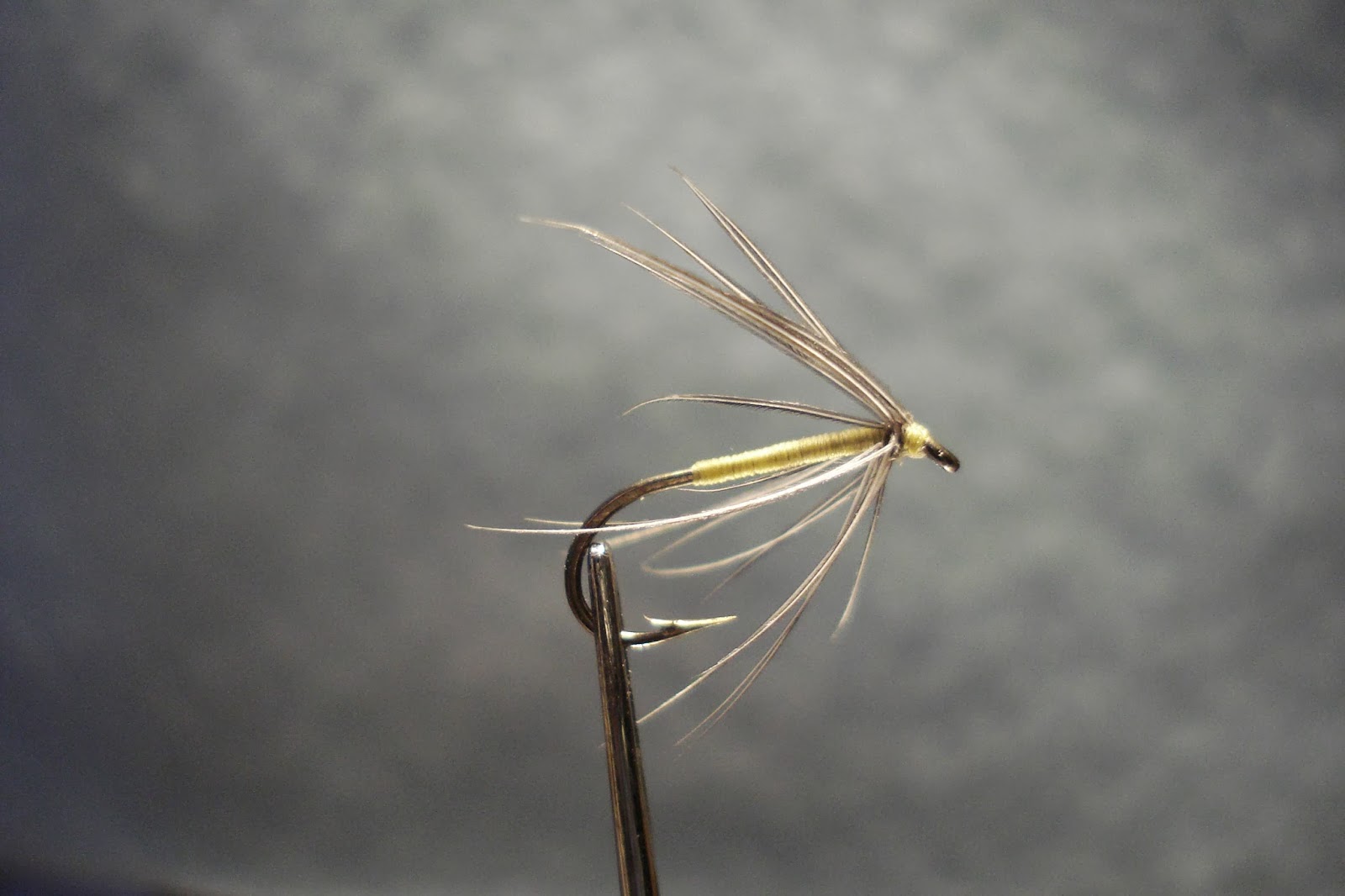
This dressing of Harfield Edmonds and Norman Lee's Waterhen Bloa uses lemon yellow Pearsall's Gossamer silk. 
Hook:

14-18
Thread:

Yellow
Body:

Yellow Pearsall’s Gossamer Silk dubbed with mole’s fur
Hackle:

Dark waterhen coverts


Multiple twentieth-century fly tiers recommend the Waterhen Bloa in a variety of sizes, including Harfield Edmonds and Norman Lee who list the Waterhen Bloa as No. 2 in their Brook and River Trouting (1916). They list it as a fly matching mayflies from “March to end of April, and again in September), and they dress it thus:

WINGS.-Hackled with a smoky grey feather from the under coverts of a Waterhen’s wing. (The darker side of the feather towards the head of the fly.)
BODY.-Yellow silk, No. 4, dubbed with Mole’s fur.
HEAD.-Yellow silk.”

Scottish angler E. M. Tod included the Water-Hen Bloa at the head of a list of “useful hackled flies (‘spiders’)” at the end of his Wet-Fly Fishing, Treated Methodically (1903):

“I. WATER-HEN BLOA (SCOTTICE ‘BLAE’).
Body.—The yellow tying silk, clubbed with water-rat (or mouse)   fur, sparingly put on and ribbed over with the same silk.
Hackle.—From the inside of wing feather of water-hen.

Season. A generally useful fly all through the season, and the best fly of its kind, in my opinion, for the fishing of ‘Waters.’  Very valuable also in river fishing.”

Their pattern is almost an exact duplication of the Water-Hen Bloa, No. 8, which T. E. Pritt included in North-Country Flies (1886), except that Pritt preferred “water Rat” to mole, much like the dressing for the Waterhen Bloa that Francis M. Walbran included in his monthly column “Monthly Notes on North-Country Trout Flies” in The Fishing Gazette, dated 10 October 1885, and which Sylvester Nemes reprints in Two Centuries of Soft-Hackled Flies (2003). Pritt notes that the Waterhen Bloa “is identical with the blue dun of Ronalds, and is indispensable during March and April, and again towards the latter end of the season. It is also a useful grayling fly all through the winter month . . . The hackled fly is, perhaps, preferable, as the real fly hatches out mainly on cold, windy days. If the day be warm the insect takes flight immediately on reaching the surface of the water; but if, as is commonly the case, the day is cold, it lingers on the surface, not completely hatched into perfect form, and is thus easily pounded upon by expectant trout." Sylvester Nemes recommends Pritt's Waterhen Bloa dressed on a size 20 hook in his 2006 additions to his original Soft-Hackled Fly (1975).

Alfred Ronalds, whose dressing for the Little Pale Blue Dun (no. 43) seems to be the pattern Pritt has in mind, dresses his fly for September in The Fly- Fisher’s Entomology (1836). The dressing for his Little Blue Dun calls for

“BODY. Very pale blue fur mixed with a very little yellow mohair.
WINGS. Feather from the sea swallow.
LEGS. The palest blue hackle to be had.

To make it buzz, a sea swallow’s feather only may be wound upon the same body.”

 If Ronald’s dressing is the same that Pritt cites, then it is a dressing that is included almost feather-for-feather and fur-for-dubbing  in the Bowlkers’ Art of Angling (1758, 1774), a much closer match than the Water-hen Bloa. Each list it as the “The Little Pale Blue,” and many British anglers, following the lead of the Bowlkers, include a dressing for the Little Pale Blue in their books.

Perhaps the Bowlkers are dressing flies in a tradition that began before them. Charles Cotton dresses a “a little dun” with “the dubbing of a Bears dun whirl’d upon yellow silk, the wings of the grey feather of a Mallard.”

This version of John Swarbrick's dressing for the Blo Flie uses primrose Pearsall's Gossamer Silk


The simplest version of the Waterhen Bloa appears in an 1807 publication by John Swarbrick that Leslie Magee reprints In Fly Fishing: the North Country Tradition. It is a simple North Country spider, the Blo Flie, No. 4, about which Swarbrick explains:

"This is a Blo Flie made from under the wing on a Water Hen some Times Make it of a large Feather and Some Times of the Small Not Harled at the Head it is a Hackle Made with yallow Silk and not very large.

Fish these Four Last Mentioned Flies [Winter Brown, Little Black, Large bloo, Blo Flie] Till about the 15 or 20 0f March when you will see the Large March Brown Come Oute."