Showing posts with label Tod. Show all posts

Wednesday, June 29, 2016

Sand Fly


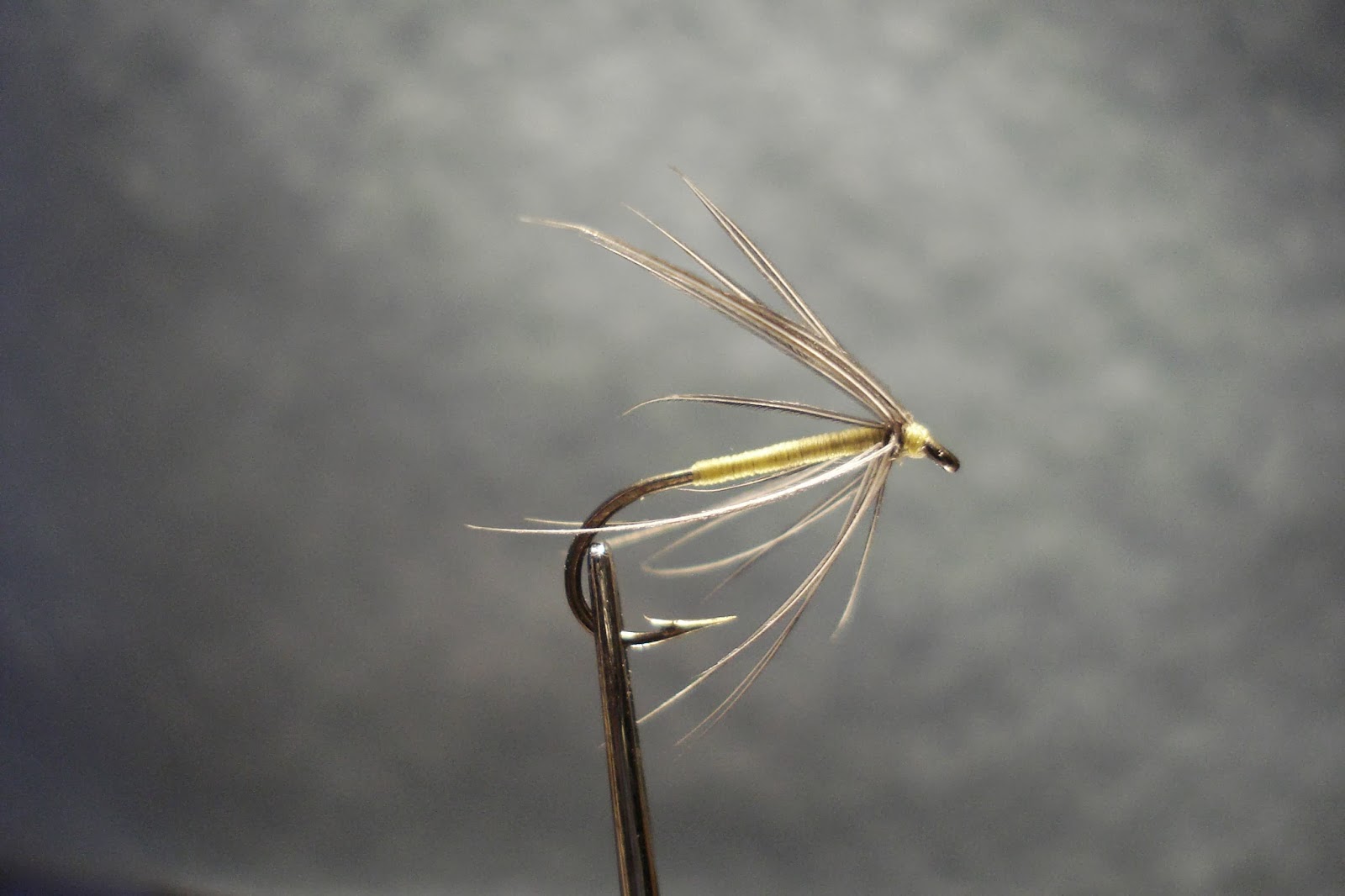
This dressing of Michael Theakston's Sand Fly configures the fly as a hackle and opts for the "yellow bronze brown hen" hackle over the three other alternatives Theakston provides.

Hook:

10-18
Thread:

Orange
Body:

Orange Pearsall's gossamer silk dubbed sparsely with muskrat
Hackle:

Lightly specked, bronzy-yellow hen


Sand Fly is the name some historical anglers use to identify the Gravel Bed Spider, but it most often refers to a caddisfly or sedge. Leslie Magee notes dressings sedges or caddisflies listed specifically as the Sandfly, Sand Fly, or Sanded Dun in six different angling texts from 1809 to 1916, including George Bainbridge’s The Fly-fisher’s Guide (1816), Alfred Ronalds’ The Fly-fisher’s Entomology (1836), and Michael Theakston’s A List of Natural Flies (1853). Robert L. Smith lists no fewer than ten dressings explicitly named Sand Fly (or an approximate dialectal variation, like Sandflee) in manuscripts and publications dating from 1712 to the twentieth in his North Country Fly: Yorkshire's Soft Hackle Tradition (2015), available from Coch-y-Bonddu Books.

Theakston gives a dressing for the Sanded Dun—“dun” is his denomination for sedge or caddis—that uses “bright copper colored silk for body; feathers, for wings and legs, from the landrail, throstle, or a yellow bronze brown hen, or the brown owl, with or without a tinge of water rat.”

Bainbridge provides a winged and hackled dressing for the Sand Fly, asserting that it “may be considered as one of the best flies for affording diversion,” since it can be fished “successfully, at all hours of the day, from April to the end of September.” He compares the flies fished on “the borders of Yorkshire, where, as well in Cumberland and Westmoreland, the snipe’s wing and golden plover’s feathers, dressed as hackles, without dubbed bodies are the favourite flies.” Presumably, he means silk bodied dressings. Bainbridge notes that, while such silk bodied flies will work, a dubbed bodied fly will often work better, recalling a afternoon when his dubbed bodied Sand Fly caught twice as many fish as its silk bodied counterpart. For the winged dressing, the “wings are made from the sandy-coloured feather of the landrail’s wing, with a ginger hackled for legs; and the bright sandy-coloured fur from the hare’s neck, mixed with a very small quantity of orange-coloured mohair, for the body; or if dressed as a hackle, the feathers from under the throstle’s wing are the nearestthe colour of the wings of the fly.”

Ronalds cites Bainbridge’s description of the Sand Fly and its dressings, adding a “silk of the same colour” as the “sandy coloured fur from the hare’s neck.” He leaves off the orange mohair that Bainbridge recommends. Ronalds also stipulates that the Sand Fly is dressed “buzz,” as a hackle, with a throstle’s undercovert, but he notes that the hackle should be “wound upon the above body.” 

In North Country Flies (1886), T. E. Pritt includes the Sandfly, No. 34, which is an almost exact replica of the winged wets Bainbridge and Ronalds list, except that he ribs a sandy body with sandy hare’s fur. John Jackson, likewise, includes a Sand Fly, No. 19 in his Practical Fly-Fisher (1854) that alternates hen pheasant undercovert for the winging, but maintains the body and hackling; E. M. Tod includes this dressing in Table I of the Appendix of his Wet-Fly Fishing (1903).

In Modern Trout Fly Dressing (1936), Roger Woolley includes a Sand Fly under the heading of General Wet Flies:

Body.—Ginger fur.
Hackle.—Ginger hen.
Wings.—Starling.

Wednesday, August 12, 2015

August Brown; or, August Dun


Hook:

12-16
Thread:

Tan
Rib:

Silk buttonhole twist – Coats & Clark’s lemon 223, size D
Body:

Tan tying thread dubbed with hare’s mask
Hackle:

Red grouse shoulder


In Two Centuries of Soft-Hackled Flies (2004), Sylvester Nemes includes some of the flies Francis M. Walbran listed in his column “Monthly Notes on North-Country Trout Flies” in The Fishing Gazette. For August 15, 1885, Walbran listed the August Brown first: “Body: Light brown silk, dubbed sparingly with hare’s face, and ribbed with yellow silk, dressed hacklewise with grouse’s feather.”

In Fly Fishing: The North Country Tradition (1994), Leslie Magee notes that the August Brown hatch is an autumn corollary to the springtime March Brown and that its name is interchangeable with the August Dun or Drake, the Autumn Dun, Cinnamon Fly (which hatches alongside a Cinnamon Sedge), and the Whirling Blue Dun. He includes Sylvester Lister's 's manuscript, which gives a September dressing, the "Cinnamon or August Drake," which he dressed with a "feather from under landrail's wing. Head, peacock's herl, body, orange with gold tinsel or covered with herl from cock pheasant's tail feather," noting that the fly is "very abundant on some Yorkshire rivers." 

Harfield Edmonds and Norman Lee included a winged August Dun in Brook and River Trouting (1916) which they recommend through the “last week in July, August and September." E. M. Tod also has a winged dressing in Wet Fly Fishing Treated Methodically (1903) for fishing in September. A winged August Brown, No. 47, is  in John Jackson’s Practical Fly-Fisher (1854), as well, a fly that he regards “equally as good in its season as the March Brown, which it very much resembles, though lightered coloured and smaller.”

In his Fly-Fisher’s Entomology (1836), Alfred Ronalds lists a winged and a hackled dressing for the August Dun No. 38:

“BODY.  Brown floss silk ribbed with yellow silk thread.
TAIL.  Two rabbit’s whiskers.
WINGS.  Feather of a brown hen’s wing.
LEGS.  Plain red hackled stained brown.

It is made buzz with a grouse hackle wound upon the above body.”

Wednesday, April 22, 2015

Blae Hen and Yellow; Yellow Dun; or the Barm-flie


Hook:

14-18
Thread:

Yellow
Body:

DMC tapestry wool #7049, light lemon
Hackle:

Dun hen


W. H. Lawrie includes the Blae Hen and Yellow on his list of Border Hackled Flies in Scottish Trout Flies (1966), noting that the fly is a “very killing fly on most of the Border streams in spring and early summer. A paler yellow body is used on the Tweed”:

“Hackle: Blue hen.
Body: Yellow worsted teased and spun on yellow tying-silk.”

Given the coloration and type of materials for each dressing and the seasons that each angler recommends fishing it, Lawrie’s Blae Hen and Yellow likely derives from some version of a historical dressing like the Yellow Dun that John Kirkbride includes in the Northern Angler (1837). Kirkbride claims to have developed the Yellow Dun from his observation of a mayfly that an angler carried straight from the water and into the shop. Kirkbride  notes that the “body of this fly, when it first appears, ought to be of very pale yellow mohair, or goat’s hair, laid on flat, and thin, and a delicate pale dun cock’s or hen’s hackle for legs; the forked-tail may consist of two strands from a blue cock’s hackle; let the wings be of the lightest part of the wing feather of the starling.” Minus the wings, this dressing matches Lawrie’s almost exactly, but Kirkbride also explains that, “to make a spider or hackle, to represent the drowned fly, take a delicate feather from underneath the jack-snipe’s wing for the hackle, and let the body be the same as that of the fly before described.”

Historically, anglers have often dressed versions of the Yellow Dun with a yellow hackle, such as the Yellow Dun, No. 15, of Alfred Ronalds’ Fly-Fisher’s Entomology (1836):

“BODY.  Yellow mohair, mixed with a little pale blue fur from a mouse. Or a yellow silk thread well waxed with cobbler’s wax to give it an olive tint.
WINGS.  The lightest part of a feather from a young starling’s wing.
LEGS.  A light yellow dun hackle.

To make it buzz, a lighter dun hackle than is represented in the figure, is wound upon the same body.”

Many winged dressings for the Yellow Dun appear in angling literature. In Fly-Fishing Treated Methodically (1903), E. M. Tod includes a Yellow Dun that he attributes to John Jackson's Practical Angler (1853).  T. E. Pritt includes the Yellow-Legged Bloa (Yellow Dun) as N0. 27 in North-Country Flies (1886), while David Webster recommends dressing the Yellow Dun with sparse canary wings and yellow hackle on a yellow silk body in The Angler and the Loop Rod (1885). 

Earlier authors like James Chetham and Charles Cotton supply dressings for yellow mayflies that resemble the Blae Hen and Yellow, too. Each author lists the Little Yellow Mayfly as one of the four most important in May. In the Angler’s Vade Mecum (1681), Chetham notes that the insect is one of “4 Flies which contend for the title of May-fly," the distinction of being the predominant hatch in the month of May: "Green-drake," the "Stone-fly," the "Black May-fly and the little Yellow May-fly." In his earlier additions to the Complete Angler (1676), Cotton comments on the four flies with an almost satirical, legalistic tone: “all of these have their Champions and Advocates to dispute and plead their priority; though I do not understand why the two last named should; the first two having so manifestly the advantage, both in their beauty, and the wonderful execution they do in their season.”

Cotton lists the fly as No. 15 for May: “The last May-Flie (that is of the four pretenders) is the little yellow May-Flie, in shape exactly like the same with the green Drake, but a very little one, and of as bright a yellow as can be seen; which is made of a bright yellow Camlet, and he wings of a white grey feather died yellow.” Chetham reprints this dressing with less politicized language—by 1681 a "pretender" might have been gaining traction to describe a soon-to-be deposed monarch—but Chetham also reprints “another Catalogue, of Flies practiced by a very good Angler, and useful to be known by young Anglers in clear, Stony Rivers.” The Yellow May-Fly is No 5. on this list: “The Body made of Yellow Wooll mixt with Yellow Fur of a Marten, Dub’d with Yellow Silk, Wings of the lightest colour’d Feather of a Throstle.”

Similarly, the fifth fly that Cotton lists for April calls for “the dubbing of Camels hair, and yellow Camlet, or wool mixt, and a white grey wing.”

A more likely precedent that both Cotton and Chetham mention for the month of June is the Barm Fly or Barm-flie, which, in their contemporary usage, would have mean leavening or yeast, a rich yellow. Cotton notes that, for June, "we have another Dunne, call'd the Barm-flie, from it's yesty colour, the dubbing of the fur of a yellow dun Cat, and a grey wing of a Mallards feather."

Wednesday, April 23, 2014

Shell flye at saynt Thomas daye; Grannom; or Greentail

This dressing assigns an olive dun thread and substitutes antron for olive wool and the black-and-white barred snipe's under wing feather for the  black-and-white barred English buzzard hackle Dame Juliana Berners gives for the pattern.

Hook:

14-16
Thread:

Olive Dun
Rib:

Peacock herl
Body:

Light olive antron
Hackle:

Webby grizzly hen hackle


In her early modern text, A treatyse of fysshynge wyth an Angle (1496), Dame Juliana Berners provides a pattern for the Grannom that would come to resonate through angling literature. Her pattern calls for the Shell flye at saynt Thomas daye to be dressed with “a body of grene wull & lappyd abowt wyth the herle of the pecoks tayle: wynges of the bosard.”

John Waller Hills devotes more attention to the Grannon than the eleven other prominent patterns of angling literature that he traces in his History of Fly Fishing for Trout (1921). His first step in tracking the lineage of the pattern is determining when the insect that the fly imitates emerges. Berners places it in July, but his experience indicates that the “Grannom comes up in April and lasts about a fortnight: the dates of its appearance and disappearance are clearly marked. The Translation of St. Thomas of Canterbury is 7th July, and I consider the Treatise particularly accurate in dates, and I never saw a Grannom, or heard of one being seen, so late as that. So reluctantly I rejected it. But my skepticism was considerably shaken by finding that Ronalds uses Shell Fly as a synonym for Grannom and also found the fly, or one like it, in trouts’ stomachs in August; and in his fifth edition says that the Grannom if dressed buzz is a good fly all the summer months into September [Ronalds’ dressing is below]. Cotton gives the Shell Fly for July but considers that it was taken by the trout for the palm that drops off the willow into the water, and other writers, who have cribbed from the Treatise or Cotton, also give it . . . Chetham gives the first undoubted reference. He calls it by its common name of Greentail in the list of flies in his Appendix. Its body is from a brown spaniel’s ear, the tail end of sea-green wool, and wings from a starling’s quill feather. Bowlker dressed it with a body of fur from the black part of a hare’s face, ribbed with peacock herl, two turns of grizzled cock’s hackle at the shoulder, and wings from a finely mottled pheasant’s wing feather. He found it no advantage to imitate the green tail of the female fly . . . the dressing has varied little in the two hundred and forty years since Chetham described it. Pritt in his Yorkshire Trout Flies (1885) give a good modern dressing: wings hackled from inside a woodcock’s wing or partridge’s neck or under a hen pheasant’s wing: body lead-coloured silk with a little fur from a hare’s face and the lower part green silk.”

The rear half of the body is dressed with green Pearsall’s Gossamer Silk and dubbed hare’s ear for the front half of the body. It also substitutes the marginal covert of an American woodcock for the English woodcock undercovert.


Hills' recounting of Pritt’s dressing for No. 33, the Greentail (Grannom Fly) is almost verbatim.  It is worth noting that Leslie Magee also list’s T. E. Pritt’s Grannom or Greentail as one of his thirty preferred flies in Fly Fishing: The North Country Tradition (1994). The similarities between Pritt’s Greentail and Alfred Ronald’s Grannom lend some creedence Hills’s claim that dressing for the caddis have changed little over time.

Alfred Ronalds’s dressing for the No. 14 Grannom or Greentail in beautifully illustrated The Fly- Fisher’s Entomology (1836) allows for a wet fly or palmered dressing:

“BODY. Fur of hare’s face left rough, spun on brown silk. A little green floss silk may be worked in at the tail to represent the bunch of eggs there.
WINGS. Feather from the partridge’s wing, and made very full.
LEGS. A pale ginger hen’s hackle.

Made buzz with a feather from the back of the patridge’s neck, wound upon the above body.”

Similar dressings also appear in Richard and Charles Bowlker’s Art of Angling (1758, 1774),  John Turton’s Angler’s Manual (1736), John Kirkbridge’s Northern Angler (1737), Michael Theakston’s List of Natural Flies (1843), John Jackson’s Practical Angler (1854), and E. M. Tod’s Wet-Fly Fishing (1903), in which Tod notes “I give the dressing of this fly because it is a favourite well known. I very seldom use it myself.”


Wednesday, March 12, 2014

Waterhen Bloa

This dressing of Harfield Edmonds and Norman Lee's Waterhen Bloa uses lemon yellow Pearsall's Gossamer silk. 
Hook:

14-18
Thread:

Yellow
Body:

Yellow Pearsall’s Gossamer Silk dubbed with mole’s fur
Hackle:

Dark waterhen coverts


Multiple twentieth-century fly tiers recommend the Waterhen Bloa in a variety of sizes, including Harfield Edmonds and Norman Lee who list the Waterhen Bloa as No. 2 in their Brook and River Trouting (1916). They list it as a fly matching mayflies from “March to end of April, and again in September), and they dress it thus:

WINGS.-Hackled with a smoky grey feather from the under coverts of a Waterhen’s wing. (The darker side of the feather towards the head of the fly.)
BODY.-Yellow silk, No. 4, dubbed with Mole’s fur.
HEAD.-Yellow silk.”

Scottish angler E. M. Tod included the Water-Hen Bloa at the head of a list of “useful hackled flies (‘spiders’)” at the end of his Wet-Fly Fishing, Treated Methodically (1903):

“I. WATER-HEN BLOA (SCOTTICE ‘BLAE’).
Body.—The yellow tying silk, clubbed with water-rat (or mouse)   fur, sparingly put on and ribbed over with the same silk.
Hackle.—From the inside of wing feather of water-hen.

Season. A generally useful fly all through the season, and the best fly of its kind, in my opinion, for the fishing of ‘Waters.’  Very valuable also in river fishing.”

Their pattern is almost an exact duplication of the Water-Hen Bloa, No. 8, which T. E. Pritt included in North-Country Flies (1886), except that Pritt preferred “water Rat” to mole, much like the dressing for the Waterhen Bloa that Francis M. Walbran included in his monthly column “Monthly Notes on North-Country Trout Flies” in The Fishing Gazette, dated 10 October 1885, and which Sylvester Nemes reprints in Two Centuries of Soft-Hackled Flies (2003). Pritt notes that the Waterhen Bloa “is identical with the blue dun of Ronalds, and is indispensable during March and April, and again towards the latter end of the season. It is also a useful grayling fly all through the winter month . . . The hackled fly is, perhaps, preferable, as the real fly hatches out mainly on cold, windy days. If the day be warm the insect takes flight immediately on reaching the surface of the water; but if, as is commonly the case, the day is cold, it lingers on the surface, not completely hatched into perfect form, and is thus easily pounded upon by expectant trout." Sylvester Nemes recommends Pritt's Waterhen Bloa dressed on a size 20 hook in his 2006 additions to his original Soft-Hackled Fly (1975).

Alfred Ronalds, whose dressing for the Little Pale Blue Dun (no. 43) seems to be the pattern Pritt has in mind, dresses his fly for September in The Fly- Fisher’s Entomology (1836). The dressing for his Little Blue Dun calls for

“BODY. Very pale blue fur mixed with a very little yellow mohair.
WINGS. Feather from the sea swallow.
LEGS. The palest blue hackle to be had.

To make it buzz, a sea swallow’s feather only may be wound upon the same body.”

 If Ronald’s dressing is the same that Pritt cites, then it is a dressing that is included almost feather-for-feather and fur-for-dubbing  in the Bowlkers’ Art of Angling (1758, 1774), a much closer match than the Water-hen Bloa. Each list it as the “The Little Pale Blue,” and many British anglers, following the lead of the Bowlkers, include a dressing for the Little Pale Blue in their books.

Perhaps the Bowlkers are dressing flies in a tradition that began before them. Charles Cotton dresses a “a little dun” with “the dubbing of a Bears dun whirl’d upon yellow silk, the wings of the grey feather of a Mallard.”

This version of John Swarbrick's dressing for the Blo Flie uses primrose Pearsall's Gossamer Silk


The simplest version of the Waterhen Bloa appears in an 1807 publication by John Swarbrick that Leslie Magee reprints In Fly Fishing: the North Country Tradition. It is a simple North Country spider, the Blo Flie, No. 4, about which Swarbrick explains:

"This is a Blo Flie made from under the wing on a Water Hen some Times Make it of a large Feather and Some Times of the Small Not Harled at the Head it is a Hackle Made with yallow Silk and not very large.

Fish these Four Last Mentioned Flies [Winter Brown, Little Black, Large bloo, Blo Flie] Till about the 15 or 20 0f March when you will see the Large March Brown Come Oute."


Wednesday, November 6, 2013

Grouse and Orange; Dark Moor-game, or Orange Grouse


Hook:

10-20
Thread:

Burnt orange
Abdomen:

Embroidery Thread - DMC 720 dark orange spice, or, better still, silk buttonhole twist, Coats & Clark’s 135-C deep orange, size D
Thorax:

Optional; gray squirrel back
Hackle:

Red grouse hackle from the shoulders or coverts


Or, better still:


The body is dressed with the traditional orange Pearsall’s marabou silk.


Sylvester Nemes includes the Grouse and Orange among the soft hackle canon he reintroduced to American readers in The Soft-Hackled Fly (1975), noting that the orange and black barring of a woodcock hackle would work well as a substitute for grouse. He recommends the Orange Grouse dressed on a size 20 hook with a herl head in his 2006 additions to his original Soft-Hackled Fly (1975). 


In T.E. Pritt’s North-Country Flies (1886), the Grouse and Orange is listed as “No. 7. Dark Moor-game, or Orange Grouse, or Freckled Dun.
Wings.—Hackled with a black and orange feather from the Red Grouse, the hen bird for preference.
Body. –Orange silk.
Head.—Either orange silk, or Peacock herl.”
Pritt explains that the pattern is a “good fly during March and April, particularly in a brown water, when the river is clearing after a flood.” It is this version of Pritt’s Orange Grouse, with a peacock rather than silk head, which Leslie Magee includes in his list of thirty favorite patterns in Fly Fishing: The North Country Tradition (1994). The hand-colored plates from Pritt’s original, which Sylvester Nemes reprints in The Soft-Hackled Fly Addict (1973), depict the Orange Grouse with the peacock herl head, but Pritt’s preferred a silk head finishing the dressing. E. M. Tod gives an almost identical dressing for the Grouse and Orange in Table IV, a table devoted to North Country spiders, of his Wet-Fly Fishing Treated Methodically (1903). He notes, also, that the dressing is a “useful fly always, but especially so in a dark ‘porter-colour water.’”


In this dressing of Blacker's Grouse Hackle, he body is dressed with the traditional orange Pearsall’s marabou silk.


Forty-three years prior to Pritt's book, William Blacker, likewise, gives an almost identical dressing for the Grouse and Orange, the Grouse Hackle, in his Art of Angling and Complete System of Fly-Making and Dyeing of Colours (1842). He calls his dressing the Grouse Hackle, lists it as best for May and June, and provides this simple dressing:
“Body, Gold colour or orange silk.  Legs, Grouse hackle.*
Gold tip.  
*When you tie on the grouse hackle take hold of the same in your right hand ; and with the left, the point of the same ; draw the fibres back with the right, tie it on at the point, and roll it on the back or outside the feather, as this keeps the hackle slanting downwards.”

Earlier still, John Kirkbride mentioned the Grouse Hackle in his Northern Angler (1837). It is the name give to a fly dressed various dubbed bodies and silk bodies of various colors, like green and yellow. 

Wednesday, July 17, 2013

Tod-Fly Hackle


This dressing of E. M. Tod's Tod-Fly Hackle uses an American woodcock covert in place of the English woodcock undercovert.

Hook:

12-16
Thread:

Dark brown
Body:

Striped peacock quill
Hackle:

Woodcock covert


The Tod Fly is the name of a fly dressed as both a winged wet and a soft-hackled fly by the Scottish angler E. M. Tod in his Wet-Fly Fishing Treated Methodically (1903). Given that he provides two different dressings, it is important that Tod observed “if I were asked to choose between the exclusive use of ‘winged’ or ‘hackled’ flies, I should then give my vote in favour of wingless artificials (call them how you like) for the fishing of tributary streams—that is, Waters.” They are very often deadly, even in large rivers, and, I need hardly say, are particularly suitable for the fishing of burns.”  Tod notes that the soft-hackled dressing of his own Tod Fly “will be found generally useful, but especially so in dull cloudy weather.” He gives the dressing in full on Table IV:

“Body.-The striped quill from moon feather of peacock.
Hackle.-The soft, pale, mottled feather from the inside of a woodcock’s wing.”

His winged Tod Fly uses the same body and hackle, but adds “two strands of game-cock’s hackle” for a tail and wings taken from a “Mavis wing, inside the feather.”

In Two Centuries of Soft-Hackled Flies (2004), Sylvester Nemes credits E. M. Tod with coining the term “soft-hackle” or at least being the author to first use the term in print, and he provides a picture of Tod’s Best Fly, presumably the Tod Fly Hackle, but his pairs an unstripped peacock herl body with what appears to be a starling hackle. (I read the body in Tod’s dressing as a stripped peacock quill because he describes it the same way as flies he dresses as “Quills.”)

Wednesday, July 3, 2013

Dark Spanish Needle, or Needle Brown;


This version substitutes embroidery thread for floss, tawny hen hackle for the now-taboo brown owl feather.
Hook:

14-18
Thread:

Burnt Orange
Rib:

Abdomen floss
Abdomen:

Embroidery thread - DMC 720 dark orange spice
Thorax:

One or two turns of peacock herl behind hackle
Hackle:

Tan hen’s back, very lightly speckled
Head:

Peacock herl


The Dark Spanish Needle was listed as No. 22 in T. E. Pritt's North-Country Flies (1886). As Sylvester Nemes reprints it in The Soft-Hackled Fly Addict, Pritt’s No. 22, Dark Spanish Needle (Needle Brown) was originally dressed:

“Wings.—Hackled with a feather from the darkest part of a Brown Owl’s wing.
Body.—Orange silk.
Head.—Peacock herl.”

In Fly Fishing: The North Country Tradition (1994), Leslie Magee notes that Pritt regarded so highly the imitation of needle flies, the small stoneflies so abundant on Yorkshire streams, that he includes four in North-Country Flies (1886). Pritt’s predecessor’s, too, ranked the pattern highly and the imitations significantly. E. M. Tod, for instance, provided the exact same dressing for the fly minus the herl head in his Wet-Fly Fishing, Treated Methodically (1903). Tod, however, attributed his dressing as “one of Walbran’s patterns,” which is likely taken from Francis M. Walbran’s monthly column “Monthly Notes on North-Country Trout Flies” in The Fishing Gazette. Sylvester Nemes reprints some of the dressings from Walbran’s 10 October 1885 column in Two Centuries of Soft-Hackled Flies (2003), among which is No. 3 the Dark Needle Fly, which Walbran dressed with an orange silk body, a dark brown owl hackle, but also with “a turn of peacock harl to form the head.”

In Brook and River Trouting (1916), Harfield Edmonds and Norman Lee provide a dressing with slightly slimmer proportions than Pritt’s. Their Dark Needle, No. 10, tied to represent stoneflies of the perlidæ family:

“WINGS.-Hackled with a brownish feather taken from where the hinder part of a Starling’s wing joins the body, (There are only about four of these feathers on each side of the bird.) or with a brownish feather from the back of a Swift.
BODY.-Orange brown silk, No. 6b.
HEAD.-Magpie herl.
Middle of April to the end of June, and again in September.”

Pritt, too, recommends the fly for the spring and again in September, noting that “the natural fly is most plentiful on the water on days with flying clouds and fitful bursts of sunshine, with a cold wind blowing underneath.” He points out that “Ronalds does not mention it,” but adds that the “name ‘Needle’ was probably given to it owing to the peculiar steely shade visible on the wings.”


Michael Theakston suggests a similar origin for the “Needle” of the name in his List of Natural Flies (1843): “On the Nidd they call them the Spanish Needle, from their steely hue and small lengthy appearance.” In his nomenclature, a “Brown” is a stonefly. Theakston gives particular attention to the winter hatches of the 1st fly in his list, the Needle Brown, in February, the first noteworthy hatch of the season, and traces their emergence throughout the year. His dressing is more fluid than Pritt’s or Edmonds and Lee’s: “Their bodies are imitated with fine bright orange or yellow silk, more or less waxed, shoulders darkest; various feathers are used to represent the wings; blo from under the judcock or snipe; brown from the water rail or swift; purple from the cock pheasant’s neck; and blue grizzle from the rump of the field fare, dressed hackle-wise, with a few fibres of fine fleshy grizzle hair or fur wrought in at the breast, but all must be very small.”


Sunday, June 2, 2013

A Very Necessary Definition and a Modus Operandi

The Necessity of Definition
As a style, soft-hackled flies have a longer lineage than any other type of pattern. Its dynamic historical scope complicates any attempt at a static definition. Flies that would be recognized as the close relatives of soft hackles today appear in angling literature as old as Juliana Berners’s A treatyse of fysshynge wyth an Angle (1496), which lists the twelve "flyes wyth whyche ye shall angle to ye trought and grayllyng," and featured dressings that clumped hackle on the top of the shank. Dressed without the convenience of modern fly tying tools, like a vice, these wings would undoubtedly have splayed loosely around the sides on the drift. Not until the twentieth century, more than four hundred years after Berners described flies tied with clumped bird hackles, did the soft-hackle style take on the name anglers know today. According to Sylvester Nemes, the English angler E. M. Tod was the first to dub the style the “soft hackle” in 1903, and only in the latter part of the twentieth century did the soft hackle begin regaining some of its former popularity, resuscitated by the likes of W. H. Lawrie and Sylvester Nemes. That the soft-hackle style could have existed so long with so little definitive explanation suggests a pattern type that was simply understood as such—“what is a soft hackle?” an angler might ask, and by this traditional logic, “why a soft hackle, of course!” would be the only answer necessary. Having become so familiar a style, the soft-hackled fly’s definition had been reduced to assumption. But the province of the soft-hackled fly time out of mind was the North Country and the swift streams of the Scottish angler. W. C. Stewart’s Scottish treatise, The Practical Angler (1857), terms the pattern "spider,  In common, historical usage it was merely the "hackle fly" or "hackles" to distinguish it from "winged flies," both of which North Country anglers listed among their dressing. Anglers had traditionally - but not universally - reserved Stewart's general "spider" for imitative midge dressings. Twenty years before Stewart, John Kirkbride referred to some his wingless wet flies as spiders in The Northern Angler (1837). If nothing else, terms like hackle, spider, and soft hackle highlight a crucial attribute of the style: the prominence of the hackle in relation to the rest of the pattern. 


Unlike the soft hackle, the names of most fly styles designate the position of the insects they imitate within the water column. The dry fly, emerger, or nymph denominates an imitative function in the pattern style, the maturity of the insects in relation to their distance from the water’s surface. Streamers are a bit different. Their name indicates that they undulate or stream out beyond the bend of the hook in imitation of a fish, crawfish, salamander, or even a larger nymph. Like the dry fly, emerger, and nymph, however, the streamer’s denomination suggests a specific, imitative functionality. Soft hackles, on the other hand, derive their name from a single part of the fly alone, the prominent, spider-like hackle. The name makes no reference to the style’s position in the water or its imitative qualities, which are indicative of the pattern’s versatility. T. E. Pritt's North-Country Flies (1886) is the standard primer for soft hackles, and he notes that "it is far more difficult to imitate a perfect insect and to afterwards impart to it a semblance of life in or on the water, than it is to produce something which is sufficiently near a resemblance of an imperfectly developed insect, struggling to attain the surface of the stream. Trout undoubtedly take a hackle fly for the insect just rising from the pupa in a half-drowned state; and the opening and closing of the fibres of the feathers give it an appearance of vitality, which even the most dexterous fly-fisher will fail to impart to the winged imitations." Since it can be fished just under the surface as an emerger or even near the stream’s bottom as a nymph, and anywhere in between (as well as on the surface, with a bit of finesse), the soft hackle cannot be confined to a name that limits its functionality to a specific position in the current or moment in the hatch.

In order to better define the novelty of his own pet style, the nymph, G. E. M. Skues contrasted nymph with the traditional soft-hackle. In his Nymph Fishing for Chalk Stream Trout, the soft hackle is not a nymph, but rather a fly “with long hackles . . . fished dragging downstream so that the hackles closely clasp the body.” The modern dean of the American soft hackle, Sylvester Nemes, defines the style in The Soft-Hackled Fly as “a class of wingless, subaqueous flies, the hackles of which come mostly from birds such as partridge, woodcock, grouse, snipe, and starling.” Each focuses on the material form of the soft-hackled fly and, fittingly, only the hackle itself. A more comprehensive sense of the soft hackle is evident in Vernon S. Hidy’s attempt to conflate the range of wet fly patterns his mentor James Leisenring tied to imitate the insects of Pennsylvania’s limestone streams. Hidy called it the “flymph,” which is “a wingless, artificial fly with a soft, translucent body of fur or wool which blends with the undercolor of the tying silk when wet, utilizing soft hackle fibers easily activated by the currents to give the effect of an insect alive in the water.” While it deemphasizes the soft hackle—the notion of a flymph presumes, after all, to redefine the nature of the soft-hackled fly—Hidy’s definition asserts a specific purpose and function for the material form that other definitions leave off.  

The best definition of a soft-hackled fly begins with the namesake hackle, as in Skues and Nemes, and develops a fly around it, like Hidy.

A Definition of the Soft-Hackled Fly
The soft-hackled fly is identified by the prominence of its hackle, which is selected for its ability to suggest the dominant patterns in coloration of the insect it imitates and for the characteristic softness of its fibers.  Softness in such fibers refers to three crucial attributes: a yielding pliability, greater width, and absorptive quality. Most commonly, soft hackles are taken from landbirds, but may also be taken from poultry, including hen and some cock hackles All other parts and attributes of the soft-hackled fly are subordinate to the qualities of the hackle itself. Since the hackle is always wound sparsely at the the head, soft-hackled fly bodies are correspondingly thin and also color coordinated to match the hackle in imitating a particular insect. Soft-hackled fly bodies aim for translucence and are generally muted in color. They may be divided into an abdomen and thorax, but also, more traditionally, a herl head, often peacock but occasionally magpie. The soft-hackled fly is sometimes ribbed and sometimes tipped or will have tails, but it will never have wings (even though historical treatments of the North Country soft hackle will often include winged and hackled patterns side-by-side).


A Rationale
Like the best artificial flies, a soft-hackled fly creates the effect of a unified, whole insect suggestively. In the soft-hackled fly, this effect results from the dominance of the soft hackle, which suggests the primary attributes of the insect to be imitated, whether they are the wings or the legs or even the body of the insect, when the soft hackle is pressed back against the body of the imitation by the pressure of a swift current. The remainder of the fly complements the hackle to suggest the lesser prominent attributes of the insect.

In its simplest and most utilitarian form, a soft hackle will always be comprised of at least two parts: the definitive, soft hackle itself and the thread that secures this hackle to the hook. A soft hackle in the Scottish or Yorkshire tradition, for instance, is little more than a silk thread body and a landbird hackle. The softness of these hackles results from fibers that are wider and much more pliable than those of dry flies. As a result, they are more absorptive than other types of feathers, rendering the fly easier to fish below the surface, matching the emergent forms of nymphal or pupal insects. The classic soft hackle was tied almost exclusively with hackles from landbirds since they were often softer and of a more varied coloration than poultry hackles. These landbird hackles popularly include the English or French partridge, starling, English red grouse, American grouse, woodcock, snipe, jackdaw, but in the American tradition can also include crow, mourning dove, bobwhite quail, and others. Yet poultry feathers, particularly from hens and the softer Indian rooster necks, also have a similar pliability and absorptive quality.  To better imitate aquatic insects and to enhance the qualities of pliability and absorption, these hackles are wound onto the hook sparsely. By this logic, a fly palmered with a soft poultry hackle might technically be considered a soft hackle, but no one would ever try to argue that a Woolly Worm or Woolly Bugger is a soft hackle. In most cases, a soft-hackled fly is hackled just behind the eye of the fly, at the forward terminus of the thorax, or at most in the front third of the hook shank. The placement of the soft hackle suggests the dominant attributes of the insect, usually its wings and legs or the overall effect of the insect’s combined attributes.

Since the name of the style establishes the dominant trait of the fly, all other parts must be secondary to that material trait, a soft hackle. Thus a soft-hackled fly will not have a wing of paired quill sections or other materials, as they would dominate the fly and overpower the hackle. In addition to its hackle, a soft-hackled fly will have a sparse body and tails, on occasion. As the parts of the soft-hackled fly complement the hackle itself, the body should be thin and less likely to distract from the hackle; soft hackle bodies should be relatively drab to coordinate with the hackle itself and should have a translucency that suggests the body of the insect.


The South Fork of the New River

The Modus Operandi
A blog dedicated to tying soft-hackled flies ought naturally to follow as simple a pattern as the simplicity of the patterns it catalogs. So will it be with this blog: each biweekly posting will provide a recipe for a particular soft-hackled fly and a corresponding picture. In some instances, postings will also include recipe variants and pictures, but the posts will include little to no commentary beyond acknowledgement of the pattern’s creator, whenever it is available. Principally, this blog will be an online pattern book, and my dressings true to the spirit of the original flies, even if they do not follow the recipe verbatim. For instance, I use regular tying threat, cotton embroidery thread, silk buttonhole twist, or the more traditional Pearsall's gossamer silk or marabou silk variably, to create different effects. Likewise, I substitute modern, legal equivalents like hen back or starling for the owl eyebrows and songbird coverets of older recipes.

For the sake of consistency, all soft-hackled flies pictured on this blog have been dressed on straight shank dry fly hooks in size 14. In tying for my fly box, however, I generally reserve this sort of hook for bodies tied with quill, feather or biot. A curved, wide-gap dry fly hook often works best, though not exclusively, for thread, silk, tubing, or dubbed body flies.

The patterns for the patterns depicted here come largely from the following texts:

Sylvester Nemes
     The Soft-Hackled Fly Addict (1981)
     The Soft-Hackled Fly (1975, and esp. 2nd ed. 2006)
     Two Centuries of Soft Hackles (2004)

Nemes’s texts, especially Two Centuries, have been invaluable in locating historical texts that list traditional soft hackle patterns and, in some cases, providing recipes from those texts.

Also,

     Leslie Magee - Fly Fishing: The North Country Tradition (1994)
     Dave Hughes - Wet Flies (1995), and the second edition (2015)
     Robert L. Smith - The North Country Fly: Yorkshire's Soft Hackle Tradition (2015)

·  Dame Julianna Berners—A treatyse of fysshynge wyth an Angle (1496)
·  Charles Cotton—The Compleat Angler (1676 fly fishing additions to Izaak Walton’s original text)
·  Richard (father) and Charles (son) Bowlker—The Universal Angler; or, The Art of Angling Improved (Nemes credits the book for staying in print from 1747-1824, but Richard Bowlker's first edition was published in 1758 and Charles Bowlker's in 1774 as The Art of Angling, and Compleat Fly-Fishing. )
·  John Turton—The Angler's Manual; or, the Fly-Fisher's Oracle (1836)
·  John Kirkbride—The Northern Angler (1837)
·  Michael Theakston—A List of Natural Flies that are taken by Trout, Grayling, & Smelt in the Streams of Ripon (1853)
·  John Jackson—The Practical Angler (1854), published posthumously
·  W. C. Stewart—The Practical Angler (1857)
·  T. E. Pritt
     Yorkshire Trout Flies (1885)
     reprinted as North-Country Flies (1886)
·  E. M. Tod—Wet-Fly Fishing Treated Methodically (1903)
·  Harfield H. Edmonds and Norman N. Lee—Brook and River Trouting (1916)
·  G. E. M. Skues
     Minor Tactics of the Chalk Stream (1910)
     The Way of a Trout with the Fly (1921)
·  James Leisenring and Pete Hidy—The Art of Tying the Wet Fly & Fishing the Flymph (1941); generally referenced in this blog as James Leisenring’s book since he provided the dressings
·  Roger Woolley—Modern Trout Fly Dressing (1950)
·  Allen Mcgee—Tying and Fishing Soft-Hackled Nymphs (2007)

According to Nemes in Two Centuries of Soft Hackles (2004) and Ernest Schwiebert discussion of the development of nymphal imitation in Nymphs (1973), the following are also worth review for their treatment of soft-hackled flies:

·  John Younger—River Angling (1840)
·  William Blacker—The Art of Fly Making (1843)
·  David Webster—The Angler and the Loop Rod (1885)
·  John Waller Hills
     A History of Fly Fishing for Trout (1921)
     The River Keeper (1934)